Selecting and ordering atoms
Three methods make a system of some of the atoms of another, or of all of them in another order:
| Method | Keeps | Order |
|---|---|---|
filter(*conditions, **equal) |
the atoms that meet every condition | as they were |
gather(atoms) |
the atoms of the given indices | as given |
sort(*by, descending=False) |
every atom | by the values of columns |
The names and their meaning are those of polars: filter keeps rows by a
condition, gather takes rows by index, sort orders them. where gives
the atoms of the conditions of filter as a mask.
import numpy as np
import polars as pl
import mdapy as mp
from mdapy.build import build_crystal

crystal = build_crystal("fcc", 3.615, elements="Cu", repeat=(6, 6, 6))
crystal = crystal.with_columns(
    element=np.where(np.arange(len(crystal)) % 4 == 0, "Ni", "Cu"),
    id=np.arange(len(crystal), 0, -1),
)

nickel = crystal.filter(element="Ni")
upper = crystal.filter("positions.z > 10")
core = crystal.filter("(positions.x - 10.8)**2 + (positions.y - 10.8)**2 < 25")
first_ten = crystal.gather(np.arange(10))
by_id = crystal.sort("id")
Each returns a new system with the same box and global information; the system it was made from does not change. Bonds, angles and other topology terms follow their atoms: they are renumbered, and a term loses its place when one of its atoms is left out.
filter
filter keeps the atoms that meet every condition given, in their order.
A condition is one of:
| Condition | Example |
|---|---|
| a condition written as a Python expression over the columns | "positions.z > 10 and element == 'Cu'" |
| a column and the value it must equal, as a keyword | element="Ni", type=2 |
| a polars expression | pl.col("charge") > 0 |
| a boolean NumPy array of one value per atom | system["positions"][:, 2] > 10 |
Several conditions must all hold:
upper_nickel = crystal.filter("positions.z > 10", element="Ni")
same = crystal.filter("positions.z > 10 and element == 'Ni'")
assert len(upper_nickel) == len(same)
Without a condition, filter keeps every atom. An atom whose value is
missing, such as a null in a column read from a file, does not meet a
condition.
Conditions as text
A condition written as text is a Python expression in which the names are columns. It is read with Python's own parser and turned into a polars expression, so it is as fast as polars, and nothing in it is run as Python code.
Text is needed because a condition such as positions.z > 10 cannot be
written directly in Python: Python would compute "z" > 10 before MDAPY
sees it.
Columns are written by their names, charge, type, element.
A name that is not a Python name, such as one with a space, a bracket or a
leading digit, goes in backticks (the key left of 1), as in pandas:
`Shear Strain` > 0.1. This is rarely needed: the columns of MDAPY are
Python names, columns from OVITO become names in lowercase with
underscores, and LAMMPS columns such as c_stress[1] … c_stress[6] become
one array column c_stress. Outside an expression no backticks are needed:
system["Shear Strain"] reads the column as it is.
Components of array columns are written column.component, by name or
by index from 0:
| Components | Names | Example |
|---|---|---|
| 3 | x, y, z |
positions.z, velocities.x, forces.y, image.z |
| 4 | x, y, z, w |
orientation.w |
| 9 | xx, xy, xz, yx, yy, yz, zx, zy, zz, a 3 × 3 tensor by rows |
atomic_virials.xy |
| any number | 0, 1, … |
positions.2, group.1 |
Columns of 6 components have no names, only indices: their order depends on where they come from (LAMMPS writes per-atom stresses as xx, yy, zz, xy, xz, yz; the Voigt order is xx, yy, zz, yz, xz, xy). MDAPY itself keeps per-atom tensors as 9 components.
Values: numbers, True and False, and text in quotes, 'Cu' or
"Cu". Elements compare as their symbols.
Operators and functions:
| Kind | Written | Example |
|---|---|---|
| comparisons | ==, !=, <, <=, >, >=; chained as in Python |
0 < positions.z < 10 |
| logic | and, or, not |
type == 1 or not charge > 0 |
| membership | in, not in a list |
element in ['Cu', 'Ni'] |
| arithmetic | +, -, *, /, //, %, ** (power) |
positions.x**2 + positions.y**2 < 25 |
| functions | abs, sqrt, exp, log, log10, sin, cos, tan, arcsin, arccos, arctan, floor, ceil, round |
abs(velocities.z) > 2 |
&, | and ~ also mean and, or and not, as in pandas, but they bind
tighter than comparisons, so each comparison needs parentheses:
(type == 1) | (charge > 0).
The same expressions give values: system["positions.x**2 + positions.y**2"]
is the value of each atom, see
Values by name.
More examples:
sphere = crystal.filter(
    "sqrt((positions.x - 10.8)**2 + (positions.y - 10.8)**2 + (positions.z - 10.8)**2) < 6"
)
slab = crystal.filter("4 <= positions.z < 8")
fast = crystal.with_columns(
    velocities=np.random.default_rng(0).normal(0, 1, (len(crystal), 3))
).filter("velocities.x**2 + velocities.y**2 + velocities.z**2 > 4")
corners = crystal.filter("floor(positions.x / 3.615) % 2 == 0", element="Cu")
Four of these selections, each in the box of the whole crystal:
from mdapy.visualization import render, write_png

size = {"width": 400, "height": 400}
pictures = [render(part, legend=True, **size) for part in (nickel, core, sphere, slab)]
write_png("images/selecting.png", np.hstack(pictures))
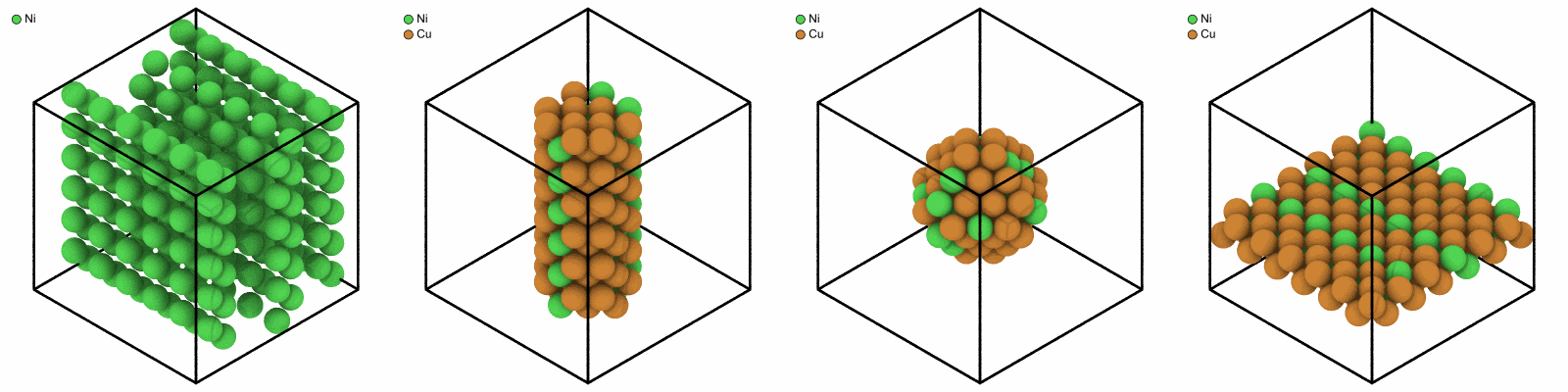
From the left: the nickel atoms, every fourth atom of the crystal; the
cylinder core of radius 5 Å along z; the sphere of radius 6 Å; the
slab between z = 4 and 8 Å.
Masks and polars expressions
A boolean mask computed with NumPy serves when a condition needs more than one atom at a time, such as distances to other atoms:
center = crystal["positions"].mean(axis=0)
distance = np.linalg.norm(crystal["positions"] - center, axis=1)
middle = crystal.filter(distance < 5.0)
A polars expression reaches everything polars does, for example the
components of a vector with arr.get:
Masks
where takes the same conditions as filter and gives the atoms that meet
them as a boolean mask, without making a new system. A mask is how analyses,
render and reduce take some of the atoms (their atoms argument), and
masks combine with &, | and ~:
nickel_mask = crystal.where(element="Ni")  # (N,) bool
upper_mask = crystal.where("positions.z > 10")
both = nickel_mask & upper_mask
others = ~both
assert (crystal.filter(both)["positions"] == crystal["positions"][both]).all()
where() without conditions is true for every atom.
gather
gather takes the atoms of the given indices, in that order. Indices count
from 0; negative ones count from the end; each atom may be given once.
last = crystal.gather([-1])
order = np.random.default_rng(1).permutation(len(crystal))
shuffled = crystal.gather(order)
back = shuffled.gather(np.argsort(order))  # the original order again
assert back.table.equals(crystal.table)
A boolean mask belongs to filter, which gather reminds when given one.
sort
sort orders all atoms by the values of columns:
| Name | Type | Default | Meaning |
|---|---|---|---|
*by |
column names, column.component, or polars expressions |
the keys: atoms equal in the first are ordered by the second, and so on | |
descending |
bool or one bool per key | False |
sort from the largest |
by_id = crystal.sort("id")
by_height = crystal.sort("positions.z")
layers = crystal.sort("positions.z", "positions.x", descending=[True, False])
by_element = crystal.sort("element")  # by atomic number: Ni (28) first, then Cu (29)
Atoms with equal keys keep their order, so sorting is repeatable. Elements sort by atomic number, not alphabetically.
After selecting or reordering
A per-atom result of an analysis, and a neighbor list, hold one entry per atom in the order of the system they were computed for.
Attach a result with with_columns before selecting or reordering, and it
follows its atoms:
from mdapy.identify import CommonNeighborAnalysis

structure = CommonNeighborAnalysis().compute(crystal)
labelled = crystal.with_columns(structure).sort("id")
labelled.table["cna_structure"]  # in the new order
A neighbor list fits only the atoms it was built for. After filter,
gather or sort, nl.fits(new) is false and an analysis given that list
raises InvalidParameter; build a new list for the new system. Analyses
that are not given a list find the neighbors themselves and are not
affected.
nl = mp.NeighborList.build(crystal, 3.0)
nl.fits(crystal)  # True
nl.fits(crystal.sort("id"))  # False: the atoms are in another order
Errors
The three methods raise
InvalidParameter
with what went wrong:
| Cause | Message |
|---|---|
| an unknown column | no column 'charge'; the columns are positions, element, id |
| an array column without a component | positions has 3 components; write one of positions.0, positions.1, positions.2, positions.x, positions.y, positions.z |
| an unknown component | stress has no component 'xx'; write one of stress.0, … |
| text that is not a Python expression | cannot read the condition 'type >': invalid syntax |
| something conditions do not support | Subscript is not supported in the condition 'positions[0] > 0' |
| a condition that does not give true or false | 'type + 1' does not give true or false for each atom |
| a mask of the wrong length or type | a mask must hold 864 booleans, got int64 of shape (864,) |
| indices out of range, repeated, or not integers | atom index out of range for 864 atoms, atom indices must not repeat |
sort without a key |
give a column to sort by |