Atomic displacement
AtomicDisplacement gives the displacement of each atom from its position
in a reference configuration, the atoms matched by their ids, across the
periodic boundaries by the nearest image.
import numpy as np
from mdapy.analysis import AtomicDisplacement
from mdapy.build import build_crystal

reference = build_crystal("fcc", 3.615, elements="Cu", repeat=(8, 8, 16))
reference = reference.with_columns(id=np.arange(1, len(reference) + 1))

# the crystal twisted about z: each layer turned by an angle that grows with z
center = reference.box.matrix.diagonal()[:2] / 2
x = reference["positions"]
angle = 0.2 * x[:, 2] / reference.box.matrix[2, 2]
c, s = np.cos(angle), np.sin(angle)
turned = x.copy()
turned[:, 0] = center[0] + c * (x[:, 0] - center[0]) - s * (x[:, 1] - center[1])
turned[:, 1] = center[1] + s * (x[:, 0] - center[0]) + c * (x[:, 1] - center[1])
twisted = reference.with_columns(positions=turned)

result = AtomicDisplacement(reference).compute(twisted)
result.displacement  # (N, 3) Å
result.magnitude  # Å, largest at the top, far from the axis
twisted = twisted.with_columns(result)  # displacement, displacement_magnitude
from mdapy.visualization import render

render(
    twisted,
    "images/displacement.png",
    color="displacement_magnitude",
    colormap="plasma",
    view=[1, -1, 0.6],
    width=500,
    height=600,
    legend="displacement (Å)",
)
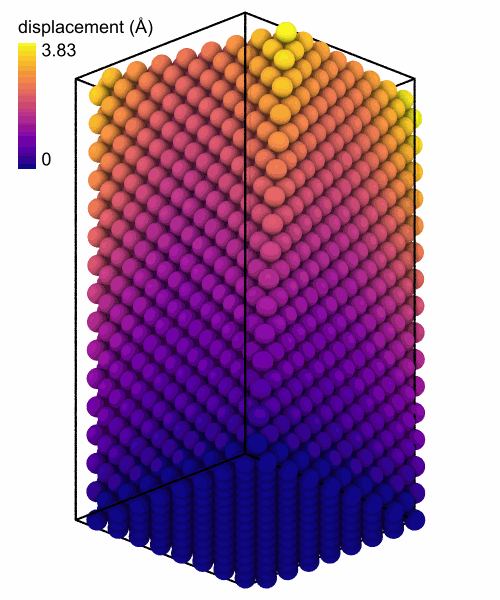
The crystal colored by the length of the displacements: zero at the bottom, growing with the height and the distance from the axis.
Parameters
AtomicDisplacement(reference, *, minimum_image=True, affine=False)
| Name | Type | Default | Meaning |
|---|---|---|---|
reference |
System |
the reference configuration | |
minimum_image |
bool | True |
along each periodic direction, the periodic image of the reference position nearest the atom |
affine |
bool | False |
measure in the reference box: the current positions mapped into it first, which removes the homogeneous deformation of the box |
compute(system) takes the current configuration. The atoms are matched
by the column id when both systems have it, in any order; without ids,
the two must have the same atoms in the same order.
Results
An AtomicDisplacementResult:
| Attribute | Type | Meaning |
|---|---|---|
displacement |
(N, 3) float64 | the displacement of each atom in Å, in the order of the system; its column displacement |
magnitude |
(N,) float64 | its length in Å; its column displacement_magnitude |
Errors
compute raises InvalidParameter for an atom whose id is not in the
reference, and, without ids, for systems of different numbers of atoms.
Definition
The displacement of an atom is \(\mathbf u = \mathbf x - \mathbf x_0\), with
\(\mathbf x_0\) its position in the reference. With affine, \(\mathbf x\) is
first mapped into the reference box: \(\mathbf x \to (\mathbf x - \mathbf o)
H^{-1} H_0 + \mathbf o_0\), with \(H\), \(H_0\) the matrices of the box vectors as
rows and \(\mathbf o\), \(\mathbf o_0\) the origins. With minimum_image, the
fractional coordinates of \(\mathbf u\) along the periodic vectors are
rounded to the nearest integers and those taken away.
See also
- OVITO Displacement vectors,
whose displacements
AtomicDisplacementgives, with and without the minimum image and the affine mapping to the reference. - Mean squared displacement over a trajectory, and Atomic strain against a reference.