Voronoi analysis
VoronoiAnalysis divides space into the Voronoi cells of the atoms, the
regions closer to one atom than to any other, and gives the volume and the
coordination of each cell, and, when asked for, its faces, its Voronoi index
and its shape as a polyhedron.
import numpy as np
from mdapy.analysis import VoronoiAnalysis
from mdapy.build import build_crystal

# an fcc crystal of 5 x 5 x 5 cubic cells, atoms displaced by about 0.05 Å
crystal = build_crystal("fcc", 3.6, elements="Cu", repeat=(5, 5, 5))
shake = np.random.default_rng(0).normal(scale=0.05, size=(len(crystal), 3))
system = crystal.with_columns(positions=crystal["positions"] + shake)

voronoi = VoronoiAnalysis(relative_face_threshold=0.01, edge_threshold=0.5)
result = voronoi.compute(system)
result.volume  # ų, a³/4 = 11.66 on average
result.coordination  # 12 for every atom
system = system.with_columns(result)  # voronoi_volume, ..., cavity_radius

# the faces too: the atom across each, its area and its edges
faces = VoronoiAnalysis(relative_face_threshold=0.01, edge_threshold=0.5, faces=True)
result = faces.compute(system)
result.index(6)  # faces with 3, 4, 5 and 6 edges: [0, 12, 0, 0]

shapes = VoronoiAnalysis(polyhedra=True).compute(system).polyhedra
shapes.vertices  # Å, the corners of every cell
The cells of the atoms near the middle of an fcc and a bcc crystal, drawn by the renderer:
from mdapy.build import build_crystal
from mdapy.visualization import render, write_png

pictures = []
for crystal in (
    build_crystal("fcc", 3.6, elements="Cu", repeat=(3, 3, 3)),
    build_crystal("bcc", 2.87, elements="Fe", repeat=(4, 4, 4)),
):
    cells = VoronoiAnalysis(polyhedra=True).compute(crystal).polyhedra
    middle = crystal.box.matrix.diagonal() / 2
    near = np.linalg.norm(crystal["positions"] - middle, axis=1) < 3.0
    pictures.append(
        render(crystal, atoms=near, polyhedra=cells, box=False, width=600, height=600)
    )
write_png("images/voronoi.png", np.hstack(pictures))
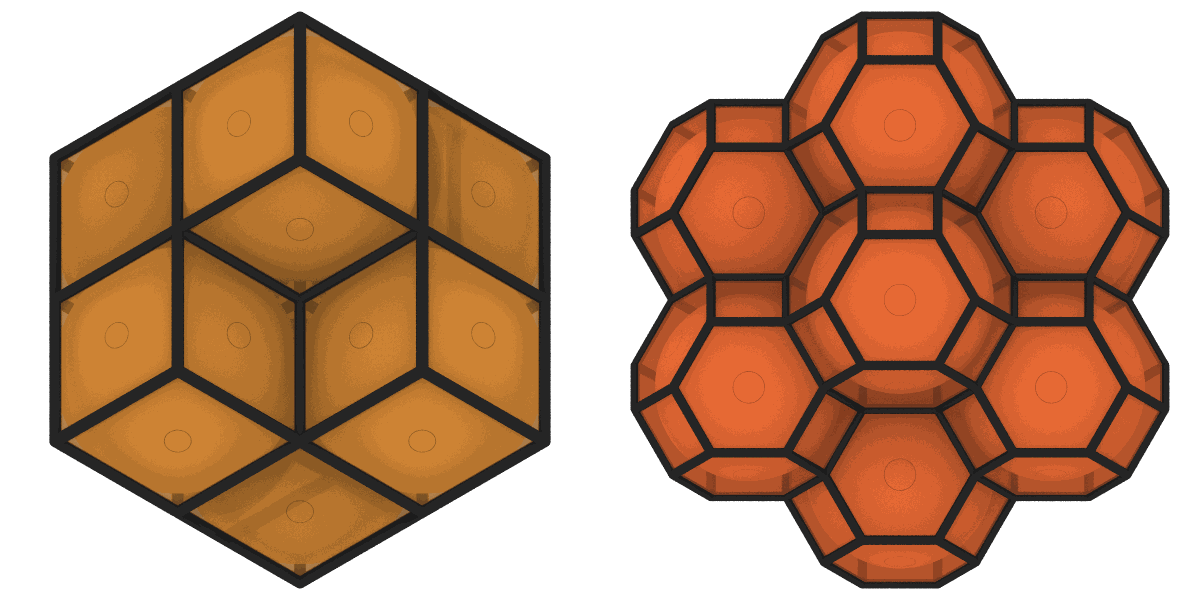
Left: in fcc every cell is a rhombic dodecahedron of 12 faces. Right: in bcc a truncated octahedron of 8 hexagons, toward the nearest neighbors, and 6 squares, toward the second neighbors.
Parameters
| Name | Type | Default | Unit | Meaning |
|---|---|---|---|---|
face_threshold |
float64 | 0 | Ų | faces of this area or less do not count |
relative_face_threshold |
float64 | 0 | faces of this fraction of the surface of their cell or less do not count; from 0 to below 1 | |
edge_threshold |
float64 | 0 | Å | edges shorter than this do not count, and faces with fewer than three edges that count do not count |
faces |
bool | False |
also give the faces of each cell that count, with the atom across each, its area and its edges | |
polyhedra |
bool | False |
also give the shape of each cell |
Without faces, the faces of each cell are counted and let go as soon as
its volume and coordination are known, so that the memory a computation
takes does not grow with the faces: some 14 per atom, which take as much as
the rest of the result several times over.
compute(system, *, progress=None, cancel=None) takes the progress and
cancel of every analysis, but no neighbor list:
the neighbors of each cell are searched as far as the cell needs. No two
atoms may be at the same position. Directions that are not periodic are
closed by the faces of the box, moved out as far as needed to include every
atom.
The thresholds remove the small faces and short edges that thermal motion
creates where a perfect crystal has a vertex shared by more than four
cells, as in fcc; they do not change the volume, the radius or the shapes.
The atoms across the faces are also a kind of
neighbor list, built
with NeighborList.build(system, voronoi=True) and the same thresholds.
Results
A VoronoiResult:
| Attribute or method | Type | Meaning |
|---|---|---|
volume |
(N,) float64 | the volume of each cell in ų; its column voronoi_volume |
coordination |
(N,) int64 | the number of faces that count shared with other atoms; its column voronoi_coordination |
radius |
(N,) float64 | the distance from each atom to the farthest vertex of its cell in Å; its column cavity_radius |
offsets |
(N + 1,) int64 | the faces that count of atom i are offsets[i]:offsets[i + 1]; with faces, else None |
j |
(F,) mdapy.index_dtype |
the atom across each face, −1 for a wall of the box; with faces |
shifts |
(F, 3) int8 | the periodic image of that atom; with faces |
areas |
(F,) float64 | the area of each face in Ų; with faces |
edges |
(F,) int32 | the number of edges of each face that count; with faces |
index(largest=8) |
(N, largest − 2) int64 | the Voronoi index: the number of faces with 3, 4, ..., largest edges shared with other atoms; with faces |
polyhedra |
VoronoiPolyhedra or None |
the shapes of the cells, with polyhedra=True |
The faces are listed like the pairs of a
neighbor list: the vector from atom i
to the atom across a face is x[j] - x[i] + shifts @ box.matrix.
The walls of the box are faces of the cells of the atoms next to them, in
the faces with j = −1, but they are not neighbors: coordination,
index and the Voronoi neighbors count only the faces shared with atoms.
OVITO and LAMMPS count the walls in the coordination and the Voronoi index
as well, so their values are larger for atoms next to a wall.
A VoronoiPolyhedra holds every face of every cell, those that do not
count included, so that each cell is a closed polyhedron, for example to
draw it:
| Attribute | Type | Meaning |
|---|---|---|
vertices |
(V, 3) float64 | the corners of the cells in Å, each cell with its own; a cell may reach out of the box |
vertex_offsets |
(N + 1,) int64 | the vertices of the cell of atom i are vertex_offsets[i]:vertex_offsets[i + 1] |
face_offsets |
(N + 1,) int64 | the faces of the cell of atom i are face_offsets[i]:face_offsets[i + 1] |
corner_offsets |
(F + 1,) int64 | the corners of face f are corners[corner_offsets[f]:corner_offsets[f + 1]] |
corners |
(C,) int64 | the vertex of each corner, counterclockwise seen from outside the cell |
j |
(F,) mdapy.index_dtype |
the atom across each face, −1 for a wall of the box |
areas |
(F,) float64 | the area of each face in Ų |
f = shapes.face_offsets[0]  # the first face of the cell of atom 0
loop = shapes.corners[shapes.corner_offsets[f] : shapes.corner_offsets[f + 1]]
polygon = shapes.vertices[loop]  # its corners in order
Errors
The constructor raises InvalidParameter for a negative threshold or a
relative_face_threshold of 1 or more; compute raises it for two atoms at
the same position, and index for a largest below 3.
Definition
The Voronoi cell of atom \(i\) at \(\mathbf r_i\) is the set of points closer to it than to any other atom or periodic image,
with \(H\) the matrix of the lattice vectors as rows. It is a convex polyhedron whose faces lie on the planes halfway to its neighbors, or on a wall of the box in a direction that is not periodic. A face counts when its area \(A\) and its edges satisfy
with \(A_\text{min}\) the face_threshold, \(f\) the
relative_face_threshold, \(\ell_\text{min}\) the edge_threshold and \(S_i\)
the surface of the cell, walls included. The coordination is the number of
faces that count shared with atoms, and the Voronoi index
\(\langle n_3, n_4, n_5, \dots \rangle\) the number of these faces with 3, 4,
5, ... edges that count. The radius, the distance to the farthest vertex of
the cell, is that of the largest sphere centered on a vertex of the cell
with no atom inside.
| Crystal | Cell | Faces | Volume |
|---|---|---|---|
| fcc | rhombic dodecahedron | 12 rhombi | \(a^3/4\) |
| bcc | truncated octahedron | 6 squares, 8 hexagons | \(a^3/2\) |
| hcp | trapezo-rhombic dodecahedron | 12 quadrilaterals | \(\sqrt 2\, a^3 / 2\) |
| cubic diamond | 12 triangles, 4 hexagons | \(a^3/8\) |
Please cite
See also
- OVITO Voronoi analysis.
- LAMMPS
compute voronoi/atom.