Lindemann index
LindemannIndex measures how much the distances between atoms fluctuate
over a trajectory, relative to their mean; it rises sharply at melting,
which makes it a criterion of melting for clusters and nanoparticles.
import numpy as np
import mdapy as mp
from mdapy.analysis import LindemannIndex

# a cluster of 30 atoms vibrating about its sites for 50 frames
rng = np.random.default_rng(0)
sites = rng.random((30, 3)) * 8 + 10
box = mp.Box(30.0, pbc=False)
frames = [
    mp.System(sites + rng.normal(scale=0.1, size=(30, 3)), box, elements="Ar")
    for _ in range(50)
]

result = LindemannIndex().compute(frames)
result.index  # over every pair of atoms
result.running  # of the frames up to each one
system = frames[0].with_columns(result)  # the column 'lindemann'
The same cluster with atoms that wander away, as in a liquid, against the one that vibrates:
from mdapy.visualization import plot

steps = rng.normal(scale=0.15, size=(50, 30, 3))
liquid = [
    mp.System(sites + walk, box, elements="Ar") for walk in np.cumsum(steps, axis=0)
]
melted = LindemannIndex().compute(liquid)

with plot.style():
    fig, ax = plot.figure("single")
    ax.plot(result.running, label="vibrating about sites")
    ax.plot(melted.running, label="wandering away")
    ax.axhline(0.1, color="0.5", linestyle="--")
    ax.set_xlabel("Frame")
    ax.set_ylabel("Lindemann index")
    ax.legend()
    plot.save(fig, "images/lindemann", formats=("png",))
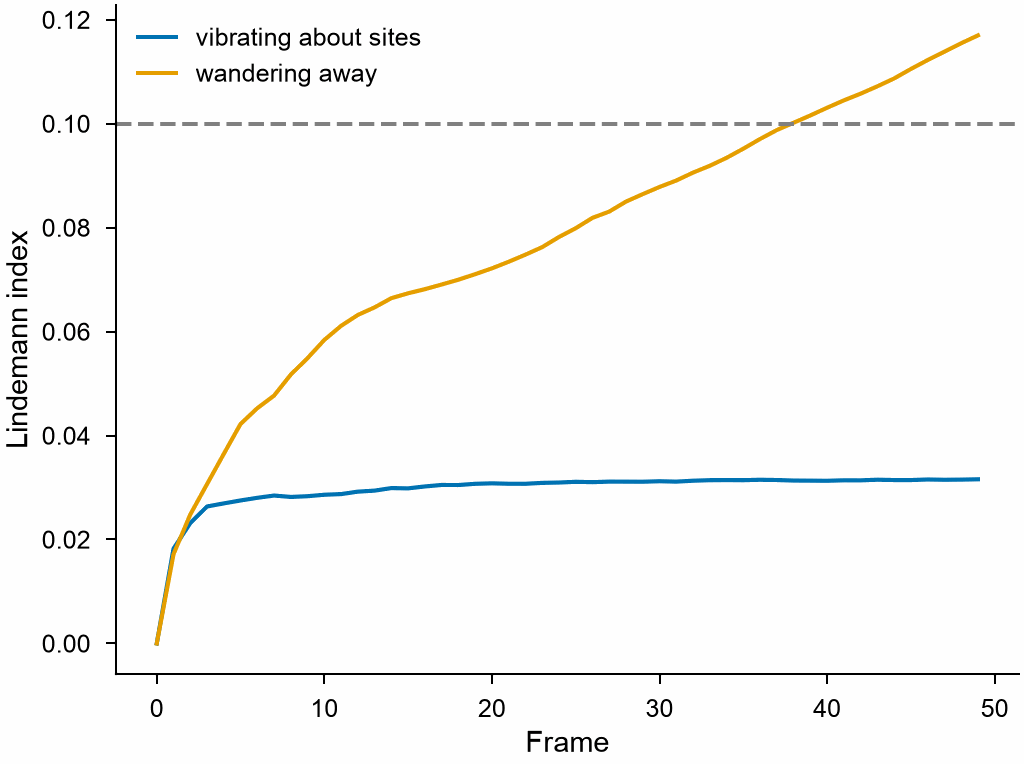
The running index levels off for atoms that vibrate about their sites and keeps rising for atoms that wander away. The dashed line marks 0.1, about where the index of a solid stands when it melts.
Parameters
| Name | Type | Default | Unit | Meaning |
|---|---|---|---|---|
unwrap |
bool | True |
follow the atoms through the periodic boundaries, or take the positions as they are, already unwrapped |
compute(frames, *, progress=None, cancel=None) takes a sequence of systems
as the mean squared displacement does, with the atoms
matched by their ids and unwrapped in the same way, and the progress and
cancel of every analysis. The distances are
those between the unwrapped positions, not between the nearest periodic
images.
Results
A LindemannResult:
| Attribute | Type | Meaning |
|---|---|---|
index |
float64 | the index \(\delta\) over every pair of atoms and every frame |
atomic |
(N,) float64 | the index \(\delta_i\) of each atom, averaged over its pairs, the atoms in the order of the first frame; its column lindemann |
running |
(T,) float64 | \(\delta\) over the frames from the first to each one; 0 for the first |
Errors
compute raises InvalidParameter as the
mean squared displacement does and for fewer than two
atoms, and Cancelled when cancelled.
Definition
With \(r_{ij}\) the distance between atoms \(i\) and \(j\) and \(\langle \cdot \rangle\) the average over the frames, for \(N\) atoms,
\(\delta\) is the mean of the \(\delta_i\). A rigid motion of all atoms leaves every distance unchanged and gives 0.
Please cite
Lindemann (1910); for this index of the distances, Zhou et al. (2002).