Chemical species
ChemicalSpecies finds the molecules of a system, the groups of atoms
joined by bonds, and their chemical formulas, from the radii of the
elements or bond lengths given by hand; and counts the molecules of each
formula along a trajectory, as the products of reactions form.
import numpy as np
import mdapy as mp
from mdapy.analysis import ChemicalSpecies

# two water molecules and a carbon dioxide in a 20 Å box
water = np.array([[0, 0, 0.119], [0, 0.763, -0.477], [0, -0.763, -0.477]])
co2 = np.array([[0, 0, 0], [0, 0, 1.16], [0, 0, -1.16]])
positions = np.vstack([water + 2, water + 8, co2 + 14])
system = mp.System(
    positions, mp.Box(20.0), elements=["O", "H", "H"] * 2 + ["C", "O", "O"]
)

result = ChemicalSpecies().compute(system)
result.formulas  # ['H2O', 'H2O', 'CO2']
result.counts()  # formula and count: H2O 2, CO2 1
system = system.with_columns(result)  # the column 'molecule', from 1

# by the van der Waals radii, as VMD and OVITO bond atoms
vdw = ChemicalSpecies("vdw").compute(system)
A box of 64 molecules of three kinds, each kind in its own color:
from mdapy.visualization import render

methane = np.array([[0, 0, 0], [0.629, 0.629, 0.629], [-0.629, -0.629, 0.629],
                    [-0.629, 0.629, -0.629], [0.629, -0.629, -0.629]])  # fmt: skip
kinds = [
    (water, ["O", "H", "H"]),
    (co2, ["C", "O", "O"]),
    (methane, ["C", "H", "H", "H", "H"]),
]
rng = np.random.default_rng(0)
grid = (
    np.stack(np.meshgrid(*[np.arange(4)] * 3, indexing="ij"), -1).reshape(-1, 3) * 5.0
    + 2.5
)
positions, elements = [], []
for center in grid:  # a molecule of a random kind, turned at random, near each point
    shape, names = kinds[rng.integers(3)]
    turn = np.linalg.qr(rng.normal(size=(3, 3)))[0]
    positions.append(shape @ turn.T + center + rng.normal(0, 0.6, 3))
    elements += names
gas = mp.System(np.vstack(positions), mp.Box(20.0), elements=elements)

found = ChemicalSpecies().compute(gas)
found.counts()  # CH4 28, CO2 19, H2O 17
kind = np.asarray(found.formulas)[found.molecule - 1]
palette = {"H2O": [0.2, 0.5, 0.9], "CO2": [0.9, 0.4, 0.2], "CH4": [0.3, 0.75, 0.4]}
render(gas, "images/species.png", color=np.array([palette[k] for k in kind]),
       representation="ball_and_stick", width=800, height=700, legend=palette)  # fmt: skip
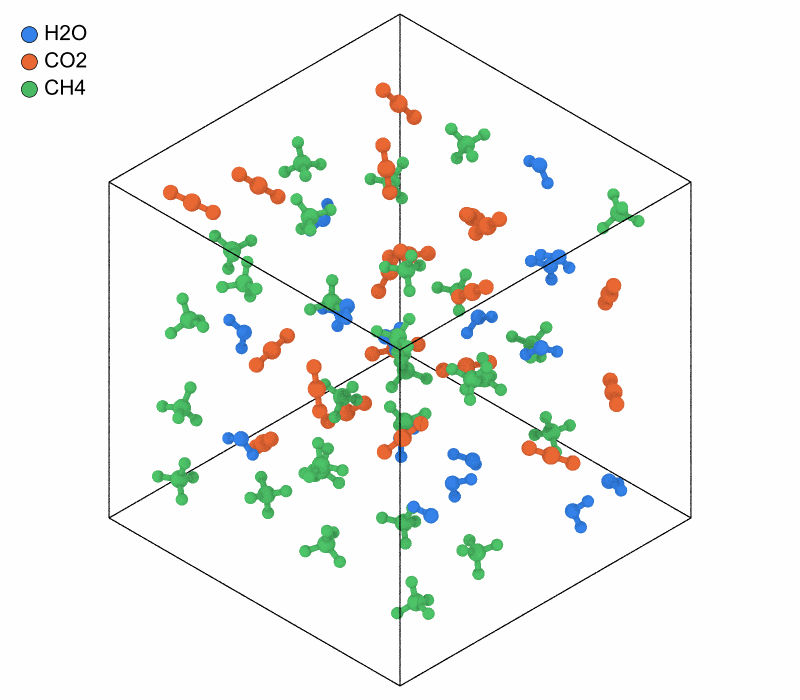
Water in blue, carbon dioxide in orange and methane in green: every atom takes the color of the formula of its molecule.
Parameters
ChemicalSpecies(radii="covalent", *, scale=None, tolerance=None, cutoffs=None)
| Name | Type | Default | Unit | Meaning |
|---|---|---|---|---|
radii |
str or dict of str to float64 | "covalent" |
Å | the radius of each element: "covalent", the covalent radii, "vdw", the van der Waals radii, or radii by element such as {"H": 0.4, "O": 0.7} |
scale |
float64 | 0.6 with "vdw", else 1 |
factor on the sum of the radii of two atoms | |
tolerance |
float64 | 0.45 with "covalent", else 0 |
Å | length added to it |
cutoffs |
dict of (str, str) to float64 | None |
Å | bond lengths for pairs of elements (a, b), in either order, instead of the radii; 0 for pairs never bonded |
Two atoms are bonded when they are closer than \(s(r_i + r_j) + t\), with \(r\) their radii, \(s\) the scale and \(t\) the tolerance, or than the cutoff of their pair of elements. Two rules come ready:
"covalent", the default: the covalent radii plus 0.45 Å, the rule of Jmol and OpenBabel, and of the bonds MDAPY draws in pictures;"vdw": 0.6 of the van der Waals radii, without tolerance, and two hydrogen atoms never bonded, the rule of VMD and of OVITO's Create bonds in its van der Waals mode. VMD and OVITO have tables of radii of their own; with the same radii, the bonds are the same. A cutoff for("H", "H")bonds hydrogen atoms again, as in the H2 molecule.
Hydrogen bonds and other contacts are left out by both. Radii by element default to a scale of 1 and no tolerance: atoms closer than the sum of their radii.
compute(system, *, neighbors=None, progress=None, cancel=None) takes the
arguments of every analysis; neighbors must
reach the longest bond. bond_lengths(elements) gives the bond length of
each pair of elements.
count(frames) computes each frame and gives a table of the number of
molecules of each formula in each frame: a frame column and a column for
each formula, the most common first.
Results
A SpeciesResult:
| Attribute or method | Type | Meaning |
|---|---|---|
molecule |
(N,) int64 | the molecule of each atom, numbered from 1 by decreasing size, ties by their first atom |
formulas |
(M,) str | the chemical formula of each molecule |
sizes |
(M,) int64 | the number of atoms of each molecule |
counts() |
polars DataFrame |
formula and count, the most common first |
The column is molecule, the molecule ID of LAMMPS data files. Formulas
are in Hill order: carbon, then hydrogen, then the other elements
alphabetically, or all alphabetically without carbon, so that ammonia is
H3N and sodium chloride ClNa; isomers have the same formula.
Errors
The constructor raises InvalidParameter for unknown radii, elements or
pairs, radii that are not positive, a scale that is not positive, a
negative tolerance or cutoff; compute raises MissingProperty without an
element column and InvalidParameter for an element without a radius,
such as "X", unless cutoffs cover its pairs.
Definition
Molecules are the clusters of atoms joined by bonds,
across periodic boundaries too. The covalent radii are those of
Cordero et al. (2008), the van der
Waals radii those of Alvarez (2013),
both in mdapy.elements.