Affine transformation
mdapy.transform.affine moves, rotates, shears or scales a system: its
atoms, the vectors they carry and its box, as OVITO's affine transformation
modifier does.
import numpy as np
from mdapy.build import build_crystal
from mdapy.transform import affine

crystal = build_crystal("fcc", 3.615, elements="Cu", repeat=(6, 6, 6))
shear = [[1.0, 0.3, 0.0], [0.0, 1.0, 0.0], [0.0, 0.0, 1.0]]
sheared = affine(crystal, shear)  # x gains 0.3 y; the box shears with the atoms
angle = np.radians(45)
turn = [
    [np.cos(angle), -np.sin(angle), 0],
    [np.sin(angle), np.cos(angle), 0],
    [0, 0, 1],
]
turned = affine(crystal, turn, translation=(10.0, 0.0, 0.0))  # about z, then moved
top = crystal["positions"][:, 2] > 10
moved = affine(crystal, np.eye(3), (0.0, 0.0, 3.0), box=False, atoms=top)
The crystal, sheared and turned:
from mdapy.visualization import render, write_png

pictures = [
    render(system, width=500, height=500, view="top")
    for system in (crystal, sheared, turned)
]
write_png("images/affine.png", np.hstack(pictures))
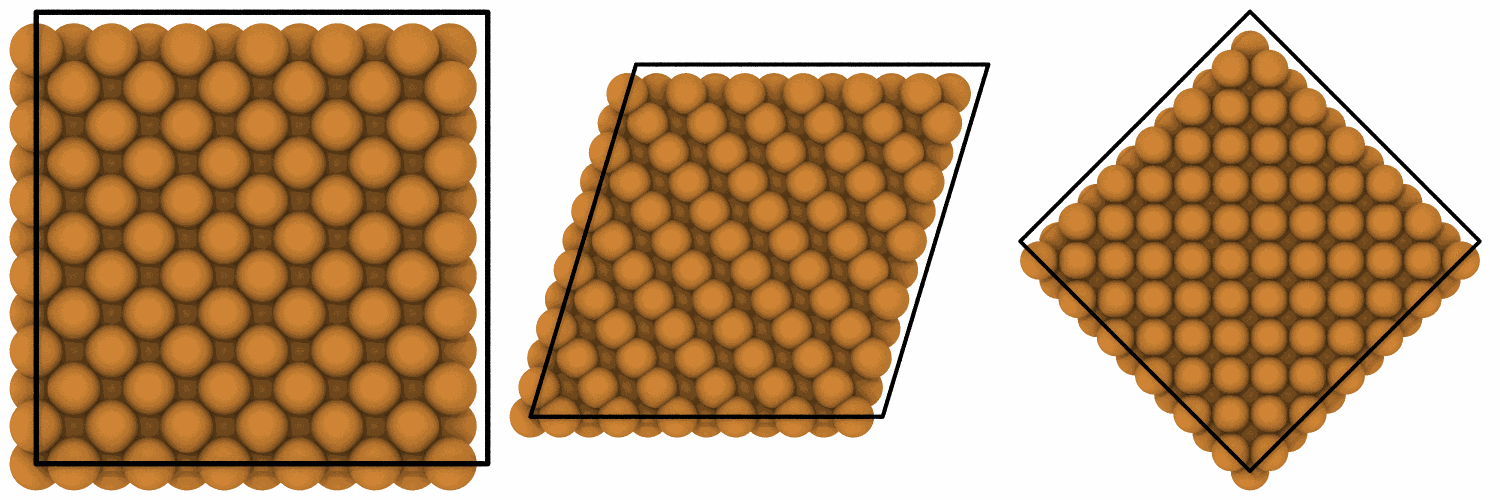
Copper seen along z: as built, sheared by 0.3 in x along y, and turned by 45° about z; the box follows the atoms.
Parameters
affine(system, matrix, translation=(0, 0, 0), *, box=True, vectors=("velocities", "forces", "displacement"), atoms=None)
| Name | Type | Default | Unit | Meaning |
|---|---|---|---|---|
system |
System |
the system to transform | ||
matrix |
(3, 3) float64 | the linear part \(M\), acting on Cartesian column vectors | ||
translation |
(3,) float64 | zero | Å | the translation \(\mathbf t\) |
box |
bool | True |
whether the box transforms too | |
vectors |
sequence of str | velocities, forces, displacement |
the columns of vectors that turn with \(M\), where the system has them | |
atoms |
(N,) bool or indices | all atoms | the atoms that move, with their vectors |
Results
A new System:
- each position \(\mathbf x\) of the atoms that move becomes \(M\mathbf x + \mathbf t\);
- each vector \(\mathbf v\) of the columns in
vectorsbecomes \(M\mathbf v\), without the translation; - with
box, the lattice vectors become \(M\mathbf a\), \(M\mathbf b\) and \(M\mathbf c\) and the origin \(M\mathbf o + \mathbf t\), whichever atoms move, so the fractional coordinates of the atoms that move stay the same and their image flags still count the same lattice vectors; - the other columns, the topology and
infoare kept.
The transformation of a box to a given shape, the atoms keeping their
fractional coordinates, is system.with_box(box, scale_positions=True).
Errors
affine raises
InvalidParameter for
a matrix that is not (3, 3) of finite numbers, a singular matrix while the
box transforms, a translation that is not three finite numbers, atoms that
are not a mask or indices of the system, and a column of vectors that does not hold
three numbers per atom.