Uncertainty and novelty
A model is unsure where it has not been trained. Two measures find such
frames without labels, to choose the ones worth a DFT calculation:
committee gives how much the predictions of several models differ, such
as NEP models trained with other seeds, or models of other kinds; and
novelty how far a frame lies from all frames of the training set in the
space of descriptors, such as SOAP. Neither depends on the
kind of model.
import numpy as np
from mdapy.calculators import EAM, NEP
from mdapy.io import read
from mdapy.mlip import SOAP, committee, novelty, structure_descriptors
from mdapy.visualization import plot

sqs = read("SQS.xyz")  # 108 atoms of CrCoNi
rng = np.random.default_rng(1)


def shaken(amplitude, missing=0):
    """The alloy with its atoms shaken, and some atoms taken away."""
    moved = sqs.with_columns(
        positions=sqs["positions"] + rng.normal(0, amplitude, (len(sqs), 3))
    )
    keep = np.ones(len(sqs), dtype=bool)
    keep[rng.choice(len(sqs), missing, replace=False)] = False
    return moved.filter(keep)


train = [shaken(a) for a in np.linspace(0.02, 0.08, 20)]
candidates = {
    "shaken as the training set": [shaken(0.05) for _ in range(10)],
    "shaken more": [shaken(a) for a in np.linspace(0.12, 0.2, 10)],
    "with vacancies": [shaken(0.05, missing=4) for _ in range(10)],
}

soap = SOAP(["Cr", "Co", "Ni"], r_cut=5.0, n_max=6, l_max=4)
known = structure_descriptors(train, soap)
models = [NEP("nep.txt"), EAM.zhou(["Cr", "Co", "Ni"])]
with plot.style():
    fig, ax = plot.figure()
    for name, frames in candidates.items():
        distance = novelty(structure_descriptors(frames, soap), known)
        spread = committee(frames, models).max_force  # eV/Å, the largest of each frame
        ax.scatter(distance, spread, s=10, label=name)
    ax.set_xlabel("distance from the training set (SOAP)")
    ax.set_ylabel("largest spread of the forces (eV/Å)")
    ax.legend()
    plot.save(fig, "images/uncertainty", formats=("png",))
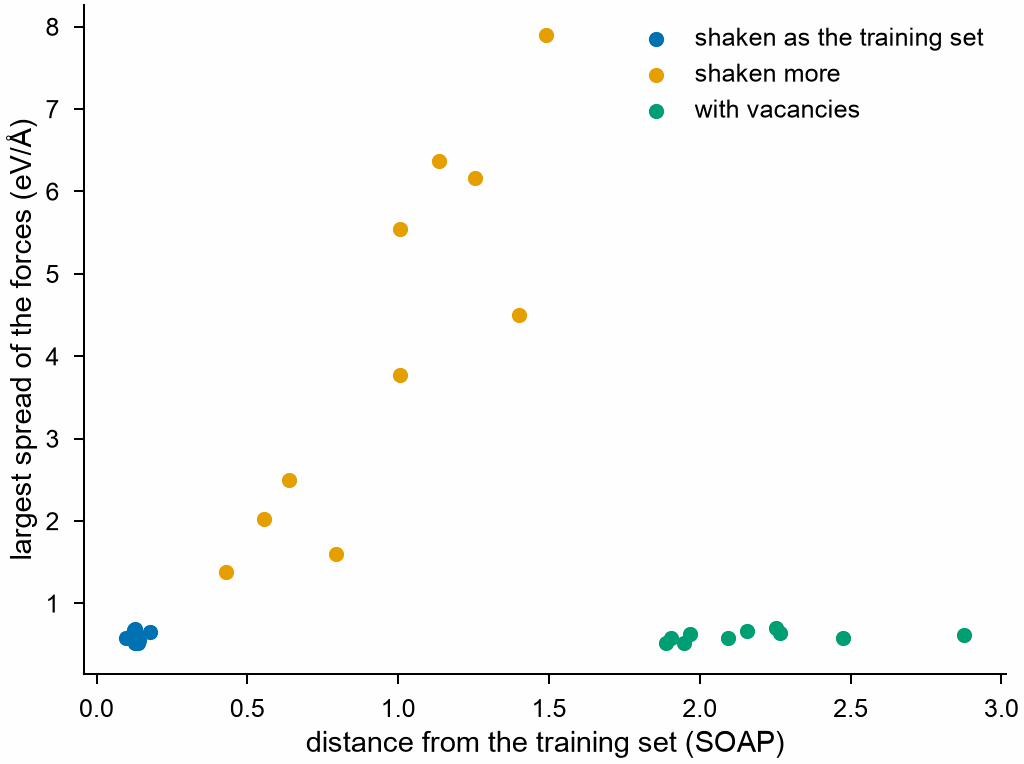
Thirty candidate frames of CrCoNi against a training set of the alloy shaken by 0.02 to 0.08 Å, with a committee of two models, a NEP and an EAM. Frames like the training set lie close to it, and the models agree on them; frames shaken more lie farther, and the models differ the more the farther they lie; frames with vacancies lie far from it, yet the models agree on them. Each measure finds frames the other misses.
With the descriptors of the training set and of the candidates, farthest point sampling then chooses among the frames far from it.
Parameters
| Function | Parameters |
|---|---|
committee(frames, calculators) |
the frames, and two or more models, any MDAPY calculators |
novelty(points, reference=None) |
(M, D) points, such as the descriptors of frames, and (K, D) points to measure from, such as those of a training set; without them, each point is measured from the other points, and repeated frames are those at zero; computed on get_num_threads() threads |
Results
committee gives a CommitteeResult:
| Attribute | Type | Unit | Meaning |
|---|---|---|---|
atoms |
(F,) int64 | the number of atoms of each frame | |
energy |
(F,) float64 | eV/atom | the standard deviation of the energy per atom over the models |
forces |
(A,) float64 | eV/Å | of each atom of all frames one after the other, the root mean square over the models of the distance of its force from their mean force |
max_force |
(F,) float64 | eV/Å | the largest of forces in each frame, the model deviation of DP-GEN |
novelty gives a (M,) float64 array: the Euclidean distance of each point
from the nearest point of the reference.
Errors
committee raises InvalidParameter for fewer than two models or no
frames; novelty raises it for arrays that are not (M, D) and (K, D) of
one D, and for no point to measure from.
See also
- Errors of a model, where labels exist.
- Choosing frames.