CHILL+
ChillPlus tells hexagonal ice, cubic ice, clathrate hydrates and their
interfaces from liquid water, by the correlation of the bond order of
neighboring molecules.
import numpy as np
from mdapy.build import build_crystal
from mdapy.identify import ChillPlus

# the oxygen atoms of hexagonal ice, one per molecule, the upper half
# disordered like liquid water
ice = build_crystal("lonsdaleite", 4.52, c=7.36, elements="O", repeat=(8, 8, 6))
upper = ice["positions"][:, 2] > 22.0
shake = np.random.default_rng(0).normal(0, 0.5, (len(ice), 3))
water = ice.with_columns(positions=ice["positions"] + shake * upper[:, None])

result = ChillPlus(cutoff=3.5).compute(water)
result.counts()  # {'other': 719, 'hexagonal_ice': 698, ...}
water = water.with_columns(result)  # the column 'structure'
For water of more than oxygen, water.filter(element="O") keeps one atom per
molecule. Each molecule in the color of its structure:
from mdapy.visualization import render

side = [0, -1, 0.15]  # seen from the side, slightly from above
render(
    water,
    "images/chill-plus.png",
    color=result,
    view=side,
    width=800,
    height=600,
    legend=True,
)
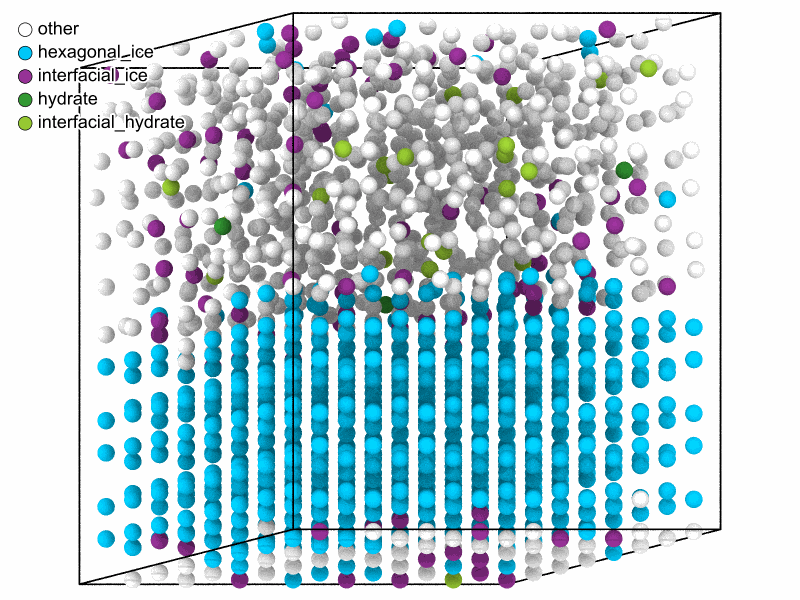
Hexagonal ice (light blue) under its disordered half (white, other). The molecules at the two interfaces, the lower one across the periodic boundary, are interfacial ice (purple); a few disordered molecules happen to have the bonds of a hydrate (green).
Parameters
| Name | Type | Default | Unit | Meaning |
|---|---|---|---|---|
cutoff |
float64 | 3.5 | Å | neighbors are the molecules closer than it; 3.5 Å for the oxygen atoms of water |
compute(system, *, neighbors=None, progress=None, cancel=None) takes the
arguments of every analysis; the system holds one
atom per molecule, for water its oxygen atoms. A given neighbor list must
reach the cutoff.
Results
A StructureResult with the types below.
Errors
The constructor raises InvalidParameter for a cutoff that is not positive;
compute raises it for a neighbor list that does not fit.
Definition
Each molecule \(i\) gets the bond order \(q_{3m}(i) = \sum_j Y_{3m}(\hat{\mathbf r}_{ij})\) over its neighbors \(j\), with the spherical harmonics \(Y_{3m}\) of degree 3, and each bond the correlation
A bond is staggered when \(c < -0.8\) and eclipsed when \(-0.35 < c < 0.25\). A molecule with four neighbors is, checked from the top of the table down:
| Index | Name | Default color | Bonds |
|---|---|---|---|
| 1 | hexagonal_ice |
light blue | 3 staggered and 1 eclipsed |
| 2 | cubic_ice |
orange | 4 staggered |
| 3 | interfacial_ice |
purple | 3 staggered and no eclipsed, or 2 staggered |
| 4 | hydrate |
green | 4 eclipsed |
| 5 | interfacial_hydrate |
yellow-green | 3 eclipsed |
| 0 | other |
light grey | any other molecule |
Please cite