Energy minimization
mdapy.simulation.minimize(system, calculator, *, max_force=1e-3, max_steps=1000,
max_step=0.1, timestep=0.001, cell=None, pressure=0.0, max_stress=1e-2,
save_every=None, callback=None)
minimizes the energy over the positions, and
optionally the box, with FIRE 2.0
(Guénolé et al. (2020)), the fast inertial relaxation
engine of Bitzek et al. (2006), as LAMMPS
min_style fire does with its default settings.
from mdapy.simulation import minimize

result = minimize(system, potential)  # the positions in a fixed box
result = minimize(system, potential, cell="full")  # and the box
result.system.box, result.stress  # the relaxed box and its stress in GPa
result = minimize(system, potential, cell="isotropic", pressure=10.0)
| Name | Type | Default | Unit | Meaning |
|---|---|---|---|---|
system |
System |
the starting configuration, with a mass or an element column; a movable column, (N, 3) bool as VASP's selective dynamics, keeps each atom still where it is False |
||
calculator |
Calculator |
computes energies and forces, and the virial when the box relaxes | ||
max_force |
float64 | 1e-3 | eV/Å | converged when every force is below it |
max_steps |
int32 | 1000 | largest number of steps | |
max_step |
float64 | 0.1 | Å | an atom moving at its current velocity goes at most this far along x, y or z in one step (LAMMPS dmax) |
timestep |
float64 | 0.001 | ps | first time step of the dynamics (the LAMMPS timestep in metal units) |
cell |
str | None |
how the box may change, in the table below | |
pressure |
float64 | 0.0 | GPa | external hydrostatic pressure when the box relaxes |
max_stress |
float64 | 1e-2 | GPa | when the box relaxes, converged when every relaxed component of the stress is this close to \(-p\) (−pressure on the diagonal, 0 off it) |
save_every |
int32 | None |
keeps the configuration every this many steps, with the first and the last, in frames |
|
callback |
callable | None |
called after each step as callback(step, system, energy, max_force); returning True stops the minimization |
cell chooses how the box changes along its periodic directions; the atoms
move with it, and the lattice vectors along directions that are not periodic
stay as they are. At a pressure \(p\) the minimization minimizes the enthalpy
\(E + pV\), so the stress of the relaxed box is \(-p\) on the diagonal.
cell |
The box | Relaxed stress components |
|---|---|---|
None |
does not change | none |
"isotropic" |
is scaled by one factor | the mean of the diagonal |
"axes" |
is scaled along each Cartesian axis by its own factor | the diagonal |
"full" |
takes any strain without rotation | all |
It returns a MinimizeResult:
| Attribute | Type | Meaning |
|---|---|---|
system |
System |
the last configuration, with forces and atomic_energies columns and energy, virial (eV) and stress (GPa) in info |
converged |
bool | whether every force fell below max_force and, when the box relaxes, every relaxed stress component came within max_stress of \(-p\) |
steps |
int32 | number of steps taken |
energy |
float64 | energy of the last configuration in eV |
max_force |
float64 | largest force of the last configuration in eV/Å |
stress |
(3, 3) float64 or None |
stress of the last configuration in GPa, positive under tension; None when the calculator does not compute the virial |
frames |
tuple of System or None |
with save_every, the kept configurations, with the columns and info of system and the step as timestep in info; None otherwise |
virial and stress are in info, and stress is set, whenever the
calculator computes the virial, also when the box does not change.
The steps on the positions are those of LAMMPS: the same time step control,
mixing and half step back after an uphill step, with masses from the mass
column or, when there is none, the standard atomic weights of the elements.
Masses change the path, not the minimum; LAMMPS takes them from the data file
or, for EAM, from the potential file. A box relaxation reaches the minimum of
LAMMPS fix box/relax (which LAMMPS runs with min_style cg, not FIRE) by
another path; LAMMPS keeps its box in restricted triclinic form, so the two
boxes agree up to a rotation.
The kept frames show the minimization on its way, with the box and the stress of each step, and can be written as a trajectory:
from mdapy.io import write

result = minimize(system, potential, cell="full", save_every=10)
write("relaxation.xyz", result.frames)
A callback follows the minimization step by step. Copper with every atom displaced at random by about 0.1 Å, relaxed to forces below 1e-4 eV/Å:
import numpy as np
from mdapy.build import build_crystal
from mdapy.visualization import plot

crystal = build_crystal("fcc", 3.615, elements="Cu", repeat=(4, 4, 4))
shake = np.random.default_rng(0).normal(0, 0.1, (len(crystal), 3))
shaken = crystal.with_columns(positions=crystal["positions"] + shake)

steps = []  # step, energy and largest force after each step


def record(step, system, energy, max_force):
    steps.append((step, energy, max_force))


result = minimize(shaken, potential, max_force=1e-4, callback=record)
step, energy, force = np.array(steps).T

with plot.style():
    fig, (top, bottom) = plot.figure("single", 100, nrows=2, sharex=True)
    top.semilogy(step, energy - result.energy)
    top.set_ylabel("Energy above the minimum (eV)")
    bottom.semilogy(step, force)
    bottom.set_ylabel("Largest force (eV/Å)")
    bottom.set_xlabel("Step")
    plot.save(fig, "images/minimize", formats=("png",))
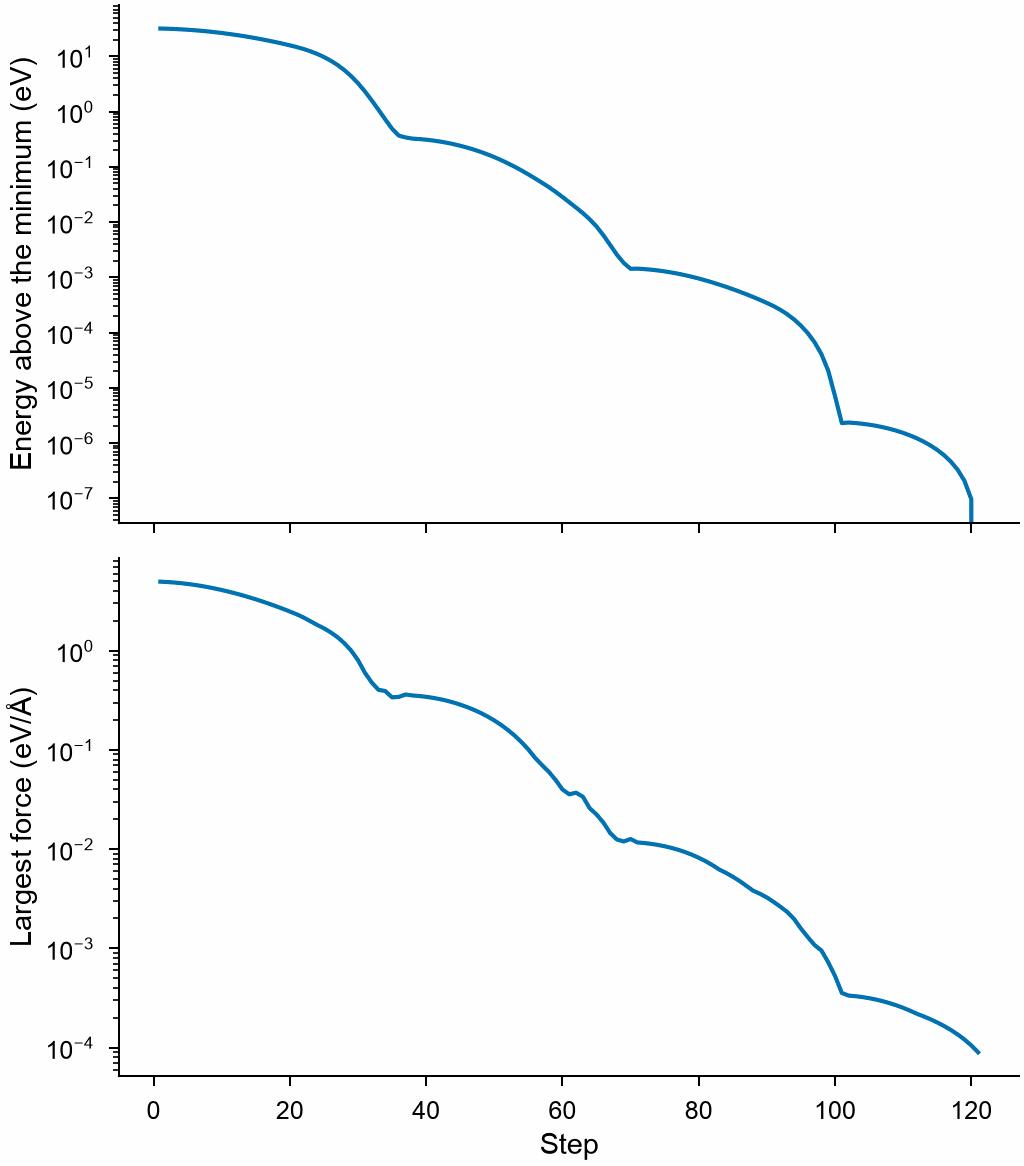
The energy and the largest force fall by orders of magnitude in 121 steps. Each kink is an uphill step: FIRE steps half a step back, stops the atoms and starts again with a shorter time step.
minimize raises InvalidParameter for a non-positive max_force,
max_step, timestep, max_stress or save_every, a negative
max_steps, an unknown cell, or a calculator that does not compute
energies and forces, and the virial when the box relaxes, and
MissingProperty for a
system with neither masses nor elements.
Please cite