Random alloys
random_alloy gives the atoms of a system elements drawn at random in
given fractions, with exact counts, for example a high-entropy alloy on a
crystal.
from mdapy.build import build_crystal, random_alloy

sites = build_crystal("fcc", 3.6, repeat=(10, 10, 10))
cantor = random_alloy(sites, {"Co": 1, "Cr": 1, "Fe": 1, "Mn": 1, "Ni": 1}, seed=1)
steel = random_alloy(
    build_crystal("bcc", 2.87, repeat=(10, 10, 10)), {"Fe": 0.9, "Cr": 0.1}, seed=2
)
import numpy as np
from mdapy.visualization import render, write_png

left = render(cantor, width=600, height=600, legend=True)
right = render(steel, width=600, height=600, legend=True)
write_png("images/alloys.png", np.hstack([left, right]))
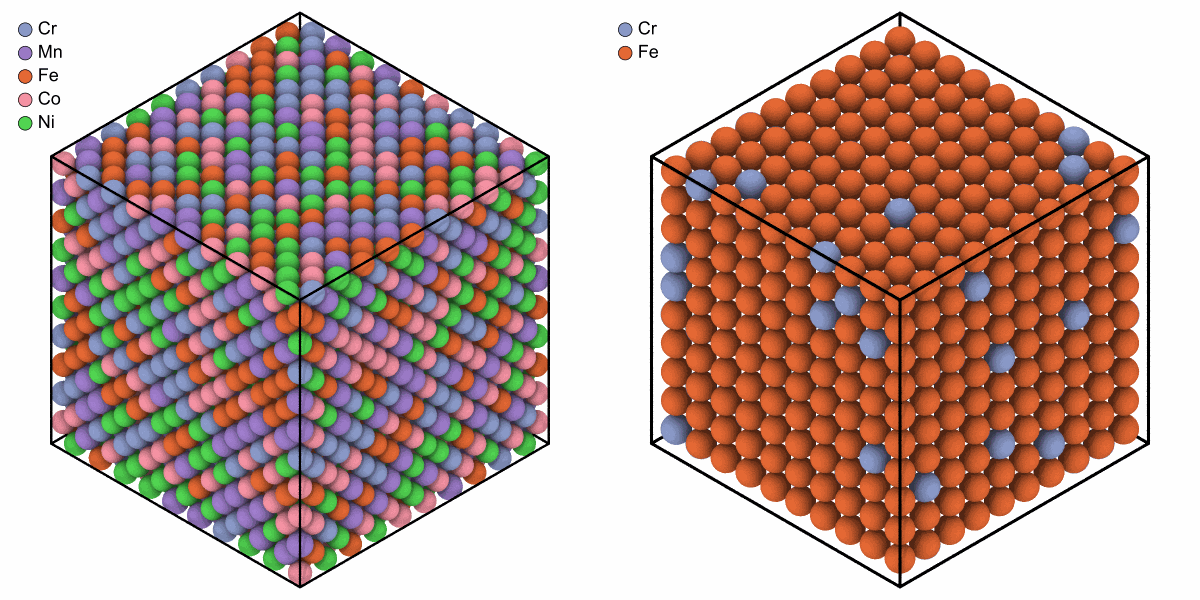
Left: the Cantor alloy CoCrFeMnNi on fcc sites, one fifth of each element. Right: Fe-10Cr on bcc sites, chromium in grey-blue.
Parameters
random_alloy(system, fractions, *, seed=None)
| Name | Type | Default | Meaning |
|---|---|---|---|
system |
System |
the sites, such as a crystal from build_crystal |
|
fractions |
dict of str to float64 | the fraction of each element, positive; they are normalized to sum to 1 | |
seed |
int64 or numpy.random.Generator |
None |
the random order; the same seed gives the same alloy |
Results
The system with a new element column and everything else unchanged. Each
element has its fraction of the atoms rounded down, and the atoms left over
go to the largest remainders, ties to the element named first: 500 atoms in
three equal fractions are 167, 167 and 166.
Errors
random_alloy raises InvalidParameter without fractions, for an unknown
element or for a fraction that is not positive.