Stacking faults at finite temperature
mdapy.simulation.stacking_fault_free_energy(crystal, potential, direction,
temperatures)
gives the free energy of a stacking fault per area at each temperature:
the difference of the free energies of the crystal with and without
it, in one box of the size the crystal has at that temperature and pressure. The
energy at rest is the business of
stacking_fault_energy.
import numpy as np
from mdapy.build import build_crystal
from mdapy.calculators import LAMMPS
from mdapy.simulation import minimize, stacking_fault_free_energy

potential = LAMMPS(
    "pair_style eam/alloy\npair_coeff * * Cu_mishin1.eam.alloy Cu", elements=["Cu"]
)
a = 3.615
layers = minimize(
    build_crystal(
        "fcc",
        a,
        elements="Cu",
        orientation=[(1, 1, -2), (-1, 1, 0), (1, 1, 1)],
        repeat=(6, 10, 4),
    ),
    potential,
    cell="axes",  # keeps the plane normal to z, whatever the rounding of a potential
    max_stress=1e-3,
).system

result = stacking_fault_free_energy(
    layers,
    potential,
    [a * np.sqrt(6) / 6, 0, 0],  # 1/6 [11-2]
    [230, 460, 690, 920, 1150],
    repeats=8,
)
result.energy, result.error  # J/m²
The fault gets cheaper with the temperature:
from mdapy.visualization import plot

with plot.style():
    fig, ax = plot.figure("single")
    ax.errorbar(
        result.temperatures, 1e3 * result.energy, 1e3 * result.error, fmt="o", capsize=2
    )
    ax.set_xlabel("Temperature (K)")
    ax.set_ylabel(r"Stacking fault energy (mJ/m$^2$)")
    plot.save(fig, "images/stacking-fault-temperature", formats=("png",))
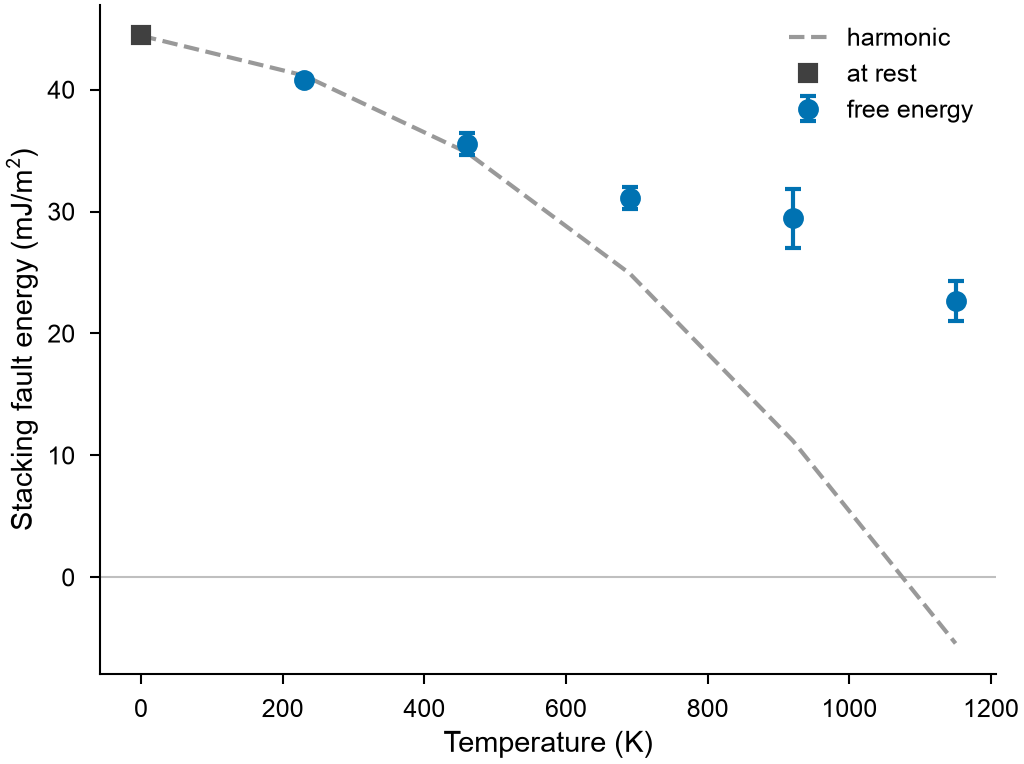
Copper with the EAM potential of Mishin et al., 1440 atoms and a plane of 684 Ų, 44 mJ/m² at rest. Up to about 500 K the free energy follows the harmonic part, drawn from the phonons of the two cells at the same volumes; above that it falls more slowly: 23 mJ/m² against -5 mJ/m² at 1150 K.
The wider the plane the smaller the error: the error of the free energy of all atoms
grows with their square root, the free energy of the fault with the area. The error
also grows towards the melting point, where 192 atoms of this copper gave ±33 mJ/m² at
1250 K against ±7 mJ/m² at 1040 K: look at error and dissipation. The crystal must
keep its fault during the runs: a slip vector that leads to no minimum of the
energy, as a partial in a potential with no stable stacking fault, slides back, and
gives something lower than the energy at rest.
| Name | Type | Default | Unit | Meaning |
|---|---|---|---|---|
crystal |
System |
the crystal, relaxed, with an element column, periodic in every direction, with the plane of the fault normal to the Cartesian axis of axis, such as fcc with z along [111] |
||
potential |
LAMMPS |
the interaction | ||
direction |
(3,) float64 | Å | (3,) the slip vector in the plane, such as a/6 [11-2] | |
temperatures |
float64 or (T,) float64 | K | the temperatures | |
height |
float64 | between the two layers nearest the middle | the fault, as a fractional coordinate along the box vector of axis |
|
axis |
int32 or str | z |
the Cartesian axis normal to the fault | |
pressure |
float64 | 0 | GPa | the pressure |
timestep |
float64 | 0.001 | ps | the time step |
equilibration |
float64 | 10 | ps | the time of each equilibration |
switching |
float64 | 50 | ps | the time of each switching between the crystal and the springs |
repeats |
int32 | 4 | independent free energies of each crystal at each temperature | |
max_force |
float64 | 1e-4 | eV/Å | convergence of the relaxation of the fault at each size of the box |
max_steps |
int32 | 10000 | the largest number of steps of each relaxation | |
seed |
int32 | 1 | the seed of the random numbers | |
progress |
callable | None |
called as progress(done, total) with the steps run |
|
cancel |
CancelToken |
None |
stops the calculation, which raises Cancelled |
Results
It returns a FaultFreeEnergyResult; arrays are read-only.
| Attribute | Type | Unit | Meaning |
|---|---|---|---|
temperatures |
(T,) float64 | K | the temperatures |
energy |
(T,) float64 | J/m² | the free energy of the fault per area |
error |
(T,) float64 | J/m² | its standard error from the repeats; zero for one repeat |
area |
float64 | Ų | the area of the fault at the first temperature |
volume |
(T,) float64 | ų | the volume per atom of the crystal |
dissipation |
(T,) float64 | eV | half the difference of the work there and back per atom, the largest over the runs |
Definition
where both free energies are those of free_energy for solids, of
the same atoms in one box but for the box vector that the fault tilts. Classical atoms,
as in molecular dynamics. With the phonons of the two cells, the
harmonic part of this difference is cheaper and free of noise, but it
gets worse with the temperature.
Errors
stacking_fault_free_energy raises InvalidParameter for invalid options, a plane not
normal to the axis, a box not periodic in every direction, or if LAMMPS fails;
MissingProperty for a crystal without an element column; Cancelled when
cancelled.
Please cite
Frenkel and Ladd (1984) and Freitas et al. (2016) for the free energies; see also Zhang et al. (2018) on stacking faults at high temperature.