Melting point
mdapy.simulation.melting_point(crystal, potential, temperature) gives the melting
point of a crystal from a first guess, by the two-phase method in
LAMMPS: a solid and a liquid share a box at constant enthalpy and
pressure, where the interface between them moves until they reach their common
temperature. A run in which one phase takes over gives a new guess, until both last.
from mdapy.build import build_crystal
from mdapy.calculators import LAMMPS
from mdapy.simulation import melting_point, minimize

potential = LAMMPS(
    "pair_style eam/alloy\npair_coeff * * Cu_mishin1.eam.alloy Cu", elements=["Cu"]
)
crystal = minimize(
    build_crystal("fcc", 3.615, elements="Cu"), potential, cell="full", max_stress=1e-4
).system

result = melting_point(crystal, potential, 1000.0)
result.temperature, result.error  # 1326 K, 1 K
result.attempts  # how the search went
The last run, whose temperature and fraction of solid atoms no longer drift:
from mdapy.visualization import plot

with plot.style():
    fig, (top, bottom) = plot.figure("single", 100, nrows=2, sharex=True)
    top.plot(result.time, result.temperatures)
    top.axhline(result.temperature, color="0.6", lw=0.8)
    top.set_ylabel("Temperature (K)")
    bottom.plot(result.fraction_time, result.fractions)
    bottom.set_ylabel("Solid fraction")
    bottom.set_xlabel("Time (ps)")
    plot.save(fig, "images/melting-point", formats=("png",))
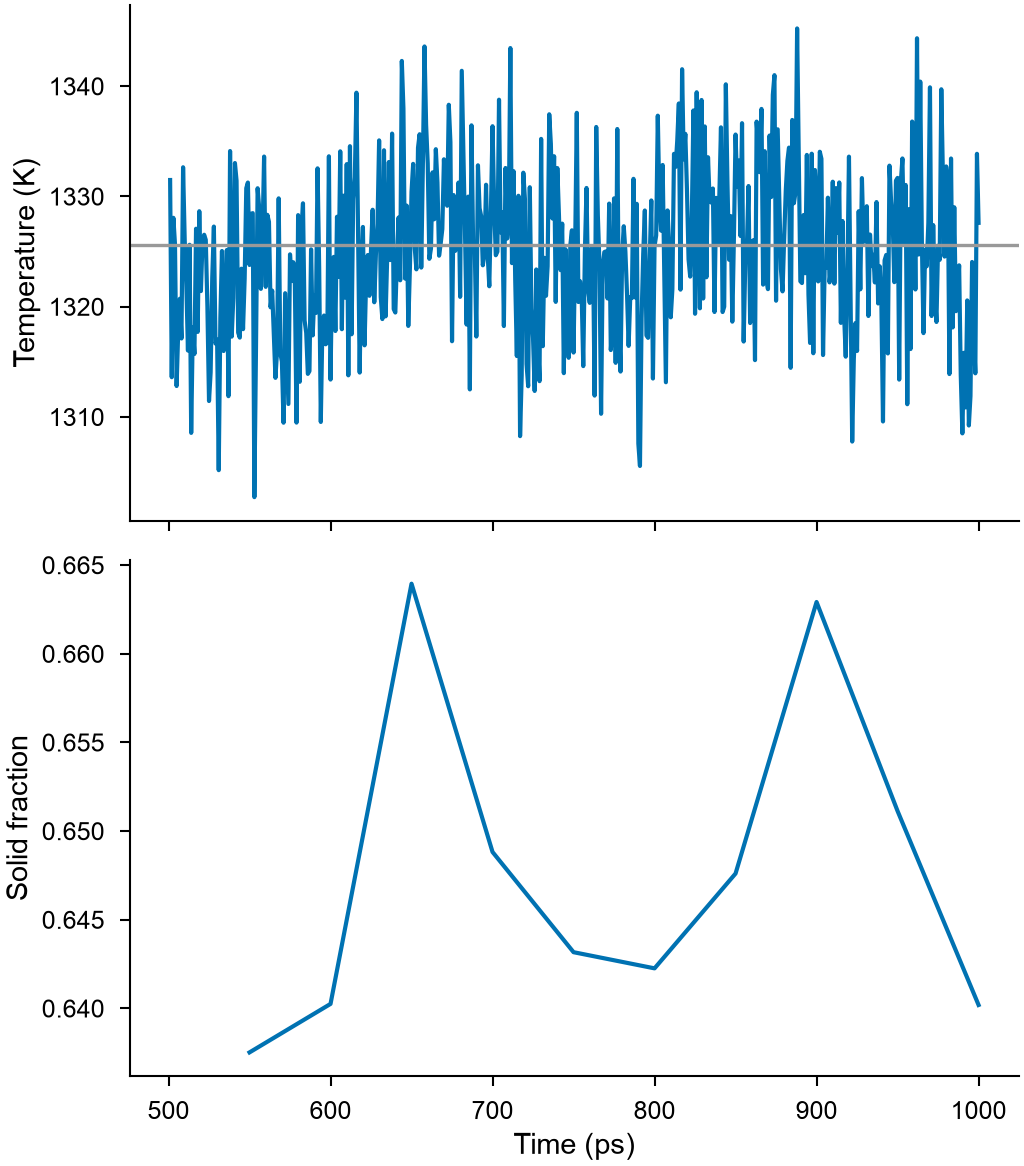
Copper with the EAM potential of Mishin et al., 16456 atoms, from a guess of 1000 K. The runs from 1000 and 1150 K froze, and the one from 1322 K kept both phases and gave 1326 K. Here is its last stretch.
The crystal is repeated to about atoms atoms in a box three times as long along its
third vector as along the others; the interface lies across that vector. Each run:
- brings the crystal to the temperature and the pressure and takes its mean box;
- holds one half still and melts the other at constant volume, at twice the temperature, hotter until its atoms have moved by about the distance between them;
- cools the melted half to the temperature and lets it settle;
- releases the crystal, relaxes the pressure of the box for a moment at this
temperature, and runs both at constant enthalpy, in stretches of
coexistence, up to five, until the temperature no longer drifts.
A run that melts started too hot and one that freezes too cold, whatever its temperature became; the next guess is 15 % away, or halfway between two such bounds. A run that keeps both phases but ends with less than a fifth of one, or with a temperature that still drifts, starts again from where its temperature was going.
Solid atoms are told from liquid ones by the order their bonds share, with as many neighbors as the first shell of the crystal has: 12 in fcc and hcp, 14 in bcc, 4 in diamond.
| Name | Type | Default | Unit | Meaning |
|---|---|---|---|---|
crystal |
System |
the crystal, relaxed, with an element column, periodic in every direction; the interface is across its third vector |
||
potential |
LAMMPS |
the interaction | ||
temperature |
float64 | K | the first guess | |
pressure |
float64 | 0 | GPa | the pressure |
atoms |
int32 | 16000 | about how many atoms the box holds; fewer for a slow potential | |
repeat |
(3,) int32 | repeats of crystal along its vectors, instead of atoms; the third is made even |
||
timestep |
float64 | 0.001 | ps | the time step |
equilibration |
float64 | 10 | ps | the time of each stage before the phases meet |
coexistence |
float64 | 500 | ps | the time of each stretch of the two phases; a larger box needs longer |
tolerance |
float64 | 3 | K | how much the temperature may still drift, from the third quarter of a stretch to the last, for it to be the answer; twice its statistical error, if that is larger |
max_runs |
int32 | 8 | the largest number of runs | |
barostat_damping |
float64 | 1000 time steps | ps | the damping time of the barostat |
seed |
int32 | 1 | the seed of the random numbers | |
progress |
callable | None |
called as progress(done, total) with the steps run, of a total that takes every run to be the last |
|
cancel |
CancelToken |
None |
stops the calculation, which raises Cancelled |
The size and the time matter. In a small box the temperature and the interface fluctuate
too much, and in a large one heat needs longer to cross it. A slow potential may need less
than the default, through atoms, repeat and coexistence, at the price of a larger
spread. For the copper above, from guesses of 1000, 1327 and 1700 K:
| Atoms | coexistence (ps) |
Melting point (K) |
|---|---|---|
| 4000 | 100 | 1316, 1325, 1326 |
| 4000 | 500 | 1326, 1318, 1328 |
| 16000 | 100 | 1322, 1319, 1336 |
| 16000 | 500 | 1327, 1328, 1324 |
where the free energies of 16384 atoms cross at 1326 K. error is the
statistical error of one run and smaller than this spread, so repeating a run with another
seed says more about the error than error does.
Results
It returns a MeltingPointResult; arrays are read-only.
| Attribute | Type | Unit | Meaning |
|---|---|---|---|
temperature |
float64 | K | the melting point: the mean temperature over the second half of the last stretch |
error |
float64 | K | the standard error of that mean, from blocks of the stretch |
pressure |
float64 | GPa | the pressure |
attempts |
tuple of MeltingAttempt |
each stretch of each run, in order | |
time |
(S,) float64 | ps | the time along the last stretch |
temperatures |
(S,) float64 | K | the temperature along the last stretch |
pressures |
(S,) float64 | GPa | the pressure along the last stretch |
fractions |
(F,) float64 | the fraction of solid atoms along the last stretch | |
fraction_time |
(F,) float64 | ps | the time of the fractions |
system |
System |
the atoms at the end, with a boolean column solid |
A MeltingAttempt has start, the temperature in K at which its run started;
outcome, "melted", "frozen" or "coexisting"; temperature, its mean
temperature in K over its second half; fraction, the fraction of solid atoms at its
end; and drift, how much in K its mean temperature changed from its third quarter
to its last.
free_energy gives the melting point another way, by where the free
energies of the two phases cross.
Errors
melting_point raises InvalidParameter for invalid options, a box not periodic in
every direction, half a crystal that does not melt, no run with two phases within
max_runs, or if LAMMPS fails; MissingProperty for a crystal without an element
column; Cancelled when cancelled.
Please cite
Morris et al. (1994) for the method.