Quasi-harmonic approximation
mdapy.lattice_dynamics.quasi_harmonic(system, calculator, temperatures, *,
volumes=None, pressures=None, pressure=0.0, supercell=None, mesh=20,
displacement=0.01, max_force=1e-6, max_stress=1e-4, max_steps=5000)
gives the thermal expansion, bulk modulus,
heat capacity and Gibbs energy of a crystal at finite temperature from its
phonons at several volumes.
import numpy as np
from mdapy.build import build_crystal
from mdapy.lattice_dynamics import primitive_cell, quasi_harmonic
from mdapy.simulation import minimize

crystal = minimize(
    build_crystal("fcc", 3.615, elements="Cu"),
    potential,
    cell="full",
    max_stress=1e-4,
).system
result = quasi_harmonic(primitive_cell(crystal), potential, np.arange(0, 1001, 50))
result.volume  # ų per atom at each temperature
result.thermal_expansion / 3  # linear thermal expansion coefficient, 1/K
result.bulk_modulus  # GPa
result.heat_capacity  # C_P, eV/K per atom
The lattice parameter of copper, four atoms to its cubic cell, and the linear thermal expansion coefficient:
from mdapy.visualization import plot

t = result.temperatures
with plot.style():
    fig, (left, right) = plot.figure("double", ncols=2)
    left.plot(t, (4 * result.volume) ** (1 / 3))
    left.set_xlabel("Temperature (K)")
    left.set_ylabel("Lattice parameter (Å)")
    right.plot(t, result.thermal_expansion / 3 * 1e6)
    right.set_xlabel("Temperature (K)")
    right.set_ylabel(r"Linear thermal expansion ($10^{-6}$/K)")
    plot.save(fig, "images/quasi-harmonic", formats=("png",))
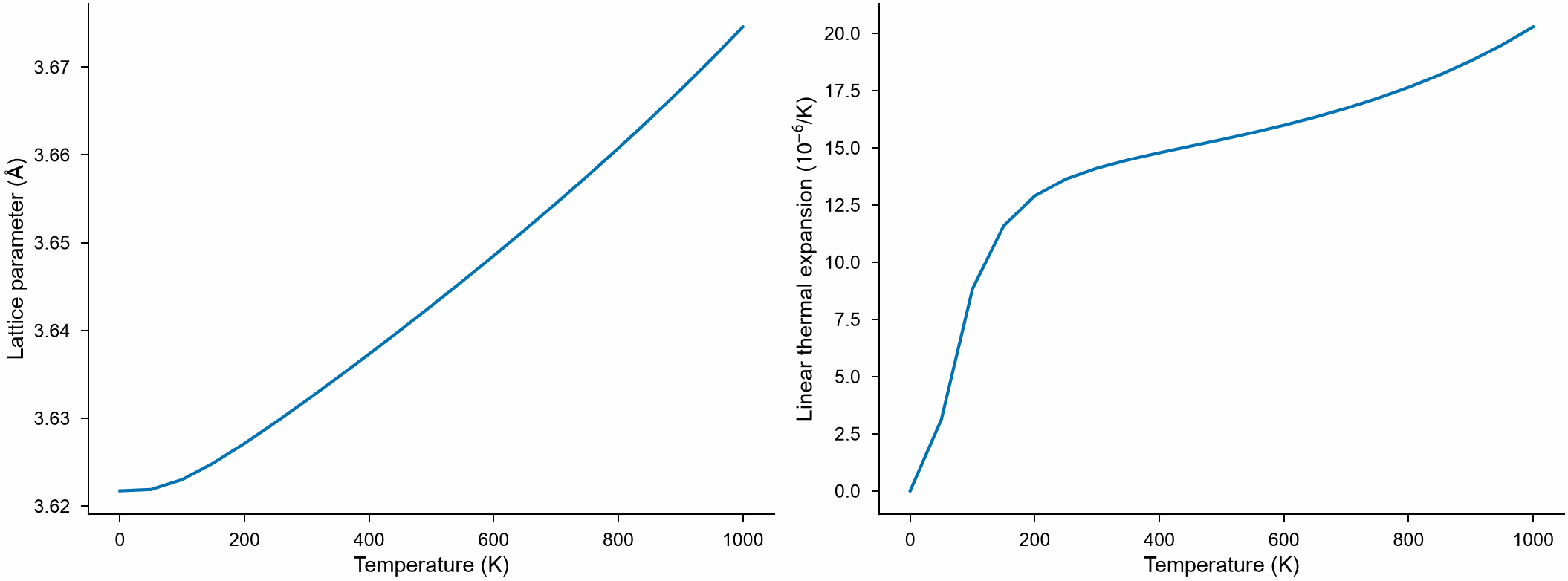
Copper with the EAM potential of Mishin et al.: at 0 K the zero-point vibrations already widen the lattice a little beyond its static 3.615 Å; it grows slowly at first, while the vibrations freeze out, then nearly linearly. The expansion coefficient rises from 0 and keeps growing slowly above the Debye temperature.
At each volume the box keeps its volume while its shape and the positions
relax, so that a crystal whose shape changes with the volume, such as hcp
with its c/a, takes its best shape at each; the phonons then give the free
energy of the vibrations. The volumes must hold the equilibrium volume at
every temperature: the default, from 0.97 to 1.09 times the volume of
system, reaches the melting point of most metals. Instead of volumes,
pressures relax the box and the positions under each pressure. The cells
of the grid are kept, for elastic constants at finite
temperature.
The quasi-harmonic approximation leaves out the anharmonic vibrations beyond the change of the frequencies with the volume, so it holds well below the melting point; near it, molecular dynamics is needed. The bulk modulus comes from the curvature of a fit through the volumes; with the default nine volumes it is good to about 1 %.
| Name | Type | Default | Unit | Meaning |
|---|---|---|---|---|
system |
System |
the cell of the crystal, periodic in every direction, with an element or a mass column; best relaxed and primitive |
||
calculator |
Calculator |
computes energies and forces | ||
temperatures |
(T,) float64 | K | the temperatures, not negative | |
volumes |
(V,) float64 | 9 from 0.97 to 1.09 | the volumes of the phonons, as ratios to the volume of system; five or more |
|
pressures |
(V,) float64 | GPa | instead of volumes, the pressures under which the box and the positions relax; five or more | |
pressure |
float64 | 0 | GPa | the pressure \(P\) |
supercell |
int32 or (3,) int32 | repeats of the cell for the phonons, as in phonons |
||
mesh |
int32 or (3,) int32 | 20 | wave vectors along each reciprocal lattice vector for the thermal properties | |
displacement |
float64 | 0.01 | Å | displacement of the atoms for the force constants |
max_force |
float64 | 1e-6 | eV/Å | convergence of the relaxation at each volume |
max_stress |
float64 | 1e-4 | GPa | convergence of the relaxation of the box |
max_steps |
int32 | 5000 | largest number of steps of each relaxation | |
symmetry |
bool or None |
None |
use the symmetry operations of the crystal, found by spglib, in the phonons, as in phonons: True, False, or by default whenever spglib is installed |
Results
It returns a QuasiHarmonicResult, all per atom; arrays are read-only.
| Attribute | Type | Unit | Meaning |
|---|---|---|---|
temperatures |
(T,) float64 | K | the temperatures |
pressure |
float64 | GPa | the pressure |
volume |
(T,) float64 | ų | the equilibrium volume \(V(T)\) |
gibbs_energy |
(T,) float64 | eV | the Gibbs energy \(G(T, P)\) |
entropy |
(T,) float64 | eV/K | the entropy \(S\) |
bulk_modulus |
(T,) float64 | GPa | the isothermal bulk modulus \(B_T\) |
thermal_expansion |
(T,) float64 | 1/K | the volumetric thermal expansion coefficient \(\alpha\); a third of it is the linear one of a cubic crystal |
heat_capacity |
(T,) float64 | eV/K | the heat capacity at constant pressure \(C_P\) |
volumes |
(V,) float64 | ų | the volumes of the phonons |
energies |
(V,) float64 | eV | the static energy at each volume |
free_energies |
(V, T) float64 | eV | the free energy of the vibrations at each volume and temperature |
cells |
tuple of System |
the relaxed cell at each volume |
Errors
quasi_harmonic raises InvalidParameter for a negative temperature,
both volumes and pressures, fewer than five of them, a relaxation that does
not converge within max_steps, imaginary frequencies at a volume, and an
equilibrium volume outside the volumes, as well as for the errors of
phonons.
Definition
At each temperature \(T\), the free energy
with \(E\) the static energy and \(F_\mathrm{vib}\) the harmonic free energy of the vibrations at volume \(V\), is fit by the third-order Birch–Murnaghan form, a cubic polynomial in \(V^{-2/3}\), by least squares. Its minimum is the equilibrium volume \(V(T)\) and the Gibbs energy \(G = F(V(T), T)\), its curvature there the bulk modulus \(B_T = V\,\partial^2F/\partial V^2\). The entropy \(S_\mathrm{vib}\) and the heat capacity \(C_V\) of the vibrations, fit alike, give at \(V(T)\)