Building structures
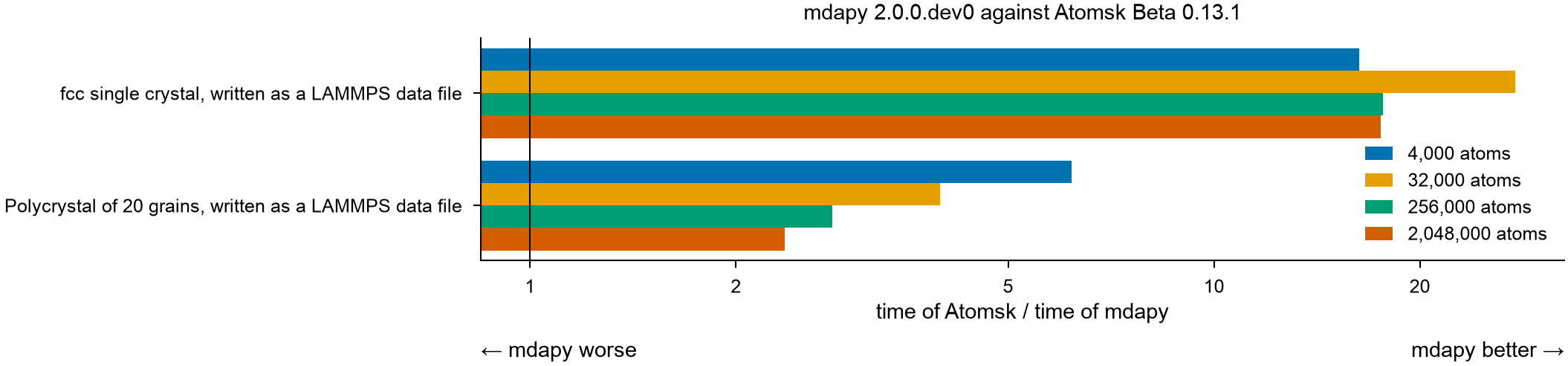
MDAPY and Atomsk build fcc copper as a single crystal and as a polycrystal of 20 grains, and write it as a LAMMPS data file, from 4 000 to 2 million atoms. A program is timed only where it builds the structure MDAPY builds.
Results
A node of the Triton cluster of Aalto University, alone for the run: two Intel Xeon Gold 6248 (40 cores, two NUMA nodes), 191 GB, Linux. Python 3.13, MDAPY 2.0.0.dev0 built with GCC 12.3, and Atomsk Beta 0.13.1, a statically linked build of its release.
What they show
- Single crystal: MDAPY builds and writes it 16 to 28 times faster than Atomsk, 0.29 s against 5.0 s at 2 million atoms; building it is a repetition of the cell, and most of the time is writing the file.
- Polycrystal: MDAPY is 2.4 to 6.2 times faster, 4.1 s against 9.6 s at 2 million atoms.
Times and memory
Every case at every size: the shortest of three times, and the memory each build took, the peak resident memory of the process minus its peak before the timings; that of Atomsk, a process of its own, is not counted.
Atomsk
| Case | Atoms | MDAPY 2.0.0.dev0 (s) | Atomsk Beta 0.13.1 (s) | Atomsk / MDAPY | MDAPY (MB) | Atomsk (MB) |
|---|---|---|---|---|---|---|
| fcc single crystal, written as a LAMMPS data file | 4,000 | 0.003 | 0.043 | 16.31 | 0 | 0 |
| fcc single crystal, written as a LAMMPS data file | 32,000 | 0.005 | 0.148 | 27.55 | 4 | 0 |
| fcc single crystal, written as a LAMMPS data file | 256,000 | 0.038 | 0.676 | 17.65 | 30 | 0 |
| fcc single crystal, written as a LAMMPS data file | 2,048,000 | 0.287 | 5.024 | 17.53 | 129 | 0 |
| Polycrystal of 20 grains, written as a LAMMPS data file | 3,981 | 0.029 | 0.180 | 6.18 | 0 | 0 |
| Polycrystal of 20 grains, written as a LAMMPS data file | 31,995 | 0.088 | 0.352 | 3.98 | 2 | 0 |
| Polycrystal of 20 grains, written as a LAMMPS data file | 255,941 | 0.483 | 1.336 | 2.76 | 42 | 0 |
| Polycrystal of 20 grains, written as a LAMMPS data file | 2,047,788 | 4.080 | 9.613 | 2.36 | 115 | 0 |
Cases
| Case | MDAPY | Atomsk |
|---|---|---|
| Single crystal | mdapy.io.write(path, build_crystal("fcc", 3.615, elements="Cu", repeat=(n, n, n))) |
atomsk --create fcc 3.615 Cu -duplicate n n n path.lmp |
| Polycrystal | mdapy.io.write(path, build_polycrystal(unit, box, seeds, orientations=rotations, min_distance=0.01)) |
atomsk --polycrystal unit.xsf parameters.txt path.lmp |
Atomsk writes every structure it builds to a file, so both programs are timed building the structure and writing it as a LAMMPS data file.
The polycrystal fills a cubic periodic box with 20 grains, the Voronoi cells
of 20 seeds at random places, each of fcc copper in a random orientation.
Both programs have the same seeds and orientations: Atomsk as a node line
with three angles of rotation, about x, then y, then z, and MDAPY as the
rotation matrices of those angles. Atomsk removes no atom where grains meet,
so MDAPY is asked to remove only atoms at the same place (min_distance
0.01 Å) rather than those closer than 0.7 times the nearest distance, as it
does by default.
How it is measured
- MDAPY runs in a process of its own with 40 threads. Atomsk runs as a
command from that process, with
OMP_NUM_THREADS40; the time of a build by Atomsk includes starting the program. - Before the timings, a separate process builds the structure with both programs and reads both files with mdapy. Single crystal: the same box and the same atoms, in any order, within 1e-9 Å (Atomsk writes 12 decimals). Polycrystal: the same box, as many atoms within 0.5 %, and in each grain the same lattice. The atoms differ: each program places the lattice of a grain in its own way, MDAPY with a lattice site at the seed, Atomsk with the center of a block of lattice at a center of the cell, so that in a grain the atoms of Atomsk are those of MDAPY moved by one vector, a different one for each grain. The check finds that vector the same for every atom of a grain away from its faces, within 1e-6 Å.
- Each process first builds a structure of 500 atoms, then three times the structure; the shortest time counts.
Running it
The comparison is benchmarks/comparison.py in the source repository, the
group builders of its cases. It runs the command atomsk, or the program
the environment variable ATOMSK names.
ATOMSK=/path/to/atomsk python benchmarks/comparison.py run --group builders \
    --sizes 4000 32000 256000 2048000 --threads 40 --memory 170 --timeout 900 \
    --output builders.json   # as above
python benchmarks/comparison.py table builders.json
python benchmarks/comparison.py plot builders.json builders.png