Bond angle distribution
BondAngleDistribution counts the angles between the bonds of each atom, in
total and for each triplet of elements.
import numpy as np
from mdapy.analysis import BondAngleDistribution
from mdapy.build import build_crystal

# fcc copper of 3 x 3 x 3 cubic cells
system = build_crystal("fcc", 3.615, elements="Cu", repeat=(3, 3, 3))

angles = BondAngleDistribution(cutoff=3.0, bins=180).compute(system)
# per atom, 24, 12, 24 and 6 angles at 60, 90, 120 and 180 degrees
angles.angle, angles.counts
angles.triplet("Cu", "Cu", "Cu")  # the angles at Cu between two Cu neighbors
The three close-packed and body-centered lattices, each shaken by 0.05 Å:
from mdapy.build import build_crystal
from mdapy.visualization import plot

rng = np.random.default_rng(0)
crystals = {
    "fcc": (build_crystal("fcc", 3.615, elements="Cu", repeat=(5, 5, 5)), 3.0),
    "bcc": (build_crystal("bcc", 2.87, elements="Fe", repeat=(6, 6, 6)), 2.7),
    "hcp": (build_crystal("hcp", 3.21, elements="Mg", repeat=(6, 6, 4)), 3.6),
}
with plot.style():
    fig, ax = plot.figure("single")
    for name, (crystal, cutoff) in crystals.items():
        shaken = crystal.with_columns(
            positions=crystal["positions"] + rng.normal(0, 0.05, (len(crystal), 3))
        )
        result = BondAngleDistribution(cutoff=cutoff, bins=180).compute(shaken)
        ax.plot(result.angle, result.density, label=name)
    ax.set_xlabel("Bond angle (°)")
    ax.set_ylabel("Density (1/°)")
    ax.legend(frameon=False)
    plot.save(fig, "images/bond-angles", formats=("png",))
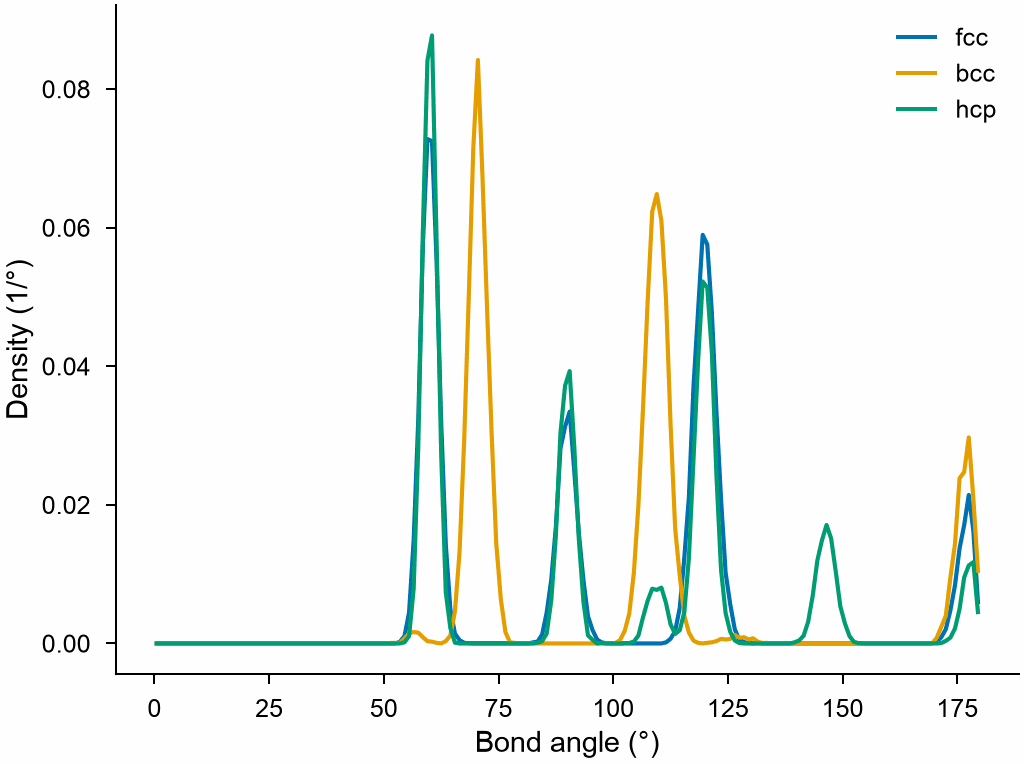
fcc and hcp share their angles at 60°, 90°, 120° and 180° and differ by those near 109° and 146° that only hcp has; bcc, with its 8 nearest neighbors, has 70.5°, 109.5° and 180°.
For water, BondAngleDistribution(cutoffs={("O", "H"): 1.2}) keeps only
the O–H bonds and triplet("O", "H", "H") gives the H–O–H angles.
Parameters
| Name | Type | Default | Unit | Meaning |
|---|---|---|---|---|
cutoff |
float64 | None |
Å | bonds are shorter than it |
bins |
int32 | 180 | number of bins of equal width from 0 to 180 degrees | |
cutoffs |
dict of (str, str) to float64 | None |
Å | instead of cutoff, a bond length for each pair of elements (a, b), in either order; pairs not given are never bonded |
compute(system, *, neighbors=None, progress=None, cancel=None) takes the
arguments of every analysis. A given neighbor list
must reach the largest cutoff; without one, the bonds are found and used at
once, never stored. Partial counts and cutoffs need an element column.
Results
A BondAngleResult:
| Attribute or method | Type | Meaning |
|---|---|---|
angle |
(bins,) float64 | bin centers in degrees |
edges |
(bins + 1,) float64 | bin edges in degrees |
counts |
(bins,) int64 | number of angles in each bin |
density |
(bins,) float64 | the counts normalized so that their integral over degrees is 1 |
partial |
dict of (str, str, str) to (B,) int64 | counts for each triplet (a, b, c): an atom of element a at the vertex and neighbors of elements b and c, b not after c by atomic number; they add up to counts |
triplet(a, b, c) |
(bins,) int64 | the counts of the triplet, with b and c in either order |
Errors
The constructor raises InvalidParameter without exactly one of cutoff
and cutoffs, for a cutoff that is not positive, an unknown element or
fewer than one bin; compute raises it for a neighbor list that does not
fit, and MissingProperty for cutoffs without an element column;
triplet raises InvalidParameter for a triplet without counts.
Definition
Every two bonds \(ij\) and \(ik\) of an atom \(i\) give the angle \(\theta_{jik}\) between the vectors to \(j\) and \(k\), counted in the bin \(\lfloor \theta / \Delta\theta \rfloor\); an atom with \(n\) bonds gives \(n(n - 1)/2\) angles. Bonds join atoms closer than the cutoff of their pair of elements, also across periodic boundaries.
See also
- OVITO Bond angle distribution.
- LAMMPS
compute adf.