Elastic strain
ElasticStrain gives the elastic strain of each atom of a crystal: how
its nearest neighbors are stretched and sheared from those of the ideal
crystal of given lattice constants, as OVITO's elastic strain calculation
does. Unlike the atomic strain, it needs no reference
configuration, and it leaves out the slip of dislocations, which moves
atoms without straining the lattice.
import numpy as np
import mdapy as mp
from mdapy.analysis import ElasticStrain
from mdapy.build import build_crystal, dislocation_quadrupole
from mdapy.visualization import render

# copper squeezed by 1 % along x: the strain of the deformation
cu = build_crystal("fcc", 3.615, elements="Cu", repeat=(5, 5, 5))
squeezed = cu.with_box(mp.Box(cu.box.matrix * [[0.99], [1], [1]]), scale_positions=True)
result = ElasticStrain("fcc", 3.615).compute(squeezed)
result.strain_tensor[0]  # (3, 3), -0.0102 along x
squeezed = squeezed.with_columns(
    result
)  # elastic_strain_structure, elastic_strain, elastic_volumetric_strain

# hcp magnesium of other constants than the ideal ratio
ElasticStrain("hcp", 3.21, c=5.21)

# two dissociated edge dislocations of copper in a periodic box, along their lines
dipole = dislocation_quadrupole("fcc edge", 3.615, (168.4, 121.4, 75.4), (14, 8, 3),
                                elements="Cu", dissociation=10)  # fmt: skip
strain = ElasticStrain("fcc", 3.615).compute(dipole)
render(dipole, "images/elastic-strain.png", color=strain.volumetric, colormap="coolwarm",
       value_range=(-0.02, 0.02), view="top", box=False, width=560, height=740, legend="volumetric strain")  # fmt: skip
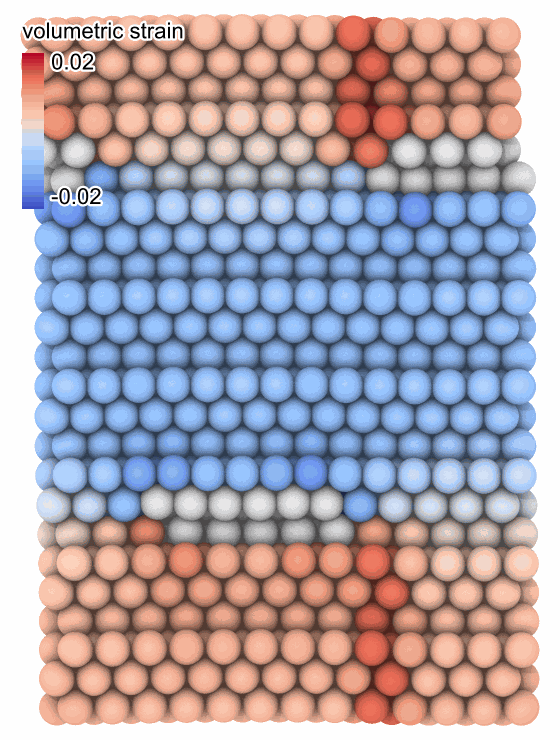
The volumetric elastic strain about two edge dislocations of copper of opposite sign, seen along their lines, each split into two Shockley partials with a stacking fault between them: the crystal is squeezed (blue) between their glide planes and stretched (red) beyond them; the atoms of the faults and the cores, which are not fcc, have none (white).
Parameters
ElasticStrain(crystal, a, c=None)
| Name | Type | Default | Unit | Meaning |
|---|---|---|---|---|
crystal |
str | "fcc", "hcp", "bcc", "cubic_diamond" or "hexagonal_diamond" |
||
a |
float64 | Å | the lattice constant of the unstrained crystal: of the cubic cell, or a of the hexagonal cell | |
c |
float64 | a √(8/3) | Å | the lattice constant c of the unstrained hexagonal cell; only for hcp and hexagonal diamond |
compute(system, *, progress=None, cancel=None) finds the atoms of the
crystal as the dislocation analysis does, with the
stacking faults of fcc and hcp in each other's structure and those of the
two diamonds in each other's, and their neighbors: the 12 nearest of fcc
and hcp, the 14 nearest of bcc, and of the diamonds the 4 nearest and
their 3 nearest each.
Results
An ElasticStrainResult:
| Attribute | Type | Meaning |
|---|---|---|
structure |
(N,) int8 | the structure of each atom, an index into names; its column elastic_strain_structure |
names, colors |
tuple of str, tuple of (3,) float64 | other, fcc, hcp, bcc, cubic_diamond, hexagonal_diamond, and their colors, those of PTM |
strain_tensor |
(N, 3, 3) float64 | the elastic strain \(\varepsilon\) of each atom of the crystal in the spatial frame, zero for the other atoms; its column elastic_strain |
volumetric |
(N,) float64 | \(\operatorname{tr}\varepsilon / 3\), zero for the atoms not of the crystal; its column elastic_volumetric_strain |
The structures, the strain tensors and the volumetric strains are those of OVITO 3.17.1 atom by atom, within 1e-12, on dislocations, stacking faults and deformed crystals of the five lattices. Where OVITO joins crystal regions across a stacking fault of a hexagonal crystal, it keeps their relation in single precision, and its strains of those atoms differ by up to 1e-7. OVITO can also give the strain in the frame of the lattice and the deformation gradient, which depend on which of the equivalent frames of the lattice it takes for a crystal region; MDAPY gives the strain in the spatial frame only, OVITO's default.
Errors
The constructor raises InvalidParameter for an unknown crystal, a
lattice constant that is not positive, and c for a cubic crystal;
compute raises it for a box so short along a periodic direction that an
atom meets its own periodic image among its neighbors, which replicating
the system along that direction mends.
Definition
The neighbors of an atom of the crystal are at the vectors \(\mathbf d_k\), each the nearest periodic image, and are matched to the ideal vectors \(\mathbf v_k\) of the crystal by the bonds among them, as the structure identification orders them. The ideal vectors are those of the cubic cell of constant \(a\); those of hcp and hexagonal diamond, of the cubic crystal with the same nearest neighbors, are stretched along c by \((c/a)/\sqrt{8/3}\). The elastic deformation gradient minimizes \(\sum_k |\mathbf d_k - F \mathbf v_k|^2\):
the Euler–Almansi strain, which does not depend on how the lattice of the crystal is turned, nor on which of its equivalent frames the ideal vectors are taken in.
See also
- OVITO Elastic strain calculation.
- Atomic strain, against a reference configuration.
Please cite