Combining systems
combine adds the atoms of one system to those of another, as OVITO's
combine datasets does: a solvent around a solute, an adsorbate on a slab,
a projectile above a target.
import numpy as np
from mdapy.build import add_vacuum, build_crystal
from mdapy.transform import combine
from mdapy.visualization import render

# a copper slab and a small gold cluster above it
slab = add_vacuum(build_crystal("fcc", 3.615, elements="Cu", repeat=(8, 8, 4)), 20.0)
gold = build_crystal("fcc", 4.078, elements="Au", repeat=(2, 2, 2))
center = slab.box.matrix.sum(axis=0) / 2
above = gold.with_columns(
    positions=gold["positions"] - gold["positions"].mean(axis=0) + center + [0, 0, 10]
)
both = combine(slab, above)  # the box of the slab, the gold atoms after the copper
render(
    both,
    "images/combine.png",
    view=(0.3, -1.0, 0.25),
    width=600,
    height=500,
    legend=True,
)
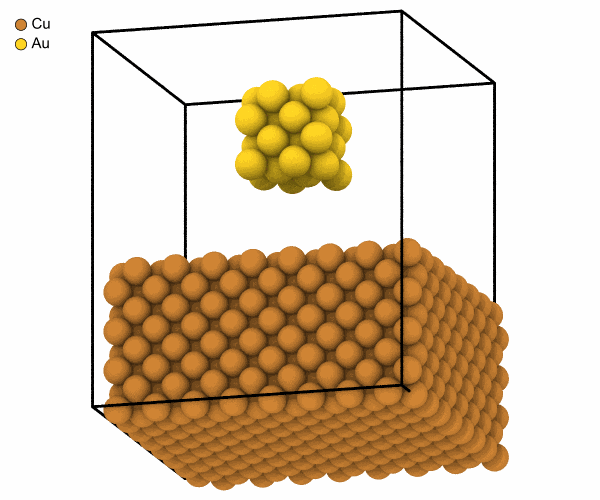
Thirty-two gold atoms of a cube of fcc gold added above a copper slab, in the box of the slab.
Parameters
combine(system, other)
| Name | Type | Meaning |
|---|---|---|
system |
System |
the atoms and the box that are kept |
other |
System |
the atoms added after them, at their positions; its box is not used |
To combine the frames of two trajectories, combine them frame by frame, as OVITO does with a trajectory as its second source:
from mdapy.io import read_trajectory

frames = [
    combine(a, b)
    for a, b in zip(read_trajectory("solute.dump"), read_trajectory("solvent.dump"))
]
Results
A System with the atoms of system, then those of other, in the box
of system:
| What | How it is combined |
|---|---|
| columns | those of either, system's first; where one has no column, zeros: 0, false, an empty text, the element X, and missing values for other types such as lists; integers in one and floats in the other become floats |
id |
where system has ids, the added atoms are numbered on from its largest, in their order, whatever their own ids; without ids in system, its atoms get 0 and the added atoms keep theirs |
molecule |
the molecules of other above 0 offset by the largest of system; 0, no molecule, stays 0 |
| topology | the bonds, angles, dihedrals and impropers of both, those of other moved to its atoms; types as they are |
| info | that of system, without energy and virial, which no longer describe the atoms |
OVITO offsets molecule 0 as well, so that atoms of other in no molecule
join a molecule of system; it matches particle types by name, as the
elements here are.
Errors
combine raises InvalidParameter for a column whose types in the two
cannot be joined, such as text in one and numbers in the other.