Free energy
mdapy.simulation.free_energy(system, potential, temperatures) gives the free
energy of a solid or a liquid per atom from molecular dynamics in
LAMMPS: at one temperature by switching to a system whose free energy
is known, and from there to other temperatures by the enthalpy along a run.
import numpy as np
from mdapy.build import build_crystal
from mdapy.calculators import LAMMPS
from mdapy.simulation import free_energy, minimize

potential = LAMMPS(
    "pair_style eam/alloy\npair_coeff * * Cu_mishin1.eam.alloy Cu", elements=["Cu"]
)
crystal = minimize(
    build_crystal("fcc", 3.615, elements="Cu", repeat=(11, 11, 11)),
    potential,
    cell="full",
    max_stress=1e-4,
).system

temperatures = np.arange(1000.0, 1601.0, 25.0)
options = dict(switching=100, scan=300, repeats=2)
solid = free_energy(crystal, potential, temperatures, **options)
liquid = free_energy(
    crystal, potential, temperatures[::-1], phase="liquid", equilibration=15, **options
)
solid.free_energy  # eV per atom at each temperature
melting = solid.crossing(liquid)
melting.temperature, melting.latent_heat  # 1328 K, 0.124 eV per atom
The two phases of copper meet at its melting point:
from mdapy.visualization import plot

with plot.style():
    fig, ax = plot.figure("single")
    difference = liquid.free_energy[::-1] - solid.free_energy
    ax.plot(solid.temperatures, 1e3 * difference)
    ax.axhline(0.0, color="0.75", lw=0.5, zorder=0)
    ax.axvline(melting.temperature, color="0.6", lw=0.8)
    ax.set_xlabel("Temperature (K)")
    ax.set_ylabel(r"$G_\mathrm{liquid} - G_\mathrm{solid}$ (meV/atom)")
    plot.save(fig, "images/free-energy", formats=("png",))
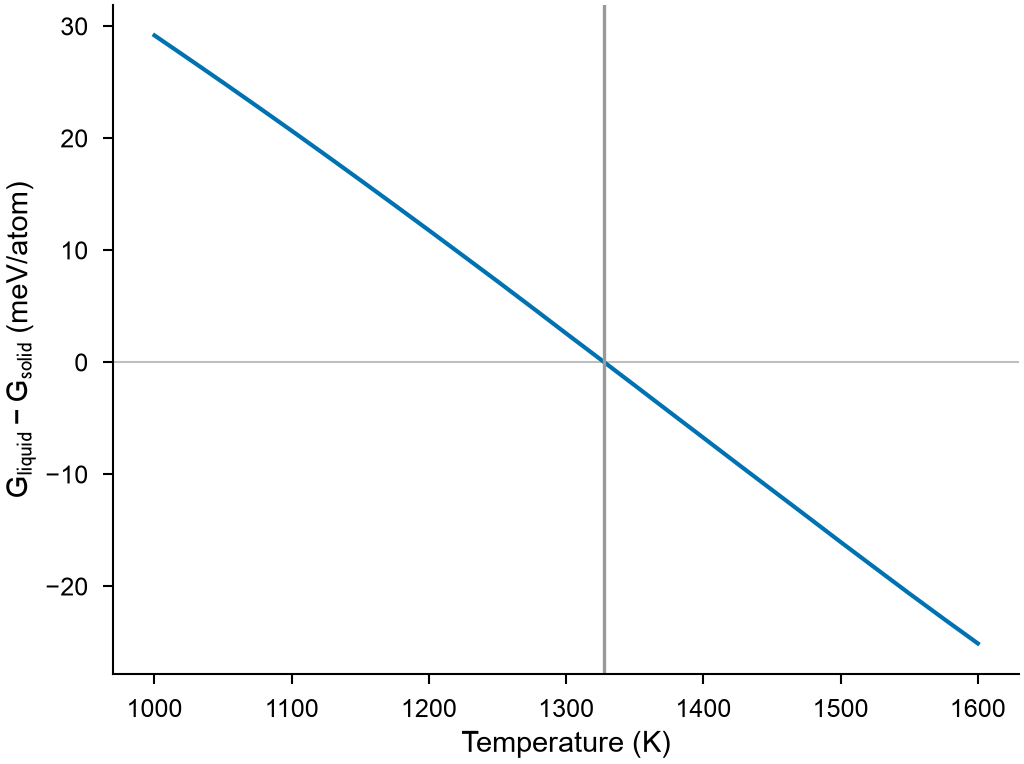
Copper with the EAM potential of Mishin et al., 5324 atoms: the liquid has the lower free energy above 1328 K. A millielectronvolt per atom is 11 K here.
These are the free energies of exactly these atoms in their periodic box, so they depend a little on the number of atoms, and so does where the phases meet: the same copper gives 1331 K with 2048 atoms and 1326 K with 16384, as does the two-phase method with 16000.
A smooth potential
The potential must be continuous at its cutoff, as those fitted for metals
are; a Lennard-Jones potential needs pair_modify shift yes. A jump of the
energy at the cutoff is in the energies the integrals read, but not in the
forces that move the atoms, and it gave an error of 1.6 meV per atom at 60 K in
a crystal of argon.
The atoms are classical, as in molecular dynamics: the free energy has no
zero-point energy, and well below the Debye temperature the
quasi-harmonic approximation is better. LAMMPS needs its
packages EXTRA-FIX, for solids, and EXTRA-PAIR, for liquids.
| Name | Type | Default | Unit | Meaning |
|---|---|---|---|---|
system |
System |
the atoms, with an element column, in a box periodic in every direction: for a solid at their places in the crystal (relax them first), for a liquid anywhere, as it is melted first |
||
potential |
LAMMPS |
the interaction; a liquid needs one pair style, not a hybrid | ||
temperatures |
float64 or (T,) float64 | K | the free energy is calculated at the first and followed from there to the others, which lie on one side of it, in order | |
phase |
str | "solid" |
"solid" or "liquid" |
|
pressure |
float64 or None |
0 | GPa | the pressure, for the Gibbs energy; None for the Helmholtz energy in the box of system |
timestep |
float64 | 0.001 | ps | the time step |
equilibration |
float64 | 10 | ps | the time of each equilibration |
switching |
float64 | 50 | ps | the time of each switching between two interactions |
scan |
float64 | 100 | ps | the time of each run between the first and the last temperature |
repeats |
int32 | 1 | independent calculations at the first temperature, for error |
|
mixing |
bool | False |
add the ideal entropy of mixing of a random solid solution, whose atoms do not exchange places in the dynamics; a liquid has it by itself | |
melt_temperature |
float64 | twice the first temperature | K | the temperature at which a liquid is melted |
barostat |
str | "aniso", "iso" for a liquid |
how the box changes, as in run |
|
seed |
int32 | 1 | the seed of the random numbers | |
progress |
callable | None |
called as progress(done, total) with the steps run |
|
cancel |
CancelToken |
None |
stops the calculation, which raises Cancelled |
Solids start from the first temperature low, near where the crystal is stable, and go up; liquids start high and come down. A crystal heated too far melts, and a liquid cooled too far freezes: when the enthalpy of a scan shows this, the scan is run again short of there, and the temperatures beyond are left out with a warning. In a scan of 200 ps a crystal kept its structure up to about 1.2 times its melting point, for copper, aluminum and nickel.
Results
free_energy returns a FreeEnergyResult, all per atom; arrays are read-only.
| Attribute | Type | Unit | Meaning |
|---|---|---|---|
temperatures |
(T,) float64 | K | the temperatures |
pressure |
float64 or None |
GPa | the pressure |
free_energy |
(T,) float64 | eV | the Gibbs energy, or the Helmholtz energy at constant volume |
enthalpy |
(T,) float64 | eV | the enthalpy, or the energy at constant volume, smoothed |
entropy |
(T,) float64 | eV/K | the entropy, \((H - G)/T\); classical, so negative at low temperatures |
volume |
(T,) float64 | ų | the volume |
phase |
str | "solid" or "liquid" |
|
error |
float64 or None |
eV | the standard error at the first temperature from the repeats; None for one |
dissipation |
(T,) float64 | eV | half the difference of the work there and back: near zero when the switching and the scan are slow enough and the phase stays as it is |
system |
System |
the atoms in the box of the first temperature |
crossing(other) gives where this phase and another at the same pressure have the
same free energy, as a PhaseCoexistence:
| Attribute | Type | Unit | Meaning |
|---|---|---|---|
temperature |
float64 | K | the temperature |
latent_heat |
float64 | eV | the change of enthalpy to the other phase |
entropy |
float64 | eV/K | the change of entropy |
volume |
float64 | ų | the change of volume |
Definition
A solid at volume \(V\) is switched to independent harmonic springs of spring constants \(k_i\) at the places of its atoms, chosen to give each element the mean square displacement it has in the crystal, and back (Frenkel and Ladd (1984); Freitas et al. (2016)):
with the forces \((1-\lambda)\) of the crystal and \(\lambda\) of the springs, and
for the center of mass, held fixed. Half the difference of the two ways removes the heat lost on the way.
A liquid at volume \(V\) is switched in the same way to the Uhlenbeck-Ford model \(U_\mathrm{UF} = -p\,k_B T \ln(1 - e^{-r^2/\sigma^2})\), with \(p = 50\) and \(\sigma = 1.5\) Å (Paula Leite et al. (2016)), which is switched in turn from nothing, the ideal gas:
Between temperatures the free energy follows the enthalpy \(H\) along runs with the temperature changing there and back, of which the mean is taken:
The Gibbs energy at pressure \(P\) is \(G = F + PV\), with \(V\) the mean volume at the first temperature and \(P\).
Errors
free_energy raises InvalidParameter for invalid options, a box not periodic in
every direction, a hybrid pair style for a liquid, a liquid whose atoms do not move
from their neighbors, a phase that changes in every scan, or if LAMMPS fails;
MissingProperty for a system without an element column; Cancelled when
cancelled. crossing raises InvalidParameter for other pressures, temperatures
that do not overlap, or free energies that do not cross between them.
Please cite
Frenkel and Ladd (1984) and Freitas et al. (2016) for solids; Paula Leite et al. (2016) for liquids.