Planar faults
PlanarFaults finds the planar faults of fcc crystals, stacking faults and
coherent twin boundaries, from the hcp-like atoms that
polyhedral template matching finds in their {111} planes, and
estimates their areas. It gives the same types as OVITO's Identify fcc
planar faults, atom by atom.
import numpy as np
from mdapy.build import build_crystal, slip
from mdapy.identify import PlanarFaults
from mdapy.transform import replicate

# fcc copper with z along [111], slipped by a/6 [11-2] above one plane
a = 3.615
cell = build_crystal(
    "fcc", a, elements="Cu", orientation=[(1, -1, 0), (1, 1, -2), (1, 1, 1)]
)
crystal = replicate(cell, (6, 4, 8))
faulted = slip(crystal, [0, a / np.sqrt(6), 0], height=0.51)

result = PlanarFaults().compute(faulted)
result.counts()["intrinsic stacking fault"]  # 96: two planes of 48 atoms
result.areas()["intrinsic stacking fault"]  # 271.6 Ų, the area of the box
faulted = faulted.with_columns(result)  # planar_fault
An intrinsic and an extrinsic stacking fault and a twin in one crystal, made by slipping above chosen (111) planes:
from mdapy.visualization import render

crystal = replicate(cell, (6, 4, 20))  # 60 (111) planes
b = [0, a / np.sqrt(6), 0]
faults = slip(crystal, b, height=10.5 / 60)  # intrinsic
for plane in (25.5, 26.5):  # extrinsic: two neighboring planes
    faults = slip(faults, b, height=plane / 60)
for plane in range(6):  # a twin six planes thick: six planes in a row
    faults = slip(faults, b, height=(40.5 + plane) / 60)

found = PlanarFaults(extrinsic=True).compute(faults)
colors = np.asarray(found.colors)[found.fault]
render(
    faults,
    "images/planar-faults.png",
    color=colors,
    view="left",
    width=600,
    height=900,
    legend=dict(zip(found.names, found.colors)),
)
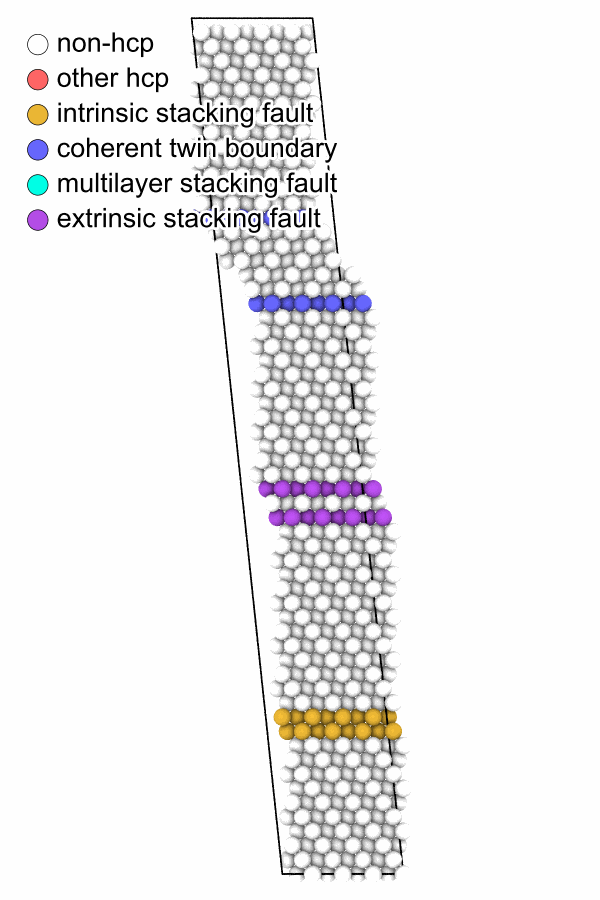
Seen along x. From the bottom: the intrinsic stacking fault (orange, two planes), the extrinsic stacking fault (purple, two planes with one fcc plane between) and the two coherent twin boundaries (blue) around the twin, whose rows of atoms turn the other way.
Parameters
PlanarFaults(structures=("fcc", "hcp", "bcc"), *, rmsd_cutoff=0.1, extrinsic=False)
| Name | Type | Default | Unit | Meaning |
|---|---|---|---|---|
structures |
iterable of str | ("fcc", "hcp", "bcc") |
the structures polyhedral template matching looks for, fcc and hcp among them | |
rmsd_cutoff |
float64 | 0.1 | atoms that deviate more from their best template are other; 0 for no cutoff | |
extrinsic |
bool | False |
also find extrinsic stacking faults, which are otherwise two coherent twin boundaries |
compute(system, *, ptm=None, neighbors=None, progress=None, cancel=None)
runs polyhedral template matching, or takes a PTMResult of the same
system already computed with template_neighbors=True; neighbors,
progress and cancel are those of every analysis.
Results
A PlanarFaultResult:
| Attribute or method | Type | Meaning |
|---|---|---|
fault |
(N,) int8 | the type of each atom, an index into names |
names |
tuple of str | non-hcp, other hcp, intrinsic stacking fault, coherent twin boundary and multilayer stacking fault, numbered as in OVITO, and extrinsic stacking fault |
colors |
tuple of (3,) float64 | OVITO's colors of the types |
interatomic_distance |
(N,) float64 | the distance in Å between nearest neighbors of the lattice each atom matched |
counts() |
dict of str to int64 | the number of atoms of each type |
areas() |
dict of str to float64 | the area in Ų of the intrinsic stacking faults, the coherent twin boundaries and the extrinsic stacking faults |
The column is planar_fault.
Errors
The constructor raises InvalidParameter for structures without fcc and
hcp, or a negative RMSD cutoff; compute raises it for a PTMResult of
another system or without the neighbors in the order of the templates.
Definition
An hcp-like atom has six neighbors in its basal plane, a {111} plane of the fcc crystal, and three above and three below it. Two hcp-like atoms one above the other are stacked, their basal planes parallel, unless an atom lies in both their basal planes. Each hcp-like atom is first classified by its hcp-like neighbors in its basal plane, those stacked above and below it, and its fcc neighbors above and below:
- stacked hcp-like neighbors on one side only: an intrinsic stacking fault, two planes of hcp-like atoms;
- no stacked hcp-like neighbors, at least one hcp-like neighbor in the basal plane and fcc neighbors on both sides: a coherent twin boundary, one plane;
- stacked hcp-like neighbors on both sides: a multilayer stacking fault, three planes or more;
- otherwise other hcp, an hcp-like atom of no planar fault.
A second pass then goes through the hcp-like atoms in the order of their indices, as OVITO does, and changes the types as it goes: a twin-boundary or other atom whose hcp-like basal neighbors include stacking-fault atoms and no twin-boundary atoms becomes a stacking-fault atom, and the other way round; the stacking-fault atoms stacked on a multilayer atom become multilayer atoms. Atoms at the edges of faults, next to partial dislocations, may thus depend on the order of the atoms.
With extrinsic, a last pass makes extrinsic stacking faults of the
twin-boundary atoms next to a single plane of fcc atoms between two planes
of hcp-like atoms: a twin-boundary atom with an fcc neighbor above or
below that has at least five hcp-like and five fcc neighbors, as an fcc
atom with six hcp-like neighbors in the planes above and below it and six
fcc neighbors in its own plane has. An extrinsic stacking fault, a plane
inserted into the stacking, is such a twin of two planes. This pass reads
the types the others left and does not depend on the order of the atoms.
The area of an atom in a {111} plane is \(\tfrac{\sqrt3}{2}d^2\), with \(d\) the interatomic distance; a stacking fault is two planes of atoms, a twin boundary one, an extrinsic stacking fault two:
Adjacent faults of different kinds can look alike: a multilayer stacking fault may be several stacking faults or twin boundaries on neighboring planes.
See also
- Polyhedral template matching, which finds the hcp-like atoms.
- OVITO Identify fcc planar faults.