Point defects, stacking faults and surfaces
add_vacancies, add_interstitials and substitute make point defects;
slip moves the atoms above a plane, for a stacking fault; add_vacuum
opens a box for a slab with two surfaces: the configurations of vacancy,
stacking fault and surface energies.
import numpy as np
from mdapy.build import (
    add_interstitials,
    add_vacancies,
    add_vacuum,
    build_crystal,
    slip,
    substitute,
)

a = 3.615
copper = build_crystal("fcc", a, elements="Cu", repeat=(4, 4, 4))
vacancy = add_vacancies(copper, atoms=[0])
octahedral = add_interstitials(copper, "Cu", positions=[[a / 2, a / 2, a / 2]])
hydrogen = add_interstitials(copper, "H", 10, min_distance=1.5, seed=1)
nickel = substitute(copper, "Ni", 5, seed=2)

# an intrinsic stacking fault: slip by 1/6 [11-2] on a (111) plane
layers = build_crystal(
    "fcc",
    a,
    elements="Cu",
    orientation=[(1, 1, -2), (-1, 1, 0), (1, 1, 1)],
    repeat=(4, 6, 6),
)
fault = slip(layers, [a / np.sqrt(6), 0, 0])
slab = add_vacuum(layers, 15.0)  # two (111) surfaces
Seen by their structure:
from mdapy.identify import CommonNeighborAnalysis
from mdapy.visualization import render, write_png

cna = CommonNeighborAnalysis()
vacancies = add_vacancies(
    build_crystal("fcc", a, elements="Cu", repeat=(8, 8, 8)), 6, seed=3
)
around = cna.compute(vacancies)
pictures = [
    render(
        vacancies,
        atoms=around.structure != 1,
        color=around,
        width=500,
        height=500,
        legend=True,
    ),
    render(
        fault,
        color=cna.compute(fault),
        view="front",
        width=500,
        height=500,
        legend=True,
    ),
    render(
        slab, color=cna.compute(slab), view="front", width=500, height=500, legend=True
    ),
]
write_png("images/defects.png", np.hstack(pictures))
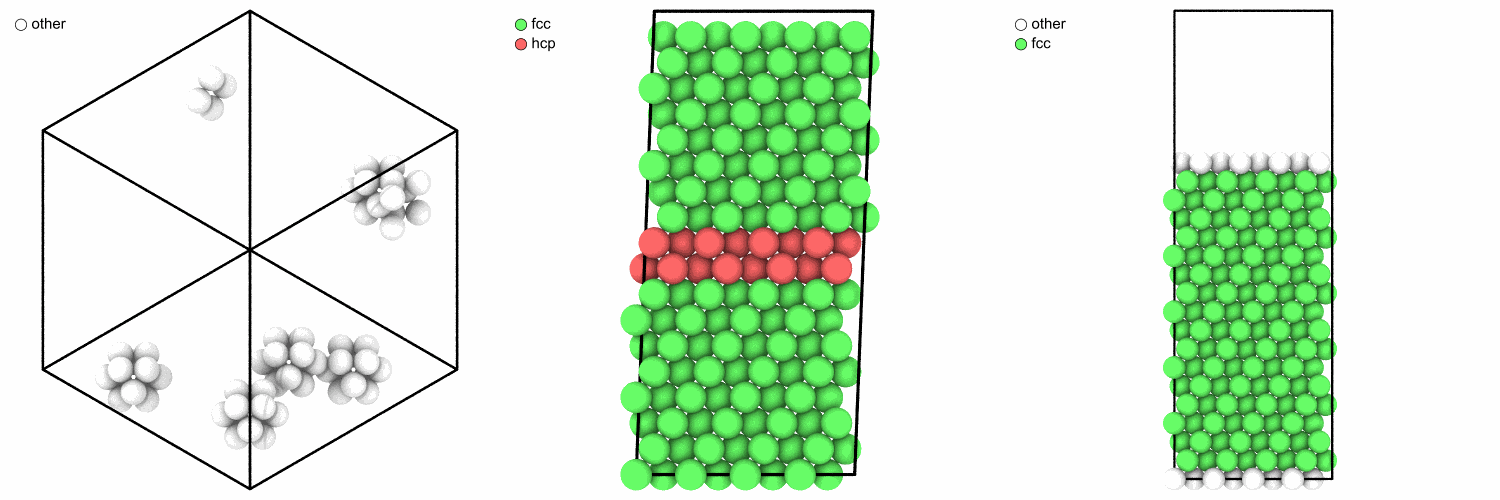
Left: six vacancies in copper, shown by the twelve neighbors each one leaves without fcc order; the other atoms are hidden. Middle: the intrinsic stacking fault, two (111) planes of hcp order (red) in fcc (green), seen along y. Right: the slab, with its (111) surfaces (white) facing the vacuum.
Parameters
| Function | Parameters |
|---|---|
add_vacancies(system, count=None, *, atoms=None, seed=None) |
count atoms removed at random, or the atoms given as indices or a boolean mask |
substitute(system, element, count=None, *, atoms=None, seed=None) |
count atoms at random, or the atoms given, become element |
add_interstitials(system, element, count=None, *, positions=None, min_distance=1.0, seed=None, attempts=1000) |
atoms of element at the (M, 3) positions in Å, or count atoms at random positions, each at least min_distance Å from every atom; attempts random positions are tried for each |
slip(system, displacement, *, height=None, axis=2) |
the atoms above the plane at the fractional coordinate height (default 0.5) of the box vector axis move by displacement (Å, along the plane) |
add_vacuum(system, thickness, *, axis=2) |
the box vector axis grows by thickness Å |
axis is 0, 1, 2 or "x", "y", "z". seed is an integer or a
numpy.random.Generator; the same seed gives the same choice.
Results
Each returns a new System:
add_vacancieskeeps the other atoms in their order.substitutekeeps every atom; a system without elements gets"X".add_interstitialsputs the new atoms after the others; their other columns are those of the first atom, exceptid, which continues from the largest.slipmoves the atoms; along a periodic axis the box vector moves with them, so that the box holds a single plane of slip, and not a second one where the box repeats.add_vacuummoves the atoms by whole box vectors so that none is cut by the boundary of that axis, and keeps the periodicity: with a periodic axis the slab has two surfaces facing a vacuum ofthickness.
Errors
They raise InvalidParameter for an unknown element, both or neither of a
count and atoms (or positions), a count out of range, repeated or invalid
indices, a mask of the wrong length, no place for an interstitial after
attempts tries, a displacement out of the plane, an unknown axis, or a
negative thickness or distance.
See also
- Surfaces and slip systems: the orientations of the common surfaces and slip systems, their energies and the shuffle and glide planes of diamond.