Polyhedral template matching
PolyhedralTemplateMatching gives each atom the crystal structure of its
neighborhood, the rotation of that crystal, its elastic deformation and the
chemical ordering of its elements, by matching the polyhedron of its
nearest neighbors to the templates of nine structures. MDAPY implements
the method of Larsen, Schmidt and Schiøtz itself and gives the same results
as OVITO 3.17, atom by atom.
import numpy as np
from mdapy.build import build_crystal
from mdapy.identify import PolyhedralTemplateMatching

# Cu3Au: an fcc lattice ordered in the L1_2 structure, slightly disordered
alloy = build_crystal("l1_2", 3.75, elements=("Cu", "Au"), repeat=(4, 4, 4))
rng = np.random.default_rng(1)
alloy = alloy.with_columns(
    positions=alloy["positions"] + rng.normal(scale=0.05, size=(256, 3))
)

ptm = PolyhedralTemplateMatching(deformation_gradient=True, ordering=True)
result = ptm.compute(alloy)
result.counts()["fcc"]  # 256
result.interatomic_distance.mean()  # about 2.65 Å, 3.75 / sqrt(2)
result.orientation[0]  # near (0, 0, 0, 1): the cubic axes along x, y and z
result.ordering_names[result.ordering[0]]  # "L12_A": a Cu site
alloy = alloy.with_columns(result)  # structure, rmsd, orientation and more
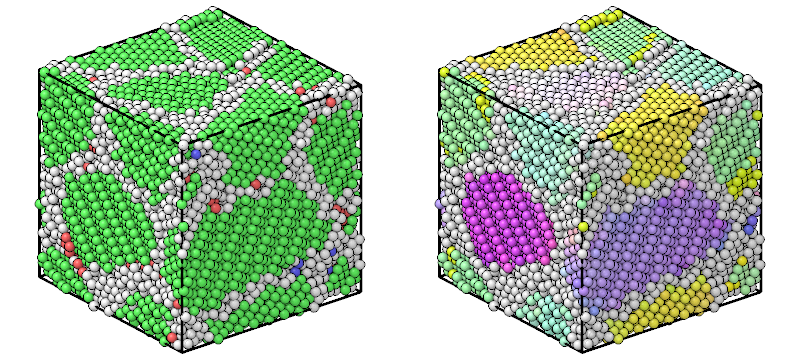
A copper polycrystal: the structure of each atom (fcc green, hcp red, other white), and the orientation of the grains, colored by the rotation of each atom.
Parameters
PolyhedralTemplateMatching(structures=("fcc", "hcp", "bcc"), *, rmsd_cutoff=0.1, deformation_gradient=False, ordering=False, template_neighbors=False)
| Name | Type | Default | Unit | Meaning |
|---|---|---|---|---|
structures |
iterable of str | ("fcc", "hcp", "bcc") |
the structures to look for: fcc, hcp, bcc, ico, sc, cubic_diamond, hexagonal_diamond and graphene |
|
rmsd_cutoff |
float64 | 0.1 | atoms that deviate more from their best template are other; 0 for no cutoff |
|
deformation_gradient |
bool | False |
compute the elastic deformation gradient of each atom | |
ordering |
bool | False |
identify the chemical ordering from the element column |
|
template_neighbors |
bool | False |
give the neighbors of each atom in the order of its template |
compute(system, *, neighbors=None, progress=None, cancel=None) takes the
arguments of every analysis. A given neighbor list
must hold the 18 nearest neighbors of every atom.
Results
A PTMResult, a StructureResult with the types
other, fcc, hcp, bcc, ico, sc, cubic_diamond,
hexagonal_diamond and graphene, numbered as in OVITO, and:
| Attribute | Type | Unit | Meaning |
|---|---|---|---|
rmsd |
(N,) float64 | the root-mean-square deviation from the best template, after scaling; 0 where none matches | |
interatomic_distance |
(N,) float64 | Å | the distance between nearest neighbors of the matched lattice |
orientation |
(N, 4) float64 | the rotation of the lattice from its standard orientation, a quaternion (x, y, z, w) | |
deformation_gradient |
(N, 3, 3) float64 or None |
the elastic deformation gradient, from the template scaled to the interatomic distance to the neighbors | |
ordering |
(N,) int8 or None |
the chemical ordering, an index into ordering_names: other, pure, L10, L12_A, L12_B, B2, zincblende_wurtzite and boron_nitride |
|
correspondences |
(N,) uint64 | the order of the neighbors that matches the template, encoded as OVITO's Correspondences | |
template_index |
(N,) int8 | which of the equivalent templates of the structure matched | |
neighbors |
(N, 16) index_dtype or None |
the neighbors of each atom in the order of the points of its template, -1 beyond its count |
The columns are ptm_structure, ptm_rmsd, ptm_interatomic_distance,
ptm_orientation, and when computed ptm_deformation_gradient (9 values per atom, by
rows) and ptm_ordering. As in OVITO, an atom above the RMSD cutoff is other but keeps
the other results of its best template; an atom that matches no template
gets zeros.
Errors
The constructor raises InvalidParameter for an unknown structure, no
structure, or a negative RMSD cutoff; compute raises it for a neighbor
list that does not hold the 18 nearest neighbors, and MissingProperty for
the ordering without an element column.
Definition
The 18 nearest neighbors of an atom are first ordered by the solid angles of the faces of its Voronoi cell, which they share. For fcc, hcp, icosahedral, bcc and simple cubic, the first 12, 14 or 6 of them form a convex hull; its graph of edges, put in a canonical form, finds the templates of the same graph and every way the neighbors can map onto the points of a template. For the diamond structures, the 4 nearest neighbors and 3 of each of their own neighbors are matched together, and for graphene 3 and 2 of each. For every mapping, the neighbors are centered and scaled, and the rotation that brings the template closest to them is found by the quaternion method; the root-mean-square deviation of that fit, the RMSD, picks the best mapping and structure. The interatomic distance comes from the scale of the fit, and the deformation gradient is the linear map that brings the scaled template closest to the neighbors. The chemical ordering compares the elements of the neighbors with the sublattices of the ordered structures on the same template.
Neighbors at exactly the same distance, as in a perfect crystal, may come in an order other than OVITO's. The structure types are then the same, but an atom that matches no structure may report another best template.
See also
- Common neighbor analysis, faster, without orientations.
- OVITO Polyhedral template matching.
Please cite