Errors of a model
predict compares the energies, forces and virials a model predicts with
the labels of frames, such as those of a training set from DFT: the root
mean square errors, a table of the errors of each frame and the frames
that err most, to look at first. Any MDAPY calculator is a model, as a
NEP or an EAM, and so is
any ASE calculator through
from_ase_calculator. read_gpumd reads
the same from the files GPUMD writes when it trains a NEP model, and
torchnep when it trains or predicts, without computing anything.
import numpy as np
from mdapy.calculators import EAM, NEP
from mdapy.io import read, write
from mdapy.mlip import predict
from mdapy.visualization import plot

# thirty frames of the CrCoNi alloy, shaken more and more, labeled by the
# EAM of Zhou as a training set would be by DFT
eam = EAM.zhou(["Cr", "Co", "Ni"])
sqs = read("SQS.xyz")  # 108 atoms
rng = np.random.default_rng(0)
shaking = np.linspace(0.02, 0.2, 30)
frames = []
for amplitude in shaking:
    shaken = sqs.with_columns(
        positions=sqs["positions"] + rng.normal(0, amplitude, (len(sqs), 3))
    )
    label = eam.compute(shaken, ("energy", "forces", "virial"))
    frames.append(
        shaken.with_columns(forces=label.forces).with_info(
            energy=label.energy, virial=label.virial
        )
    )

# a NEP model of CrCoNi, trained on DFT, against those labels
result = predict(frames, NEP("nep.txt"))
result.rmse()  # {"energy": eV/atom, "forces": eV/Å, "virial": eV/atom}
table = result.table()  # the errors of each frame
worst = result.worst(5)  # the five frames of the largest force errors
write("worst.xyz", [frames[k] for k in worst])

with plot.style():
    fig, (left, right) = plot.figure("double", ncols=2)
    plot.parity(
        result.forces[:, 0].ravel(),
        result.forces[:, 1].ravel(),
        ax=left,
        label="forces",
        unit="eV/Å",
    )
    right.plot(shaking, table["force_rmse"], "o")
    right.set_xlabel("shaking (Å)")
    right.set_ylabel("force error of the frame (eV/Å)")
    plot.save(fig, "images/errors", formats=("png",))
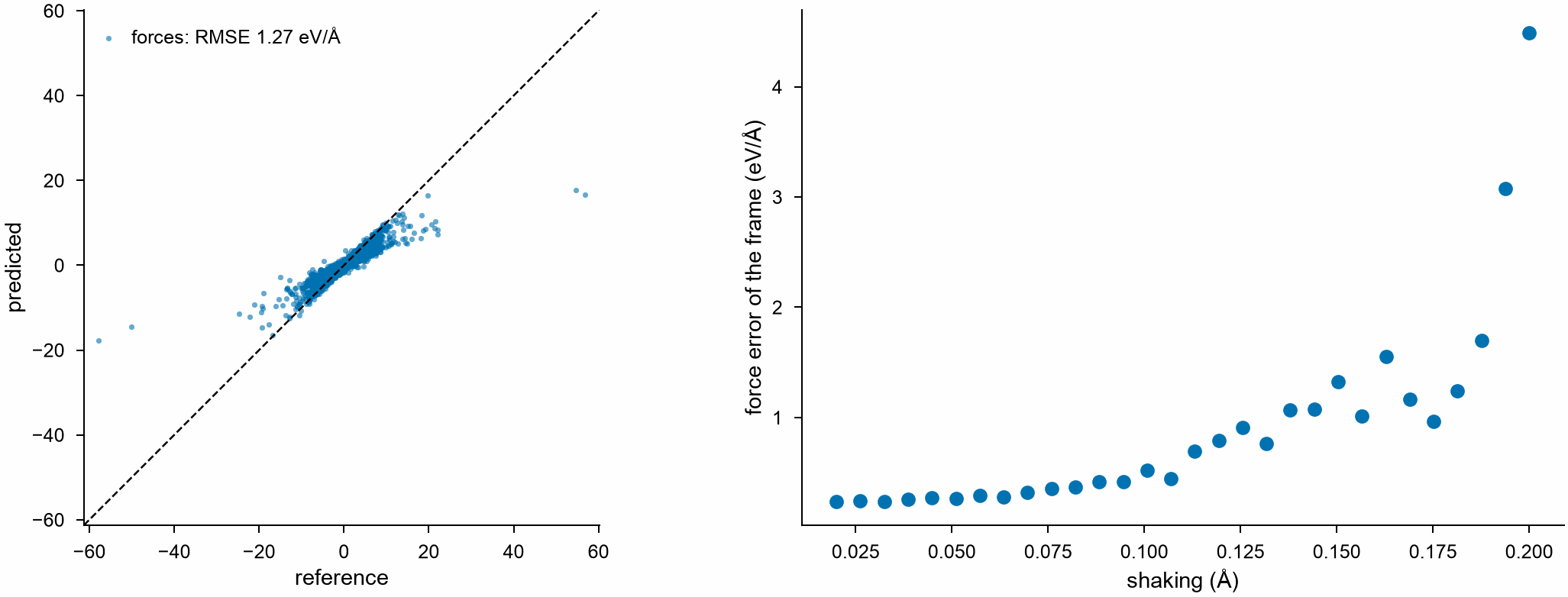
Left: each force component of the NEP model against the label of the
EAM, over all atoms of the thirty frames. Right: the root mean square
force error of each frame grows with how far its atoms are shaken, as
the two potentials part further from the crystal; worst picks the
frames at the right end.
The files of a NEP model of GPUMD trained on train.xyz, in the folder it
ran in, or of the predictions of torchnep, whose frames may lie elsewhere:
from mdapy.mlip import read_gpumd

result = read_gpumd("nep_folder")  # energy_train.out, force_train.out, ...
result.rmse()
test = read_gpumd("nep_folder", "test")  # with test.xyz

# torchnep: predict_dataset("nep.txt", "data/all.xyz", "predicted")
other = read_gpumd("predicted", xyz="data/all.xyz")
A NEP model computes many frames at a time, a frame on each of the threads
of set_num_threads, each as it would
be alone, in predict and committee; other models frame by frame.
Parameters
| Function | Parameters |
|---|---|
predict(frames, calculator) |
the frames, their labels the info energy and virial (eV) and the column forces (eV/Å) as extended XYZ training sets hold them; and the model |
read_gpumd(folder, kind="train", *, xyz=None) |
the folder of energy_train.out, force_train.out and virial_train.out, as GPUMD writes them when it trains a NEP model and torchnep when it trains or predicts; kind="test" for those of the test set; and the extended XYZ file of the frames, for their numbers of atoms, by default train.xyz (or test.xyz) in the folder |
Predictions.worst(count, by="force_rmse") |
how many frames, and the column of table() to rank them by: energy_error (by its size), force_rmse, force_max_error or virial_rmse |
Results
A Predictions:
| Attribute | Type | Unit | Meaning |
|---|---|---|---|
atoms |
(F,) int64 | the number of atoms of each frame | |
energy |
(F, 2) float64 | eV/atom | the label and the prediction of each frame; NaN for a frame without a label |
forces |
(A, 2, 3) float64 | eV/Å | the label and the prediction of the force on each atom of all frames one after the other |
virial |
(F, 2, 3, 3) float64 | eV/atom | the label and the prediction of the virial of each frame, NaN where either is missing, as for a model that does not compute virials |
frame_of_atom |
(A,) int64 | the frame of each atom of forces |
rmse() gives the root mean square errors over the frames with labels:
energy in eV/atom, forces in eV/Å over the force components, virial
in eV/atom over its components. table() gives a
polars DataFrame of one row per frame: frame,
atoms, energy (the label per atom), energy_error, force_rmse,
force_max_error (of a component) and virial_rmse. The energies of two
potentials, or of DFT codes with other references, differ by a constant
per atom of each element; the errors of the forces and the spread of the
energy errors are what compare them.
Errors
predict raises InvalidParameter for no frames, and what the model
raises for frames it cannot compute; read_gpumd raises it for files it
cannot read, files of other numbers of columns, and files that do not hold
the frames of the XYZ file; worst raises it for another column.
See also
- Uncertainty and novelty: where a model has not seen enough.
- Checking frames: frames that look wrong before training.
- Choosing frames.