Radial distribution function
RadialDistributionFunction gives the radial distribution function g(r) of
a system and its partial functions for each pair of elements.
import numpy as np
from mdapy.analysis import RadialDistributionFunction
from mdapy.build import build_crystal, random_alloy

# a random Cu-Ni alloy on an fcc lattice of 5 x 5 x 5 cubic cells
crystal = build_crystal("fcc", 3.6, elements="Cu", repeat=(5, 5, 5))
system = random_alloy(crystal, {"Cu": 0.5, "Ni": 0.5}, seed=0)

rdf = RadialDistributionFunction(r_max=8.0, bins=160).compute(system)
rdf.r, rdf.g  # bin centers in Å and g(r)
rdf.pair("Cu", "Ni")  # a partial function
rdf.coordination[-1]  # mean number of neighbors closer than 8 Å
Plotted with mdapy.visualization.plot, for a
larger alloy whose atoms are shaken by 0.12 Å as at a finite temperature:
from mdapy.build import build_crystal, random_alloy
from mdapy.visualization import plot

alloy = random_alloy(
    build_crystal("fcc", 3.6, repeat=(6, 6, 6)), {"Cu": 1, "Ni": 1}, seed=1
)
shake = np.random.default_rng(0).normal(0, 0.12, (len(alloy), 3))
hot = alloy.with_columns(positions=alloy["positions"] + shake)
partials = RadialDistributionFunction(r_max=8.0, bins=160).compute(hot)
with plot.style():
    fig, ax = plot.figure("single")
    plot.rdf(partials, ax=ax, partial=True)
    plot.save(fig, "images/rdf", formats=("png",))
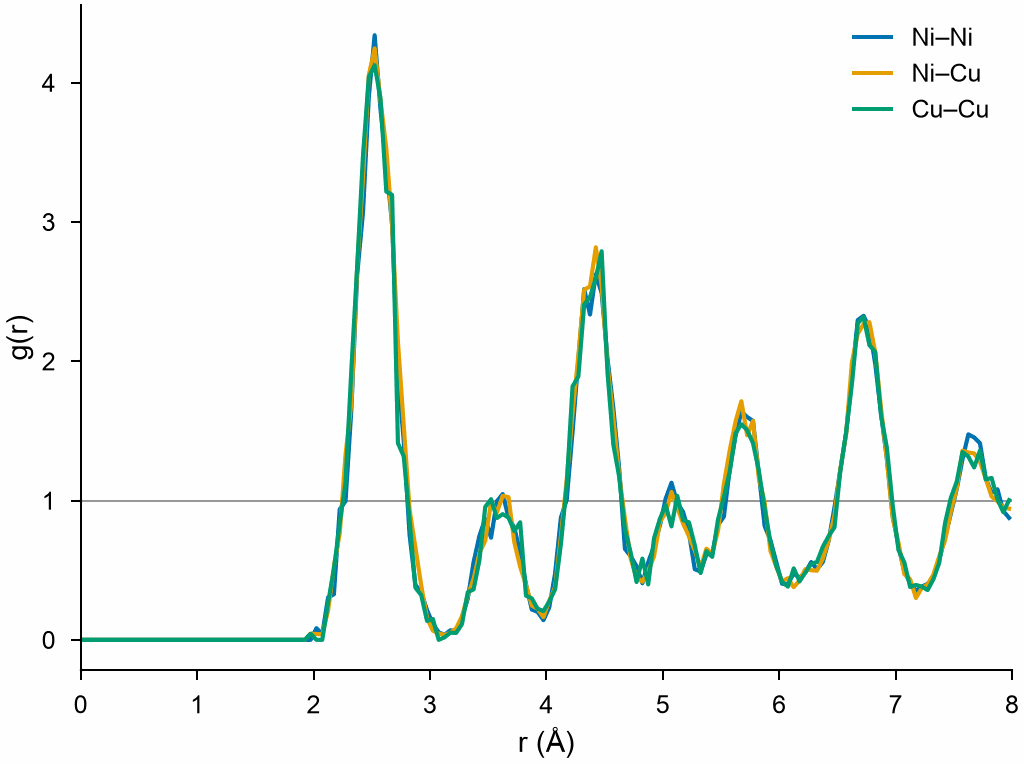
The three partial functions of the random alloy agree: Cu and Ni share the sites at random. The peaks are the neighbor shells of fcc at a/√2, a, a√(3/2), a√2 and beyond.
Parameters
| Name | Type | Default | Unit | Meaning |
|---|---|---|---|---|
r_max |
float64 | Å | largest distance; it may exceed half the box, periodic images count | |
bins |
int32 | 200 | number of bins of equal width from 0 to r_max |
compute(system, *, neighbors=None, progress=None, cancel=None) takes the
arguments of every analysis. A given neighbor list
must reach r_max; without one, the pairs are counted as they are found,
never stored. Partial functions need an element column.
Results
A RadialDistributionResult:
| Attribute or method | Type | Meaning |
|---|---|---|
r |
(bins,) float64 | bin centers in Å |
edges |
(bins + 1,) float64 | bin edges in Å |
g |
(bins,) float64 | g(r) |
coordination |
(bins,) float64 | mean number of neighbors closer than the upper edge of each bin |
partial |
dict of (str, str) to (B,) float64 | g_ab(r) of each pair of elements (a, b), a not after b by atomic number |
pair(a, b) |
(bins,) float64 | g_ab(r), with a and b in either order |
Errors
The constructor raises InvalidParameter for an r_max that is not
positive or fewer than one bin; compute raises it for a neighbor list that
does not fit, and pair for a pair of elements without a function.
Definition
With \(n_k\) the number of ordered pairs \((i, j)\), \(j\) any atom or periodic image other than \(i\) itself, at a distance in bin \(k\) from \(r_k\) to \(r_{k+1}\), and \(n^{ab}_k\) those with \(i\) of element \(a\) and \(j\) of element \(b\),
with \(V\) the volume of the box, \(N\) the number of atoms and \(N_a\) that of element \(a\); a pair at distance \(r\) is in bin \(\lfloor r / \Delta r \rfloor\). The partial functions add up as \(g = \sum_{a,b} x_a x_b\, g_{ab}\) with the fractions \(x_a = N_a / N\). The volume is that of the box also along directions that are not periodic, where \(g\) does not tend to 1.
This is the normalization of OVITO. LAMMPS compute rdf divides by
\(N(N - 1)\) instead of \(N^2\), and by \(N_a(N_a - 1)\) for like pairs, so its
values are larger by about \(N / (N - 1)\).
See also
- OVITO Coordination analysis.
- LAMMPS
compute rdf.