Sheets
Elastic constants and phonons of two-dimensional materials such as graphene. A box that is periodic along two vectors in the x-y plane and not along a third along z makes a system a sheet; nothing else changes in the calls.
import mdapy
from mdapy.build import build_crystal
from mdapy.calculators import LAMMPS
from mdapy.lattice_dynamics import elastic_constants, phonons
from mdapy.simulation import minimize

potential = LAMMPS("pair_style lcbop\npair_coeff * * C.lcbop C", elements=["C"])
crystal = build_crystal("graphene", 2.46, c=20.0, elements="C")
sheet = crystal.with_box(mdapy.Box(crystal.box.matrix, pbc=(True, True, False)))
sheet = minimize(sheet, potential, cell="full", max_stress=1e-3).system

elastic = elastic_constants(sheet, potential)
elastic.constants  # (3, 3) N/m: 331, 73 and 129
elastic.young_modulus(), elastic.poisson_ratio()  # 315 N/m, 0.22

result = phonons(sheet, potential)
bands = result.band_structure("hexagonal")  # Γ-M-K-Γ
dos = result.dos(100)  # the mesh is 100 x 100 x 1
thermal = result.thermal([100, 300, 1000], mesh=100)  # F, E, S, C_V per atom
The phonons of graphene, drawn with the same calls as those of a crystal:
from mdapy.visualization import plot

with plot.style():
    fig, (left, right) = plot.figure(
        "single", ncols=2, sharey=True, width_ratios=[3, 1]
    )
    plot.band_structure(bands, ax=left)
    plot.phonon_dos(dos, ax=right)
    plot.save(fig, "images/sheets", formats=("png",))
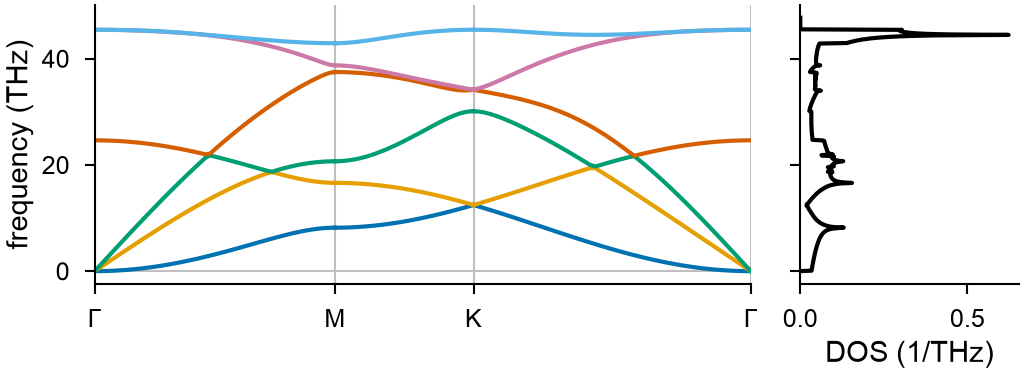
Graphene with the LCBOP potential of LAMMPS. The lowest branch near Γ, the vibration across the sheet, is quadratic; the two above it are linear.
The height of the box does not matter and the atoms need no vacuum around them: a sheet has no images along z. A calculator that always takes the box as periodic, such as VASP, needs a box high enough that the images of the sheet do not meet.
Elastic constants
elastic_constants strains the sheet along xx, yy and xy only and returns a
SheetElasticResult, per unit of the area of the sheet, so that no thickness
has to be chosen. The parameters are those of
elastic_constants.
| Attribute or method | Type | Meaning |
|---|---|---|
constants |
(3, 3) float64 | elastic constants \(C\) in N/m, in the order xx, yy, xy; read-only |
young_modulus(axis="x") |
float64 | the Young's modulus in N/m along "x" or "y" |
poisson_ratio(axis="x") |
float64 | the contraction across a stretch along "x" or "y", over the stretch |
shear_modulus() |
float64 | the shear modulus in N/m |
area_modulus() |
float64 | the area modulus in N/m: the tension per unit of relative change of the area |
With \(S = C^{-1}\) these are
Phonons
phonons takes the parameters and returns the Phonons of a crystal, with
these differences:
supercellrepeats the cell along its plane only: one integer means both vectors, three integers end in 1, and by default it is the supercell nearest a square at least twice the cutoff of the calculator wide;- a
meshof one integer indosandthermalmeans the plane, and three integers end in 1. The vibrations across the sheet make the thermal properties converge slowly with the mesh, so a mesh of 100 is a good start; - the paths
"auto"and"hexagonal"ofband_structurekeep the sections in the plane: Γ-M-K-Γ for a hexagonal sheet.
primitive_cell takes a sheet and gives the primitive cell of its plane, in a
box of the same height.
In gigapascals
A sheet has no thickness of its own, so its constants are in N/m. With a thickness \(h\) chosen by convention, such as the 3.35 Å between the layers of graphite, the constants of a material of that thickness are \(C[\mathrm{GPa}] = 10\, C[\mathrm{N/m}] / h[\text{Å}]\): 356 N/m is 1063 GPa.
Molecular dynamics
MolecularDynamics runs a sheet as it is. barostat="xy" controls the
pressure in the plane and keeps the height of the box:
from mdapy.simulation import MolecularDynamics

with MolecularDynamics(sheet, potential) as md:
    md.velocities(600.0, seed=1)
    md.run(20000, ensemble="npt", temperature=300.0, pressure=0.0, barostat="xy")
LAMMPS divides the forces by the volume of the box, with its vacuum. A tension of \(\sigma\) in N/m is therefore the pressure \(-10\, \sigma / h\) GPa, with the height of the box \(h\) in Å; at zero pressure the height does not matter.
Errors
elastic_constants, phonons and primitive_cell raise InvalidParameter
for a box that is not periodic in every direction and is not that of a sheet.
phonons raises it for a supercell that leaves the plane, dos and thermal
for a mesh with more than one wave vector along z. The methods of
SheetElasticResult raise it for an axis other than "x" or "y" and for
constants that cannot be inverted.
quasi_harmonic and elastic constants from molecular
dynamics need a box periodic in every direction: a sheet has
no volume to scan. The moduli of ElasticResult, for a sheet in a periodic box
with vacuum, raise InvalidParameter, as its constants cannot be inverted.