Steinhardt parameters
SteinhardtParameters gives the bond-orientational order parameters \(q_l\)
of each atom, which tell crystals, liquids and glasses apart, plain or
averaged over the neighbors, with neighbors by number, by distance or by
Voronoi cell, optionally weighted by the areas of the Voronoi faces; with
solid, it also tells the solid-like atoms from the liquid-like ones by the
order their bonds share.
import numpy as np
from mdapy.analysis import SteinhardtParameters
from mdapy.build import build_crystal

# fcc copper of 3 x 3 x 3 cubic cells
system = build_crystal("fcc", 3.615, elements="Cu", repeat=(3, 3, 3))

result = SteinhardtParameters(degrees=(4, 6), num_neighbors=12).compute(system)
result[6]  # q6 of each atom: 0.574524 in fcc
averaged = SteinhardtParameters(cutoff=3.0, average=True).compute(system)
weighted = SteinhardtParameters(voronoi=True, weighted=True).compute(system)
system = system.with_columns(result)  # columns q4 and q6
The averaged parameters tell the structures apart even when the atoms are shaken by 0.15 Å:
from mdapy.build import build_crystal
from mdapy.visualization import plot

rng = np.random.default_rng(0)
crystals = {
    "fcc": build_crystal("fcc", 3.615, elements="Cu", repeat=(5, 5, 5)),
    "hcp": build_crystal("hcp", 3.21, elements="Mg", repeat=(6, 6, 4)),
    "bcc": build_crystal("bcc", 2.87, elements="Fe", repeat=(6, 6, 6)),
}
with plot.style():
    fig, ax = plot.figure("single")
    for name, crystal in crystals.items():
        shaken = crystal.with_columns(
            positions=crystal["positions"] + rng.normal(0, 0.15, (len(crystal), 3))
        )
        neighbors = 14 if name == "bcc" else 12  # bcc: the first two shells
        q = SteinhardtParameters(
            degrees=(4, 6), num_neighbors=neighbors, average=True
        ).compute(shaken)
        ax.scatter(q[4], q[6], s=2, alpha=0.6, label=name)
    ax.set_xlabel(r"$\bar q_4$")
    ax.set_ylabel(r"$\bar q_6$")
    ax.legend(frameon=False, markerscale=4)
    plot.save(fig, "images/steinhardt", formats=("png",))
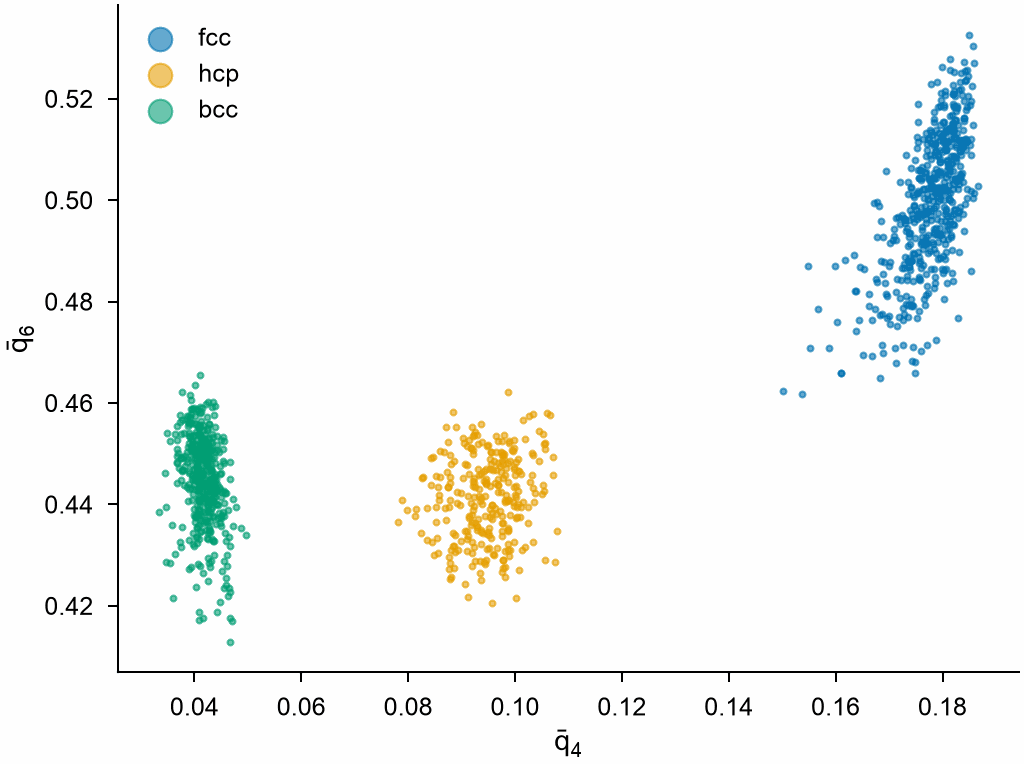
Each atom of the three crystals as a point: fcc, hcp and bcc fall in separate clouds, as in Lechner and Dellago (2008).
With solid, each atom gets its number of solid-like bonds, those to
neighbors whose harmonics of degree 6 are nearly parallel to its own, and is
solid-like with at least 7: copper whose upper half is disordered like a
liquid, the lower half shaken as at a high temperature:
from mdapy.visualization import render

melt = build_crystal("fcc", 3.615, elements="Cu", repeat=(8, 8, 12))
upper = melt["positions"][:, 2] > 22.0
shake = (
    rng.normal(0, 0.1, (len(melt), 3))
    + rng.normal(0, 0.6, (len(melt), 3)) * upper[:, None]
)
melt = melt.with_columns(positions=melt["positions"] + shake)

phases = SteinhardtParameters(solid=True).compute(melt)
phases.solid  # True for the solid-like atoms
phases.solid_bonds  # their solid-like bonds, of 12
melt = melt.with_columns(phases)  # columns q4, q6, solid and solid_bonds

side = [0, -1, 0.15]
render(
    melt,
    "images/steinhardt-solid.png",
    color=phases.solid_bonds,
    value_range=(0, 12),
    view=side,
    legend="solid bonds",
)
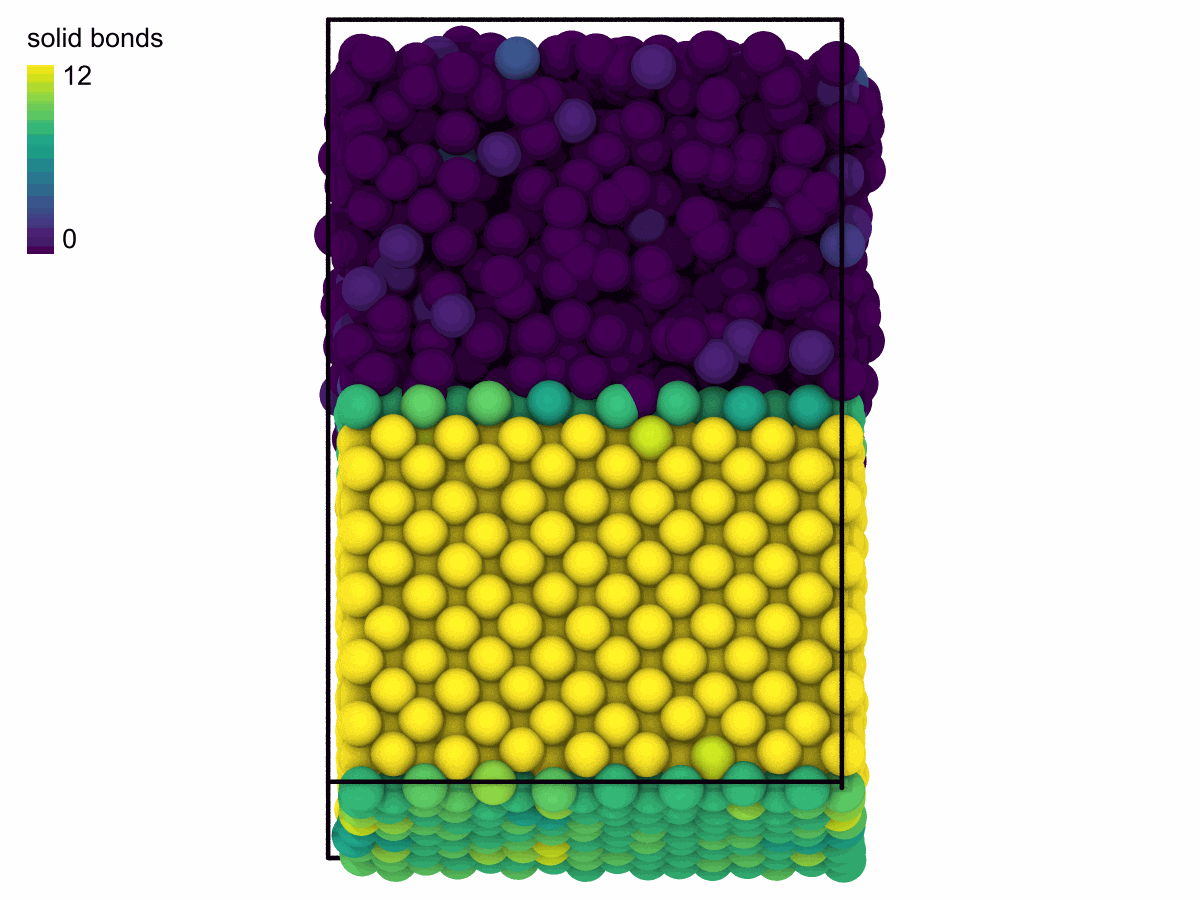
The solid-like bonds of each atom, from 0 (dark) to 12 (yellow): all 12 in the crystal, few in the disordered half, a few layers in between at the interfaces, the lower one across the periodic boundary.
Parameters
| Name | Type | Default | Unit | Meaning |
|---|---|---|---|---|
degrees |
sequence of int32 | (4, 6) | the degrees \(l\), from 0 to 20 | |
num_neighbors |
int32 | None |
the number of nearest neighbors; 12 when neither it, cutoff nor voronoi is given |
|
cutoff |
float64 | None |
Å | instead, the neighbors are closer than it |
voronoi |
bool | False |
instead, the neighbors share a face of the Voronoi cell | |
weighted |
bool | False |
with voronoi, weight each neighbor by the area of its face |
|
average |
bool | False |
average the \(q_{lm}\) over the atom and its neighbors | |
solid |
bool | False |
also count the solid-like bonds of each atom and tell the solid-like atoms | |
solid_degree |
int32 | 6 | with solid, the degree \(l\) of the harmonics of the bonds |
|
bond_threshold |
float64 | 0.7 | with solid, a bond is solid-like when the normalized product of the harmonics of its atoms exceeds it |
|
min_solid_bonds |
int32 | 7 | with solid, an atom is solid-like with at least so many solid-like bonds |
compute(system, *, neighbors=None, progress=None, cancel=None) takes the
arguments of every analysis. A given neighbor list
must reach the cutoff, hold the num_neighbors nearest neighbors of every
atom, or, with voronoi, be a list of
Voronoi neighbors, whose
thresholds then choose the faces; without one, every face of a cell counts.
The walls of a box that is not periodic are not neighbors.
Results
A SteinhardtResult:
| Attribute or method | Type | Meaning |
|---|---|---|
degrees |
tuple of int32 | the degrees |
q |
(N, degrees) float64 | \(q_l\) of each atom, one column per degree; 0 for an atom without neighbors |
average |
bool | whether the parameters are averaged |
result[l] |
(N,) float64 | the parameter of degree \(l\) |
solid_bonds |
(N,) int32 | with solid, the number of solid-like bonds of each atom; else None |
solid |
(N,) bool | with solid, whether each atom is solid-like; else None |
Its columns are q4, q6, …, with the options in their names, in this order:
q6_average, q6_voronoi, q6_average_voronoi, q6_voronoi_weighted, and with solid
also solid and solid_bonds.
Errors
The constructor raises InvalidParameter for a degree outside 0 to 20, more
than one of num_neighbors, cutoff and voronoi, either number not
positive, weighted without voronoi, a solid_degree that is not an
integer from 0 to 20, a bond_threshold outside −1 to 1, or a
min_solid_bonds that is not an integer of at least 0; compute raises it for a
neighbor list that does not fit or, with voronoi, two atoms at the same
position, and result[l] for a degree not computed.
Definition
For the \(N_b(i)\) neighbors \(j\) of atom \(i\), with \(\hat{\mathbf r}_{ij}\) the direction to \(j\) and \(Y_{lm}\) the spherical harmonics,
With weighted, each neighbor counts by the area \(A_{ij}\) of the face it
shares with atom \(i\), so that a small face, which a tiny displacement can
create or remove, adds little:
With average, the \(q_{lm}\) of each atom are first averaged over the atom
and its neighbors, which separates crystal structures more sharply:
and \(\bar q_l\) is formed from them as \(q_l\), the average itself unweighted. Values for perfect lattices:
| Lattice | Neighbors | \(q_4\) | \(q_6\) |
|---|---|---|---|
| fcc | 12, or Voronoi | 0.190941 | 0.574524 |
| hcp | 12, or Voronoi | 0.097222 | 0.484762 |
| bcc | 8 | 0.509175 | 0.628539 |
| bcc | 14, or Voronoi | 0.036369 | 0.510688 |
| bcc | Voronoi, weighted | 0.224025 | 0.566940 |
| icosahedron | 12 | 0 | 0.663325 |
With solid, the bond between atom \(i\) and its neighbor \(j\) is solid-like
when the harmonics of the two atoms, of degree \(l\) = solid_degree, point
alike:
\(d_c\) = bond_threshold, from the plain \(q_{lm}\) (not averaged), with the
neighbors and weights above; an atom with at least min_solid_bonds such
bonds is solid-like (ten Wolde et al. 1996).
For \(l = 6\), \(d_c = 0.7\) and 6 to 8 bonds suit fcc and bcc crystals
(Filion et al. 2010); in a perfect
crystal every bond is solid-like, \(d_6 = 1\). An atom without neighbors has
no bonds.
See also
- OVITO Steinhardt parameters.
- LAMMPS
compute orientorder/atom. - freud
SolidLiquid, the same solid-like bonds and atoms.
Please cite
Steinhardt et al. (1983); with average, also Lechner and Dellago (2008); with weighted, also Mickel et al. (2013); with solid, also ten Wolde et al. (1996).