Checking frames
A training set gathered from many calculations often holds a few frames
that would spoil a model: atoms that overlap, as after a wrong wrap or a
failed relaxation; forces that do not sum to zero, as of a calculation that
did not converge; and labels left out. check_frames finds them before
training, frame by frame.
import numpy as np
import polars as pl
from mdapy.calculators import EAM
from mdapy.io import read, write
from mdapy.mlip import check_frames
from mdapy.visualization import plot

# forty frames of the CrCoNi alloy, shaken and labeled by an EAM
eam = EAM.zhou(["Cr", "Co", "Ni"])
sqs = read("SQS.xyz")  # 108 atoms
rng = np.random.default_rng(2)
frames = []
for k in range(40):
    x = sqs["positions"] + rng.normal(0, 0.1, (len(sqs), 3))
    if k == 12:
        x[0] = x[1] + [0.6, 0, 0]  # an atom on top of another
    shaken = sqs.with_columns(positions=x)
    label = eam.compute(shaken, ("energy", "forces", "virial"))
    forces = label.forces + ([0.05, 0, 0] if k == 27 else 0)  # not converged
    virial = None if k == 33 else label.virial  # left out
    frames.append(
        shaken.with_columns(forces=forces).with_info(energy=label.energy, virial=virial)
    )

table = check_frames(frames)  # close=0.5 of the sum of the covalent radii
bad = table.filter(
    pl.col("too_close")
    | (pl.col("net_force") > 1e-3)
    | ~(pl.col("has_energy") & pl.col("has_forces") & pl.col("has_virial"))
)
bad["frame"].to_list()  # [12, 27, 33]
write("clean.xyz", [f for k, f in enumerate(frames) if k not in bad["frame"]])

with plot.style():
    fig, (left, right) = plot.figure("double", ncols=2)
    near = table["closest"].to_numpy()  # infinite when no pair is close
    left.bar(table["frame"], np.where(np.isfinite(near), near, 0))
    left.axhline(0.5, color="0.5", ls="--", lw=0.8)
    left.set_ylim(0, 0.6)
    left.set_xlabel("frame")
    left.set_ylabel("closest pair / sum of covalent radii")
    right.semilogy(table["frame"], table["net_force"], "o")
    right.set_xlabel("frame")
    right.set_ylabel("net force (eV/Å)")
    plot.save(fig, "images/checks", formats=("png",))
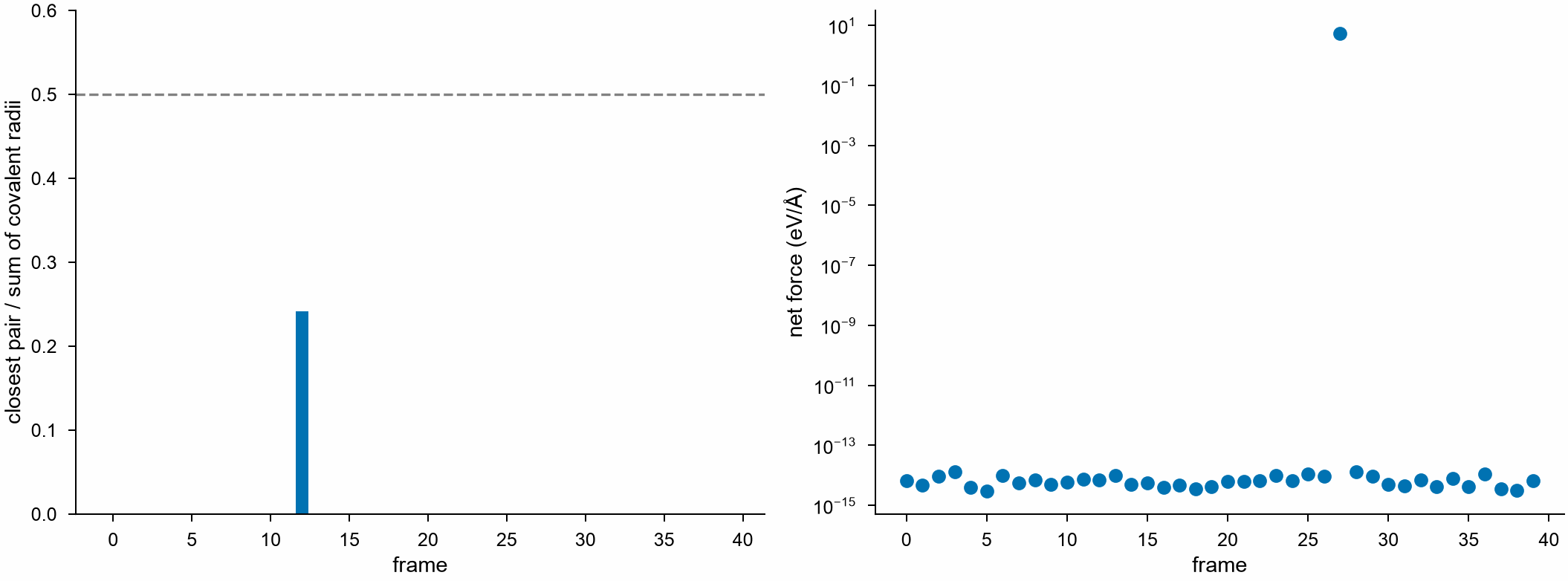
Left: the one frame with two atoms nearer than half the sum of their covalent radii; the others have no pair that near. Right: the net force of each frame, near the rounding of the forces in all but the one whose forces were shifted by 0.05 eV/Å along x, 5.4 eV/Å over its 108 atoms.
Parameters
| Name | Type | Default | Meaning |
|---|---|---|---|
frames |
sequence of System |
the frames, with an element column; their labels the info energy and virial and the column forces, as extended XYZ training sets hold them |
|
close |
float64 | 0.5 | two atoms closer than this fraction of the sum of their covalent radii are too close |
Results
A polars DataFrame of one row per frame:
| Column | Type | Unit | Meaning |
|---|---|---|---|
frame |
int64 | the index of the frame | |
atoms |
int64 | its number of atoms | |
closest |
float64 | the smallest distance of two atoms over the sum of their covalent radii, where it is below close; inf otherwise |
|
too_close |
bool | whether closest is below close |
|
net_force |
float64 | eV/Å | the length of the sum of the forces; NaN without forces |
has_energy, has_forces, has_virial |
bool | whether the frame has these labels |
The covalent radii are those of Cordero et al. (2008). The net force of a crystal or a cluster in vacuum is zero: a frame whose net force is far above the rounding of its forces holds forces of a calculation that did not converge, or of another frame.
Errors
check_frames raises InvalidParameter for a close that is not
positive, and MissingProperty for frames without an element column.
The closest pairs of many frames are found at a time, a frame on each of
the threads of set_num_threads, the
same whatever the threads.