Surface mesh
SurfaceMesh finds the surface of the solid the atoms make: the outside of
a particle, the two faces of a slab, the walls of the voids and pores in a
crystal. The surface is a mesh of triangles through the outer atoms, found
by the alpha-shape method: the space a probe sphere cannot enter is solid.
With regions=True the solid and the empty space are also split into
connected regions, among them the voids, with the volume and the area of
each.
import numpy as np
from mdapy.analysis import SurfaceMesh
from mdapy.build import build_crystal

crystal = build_crystal("fcc", 3.615, elements="Cu", repeat=(14, 14, 14))
box = crystal.box
keep = np.ones(len(crystal), dtype=bool)
# voids of radius 7, 5 and 6 Å, the last around a corner of the box
for center, radius in [
    ((0.3, 0.3, 0.5), 7.0),
    ((0.7, 0.65, 0.4), 5.0),
    ((0, 0, 0), 6.0),
]:
    away = box.minimum_image(crystal["positions"] - np.array(center) @ box.matrix)
    keep &= np.linalg.norm(away, axis=1) > radius
system = crystal.filter(keep)

result = SurfaceMesh(radius=4.0, regions=True, surface=True).compute(system)
result.area  # Ų, 1504: the walls of the voids
result.solid_volume  # ų, 126360 of the 129631 of the box
regions = result.regions
voids = regions.voids  # the empty regions closed on every side: [1, 2, 3]
regions.volume[voids]  # ų, [1181, 598, 1492]
regions.area[voids]  # Ų, [536, 319, 649]
result.mesh  # TriangleMesh(166 vertices, 320 triangles, periodic)
system = system.with_columns(result)  # surface: the 166 atoms on it
A particle in a box that is not periodic is surrounded by the exterior, an empty region without end:
from mdapy import Box

block = build_crystal("fcc", 3.615, elements="Cu", repeat=(10, 10, 10))
middle = block.box.matrix.sum(axis=0) / 2
ball = block.filter(np.linalg.norm(block["positions"] - middle, axis=1) < 15)
particle = ball.with_box(Box(block.box.matrix, pbc=False))

outside = SurfaceMesh(regions=True).compute(particle)
outside.regions.exterior  # [True, False]: the space around, then the particle
outside.regions.volume  # ų, [inf, 12062]
outside.area  # Ų, 2570, through the centers of the outer atoms
The voids, each in its own color, the particle as it is and smoothed, drawn by the renderer:
from mdapy.visualization import render, write_png

colors = np.array([(0.84, 0.37, 0.0), (0.0, 0.45, 0.7), (0.0, 0.62, 0.45)])
empty = regions.faces[:, 1]  # the empty region on the outer side of each triangle
pictures = [
    render(
        system,
        atoms=np.zeros(len(system), dtype=bool),
        mesh=result.mesh,
        mesh_color=colors[np.searchsorted(voids, empty)],
        width=500,
        height=500,
    )
]
for smoothing in (0, 8):
    mesh = SurfaceMesh(smoothing=smoothing).compute(particle).mesh
    pictures.append(
        render(particle, radius=0.5, mesh=mesh, box=False, width=500, height=500)
    )
write_png("images/surface-mesh.png", np.hstack(pictures))
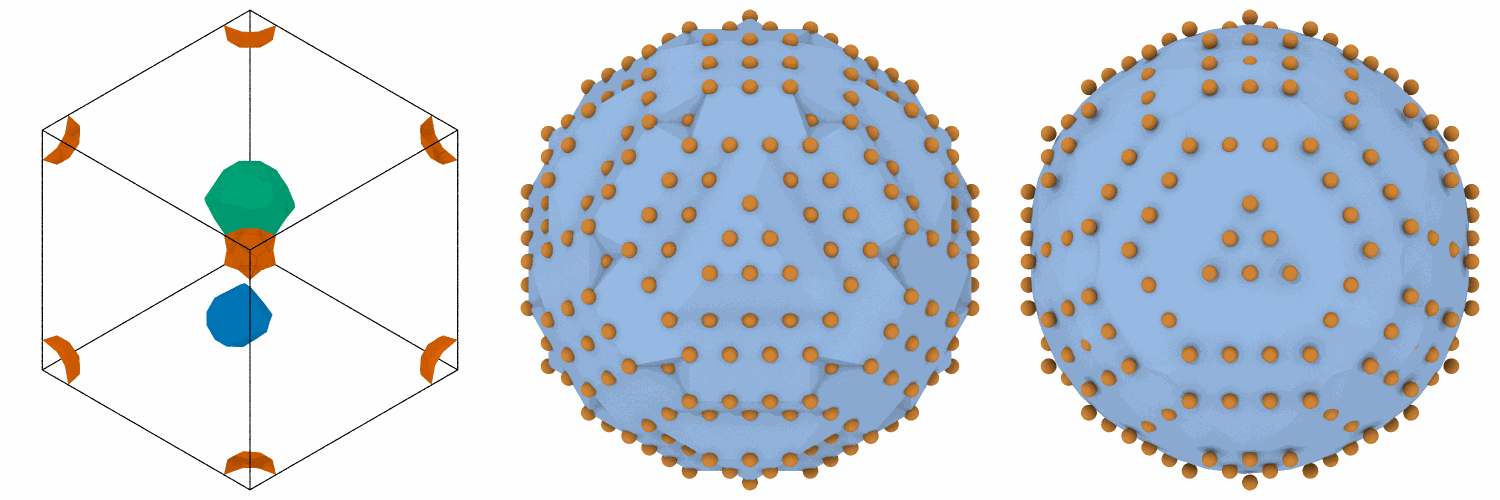
Left: the three voids; the one around a corner of the box is cut by its faces and seen in all eight corners. Middle: the surface of a copper particle through the centers of its outer atoms, drawn small. Right: the same surface after 8 smoothing steps.
Parameters
| Name | Type | Default | Unit | Meaning |
|---|---|---|---|---|
radius |
float64 | 4 | Å | radius of the probe sphere; larger than the distance between neighbors and smaller than the voids looked for |
smoothing |
int32 | 8 | the number of smoothing steps of the mesh, which round its shape and leave the volumes as they are | |
regions |
bool | False |
also split the solid and the empty space into regions, and find the voids | |
surface |
bool | False |
also mark the atoms on the surface |
compute(system, *, progress=None, cancel=None) takes the progress and
cancel of every analysis, but no neighbor list.
No two atoms may be at the same position. Out of a box that is not periodic
is empty space.
A smaller probe fits into smaller gaps: a probe smaller than the distance between neighbors sees the gaps between the atoms of a crystal as empty, one as large as a void fills it. The volumes and the areas of the regions do not depend on the smoothing; the area of the mesh does.
Results
A SurfaceMeshResult:
| Attribute | Type | Meaning |
|---|---|---|
mesh |
TriangleMesh |
the surface, its normals pointing out of the solid |
atoms |
(V,) int64 | the atom at each vertex of the mesh |
area |
float64 | the area of the surface in Ų |
solid_volume |
float64 | the volume of the solid in ų |
regions |
SurfaceRegions or None |
the regions, with regions=True |
surface |
(N,) bool or None |
whether each atom lies on the surface, with surface=True; its column surface |
A SurfaceRegions:
| Attribute | Type | Meaning |
|---|---|---|
solid |
(R,) bool | whether each region is solid |
volume |
(R,) float64 | the volume of each region in ų; infinite for the exterior |
area |
(R,) float64 | the area of the surface around each region in Ų |
exterior |
(R,) bool | whether the region is the empty space around the atoms, out of a box that is not periodic; the first region when there is one |
periodic |
(R,) bool | whether the region runs across a periodic boundary into its own image, without end, as the vacuum over a slab |
faces |
(F, 2) int64 | the solid and the empty region on the two sides of each triangle of the mesh |
voids |
(K,) int64 | the empty regions that are neither exterior nor periodic: closed by the solid on every side |
In a periodic box the volumes of the regions add up to that of the box.
OVITO also calls the vacuum over a slab a void; here it is periodic and
not among the voids.
Triangle meshes
A TriangleMesh, also mdapy.analysis.TriangleMesh, holds any mesh of triangles,
across periodic boundaries too:
| Attribute or method | Type | Meaning |
|---|---|---|
vertices |
(V, 3) float64 | the positions of the vertices in Å |
faces |
(F, 3) int64 | the vertices of each triangle, counterclockwise seen from the side its normal points to |
shifts |
(F, 3, 3) int8 or None |
the periodic image of each corner: corner k of triangle f is at vertices[faces[f, k]] + shifts[f, k] @ box.matrix |
box |
Box or None |
the box of the periodic images |
corners() |
(F, 3, 3) float64 | the corners of each triangle in Å, each triangle whole |
areas |
(F,) float64 | the area of each triangle in Ų |
area |
float64 | their sum |
normals |
(F, 3) float64 | the unit normal of each triangle, zero for one without area |
pieces() |
(T, 3, 3) float64, (T,) int64 | the triangles cut at the periodic faces of the box and moved into it, and the triangle of each piece |
TriangleMesh(vertices, faces, shifts=None, box=None) makes one; like a
Box it cannot be changed. render(system, mesh=...) draws it as its
pieces(), with mesh_color one color or one per triangle and
mesh_alpha its opacity.
mesh = result.mesh
corners = mesh.corners()  # (F, 3, 3) Å, each triangle whole
mesh.normals  # (F, 3) out of the solid: into the voids
pieces, triangle = mesh.pieces()  # in the box, for drawing elsewhere
Errors
The constructor raises InvalidParameter for a radius that is not
positive and a smoothing that is not an integer of at least 0; compute
raises it for a periodic box so short that an atom meets its own periodic
image across a cell of the tessellation (replicate the system first).
TriangleMesh raises it for arrays of the wrong shape, vertices that are
not finite, faces of vertices that do not exist, and shifts without a box.
Definition
The atoms, periodic images included, are divided into the tetrahedra of their Delaunay tessellation: no atom lies inside the sphere through the four corners of a tetrahedron. A tetrahedron is solid when the radius \(R\) of that sphere is smaller than the probe radius \(r\),
the others and the space outside the tessellation empty: the alpha shape of the atoms. The surface is made of the faces between a solid and an empty tetrahedron, turned so that their normals point to the empty side; its vertices are the atoms on it. The volume of the solid is that of its tetrahedra. Solid tetrahedra that share faces make a region, and so do empty ones; a region that meets itself in another periodic image runs without end.
Smoothing moves every vertex \(\mathbf x\) toward the mean of its \(n\) neighbors along the edges of the mesh,
once with \(\lambda = 0.5\) and once with \(\mu = 1/(0.1 - 1/\lambda) \approx -0.53\) per step, which rounds the mesh without shrinking it (Taubin), with the factors OVITO takes.
The tessellation of a perfect crystal is not unique: four atoms of a square can be split into two triangles along either diagonal. The atoms are moved at random by up to \(10^{-4}\) Å first, always the same way, which settles each such choice. The area and the volumes are those of either choice; the smoothed mesh can differ from OVITO's where OVITO chose otherwise, and is the same as OVITO's when the atoms are not on a perfect lattice.
Please cite
Edelsbrunner and Mücke (1994) and Stukowski (2014); with smoothing Taubin (1995).
See also
- OVITO Construct surface mesh, the same with its alpha-shape method.
- Voronoi analysis for the empty space around single atoms, and cluster analysis for groups of atoms.