Spatial correlation function
SpatialCorrelation gives how a property of the atoms at one place goes
with a property, the same or another, at a distance r from it: the
correlation function ⟨P₁(0) P₂(r)⟩, from fast Fourier transforms on a grid
up to half the box, and on request by a direct sum over the pairs of
neighbors at short range, as OVITO's spatial correlation function does.
import numpy as np
from mdapy.analysis import SpatialCorrelation
from mdapy.build import build_crystal
from mdapy.visualization import plot

# nickel with twelve spherical copper precipitates of radius 8 Å
nickel = build_crystal("fcc", 3.55, elements="Ni", repeat=(16, 16, 16))
box = nickel.box
centers = np.random.default_rng(3).random((12, 3))
step = box.to_fractional(nickel["positions"])[:, None, :] - centers
step -= np.round(step)
inside = (np.linalg.norm(step @ box.matrix, axis=-1) < 8).any(axis=1)
alloy = nickel.with_columns(
    element=np.where(inside, "Cu", "Ni"), copper=inside.astype(float)
)

result = SpatialCorrelation("copper", direct=True, cutoff=10.0, bins=40).compute(alloy)
result.r, result.correlation  # the grid, up to half the box
result.neighbor_r, result.neighbor_correlation  # the pairs closer than 10 Å

# normalized as OVITO's plot offers it: by the pair distribution, less the
# square of the mean, over the variance
mean = result.means[0]
variance = result.mean_squares[0] - mean**2
grid = (result.correlation / result.rdf - mean**2) / variance
shells = result.neighbor_rdf > 0  # the bins of the crystal's neighbor shells
pairs = result.neighbor_correlation[shells] / result.neighbor_rdf[shells]
pairs = (pairs - mean**2) / variance
with plot.style():
    fig, ax = plot.figure("single")
    ax.plot(result.r, grid, "o-", label="grid of 3 Å")
    ax.plot(result.neighbor_r[shells], pairs, "s", label="neighbor shells")
    ax.axhline(0, color="0.6", lw=0.5)
    ax.set_xlabel("r (Å)")
    ax.set_ylabel("normalized correlation")
    ax.legend()
    plot.save(fig, "images/spatial-correlation", formats=("png",))
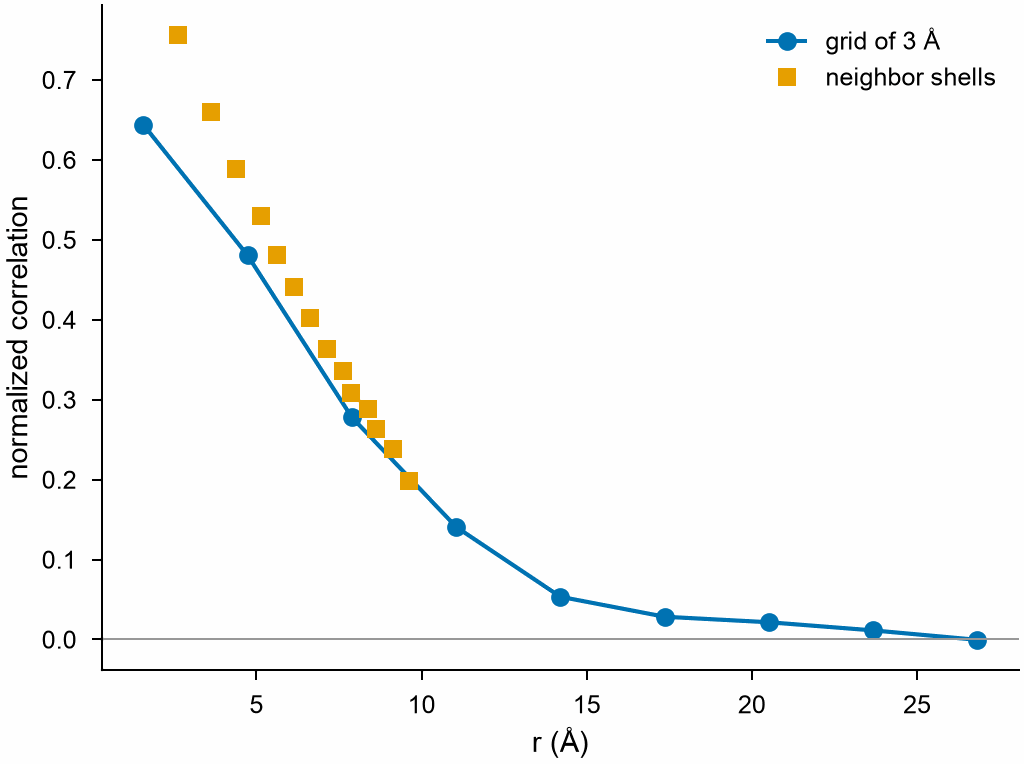
Copper atoms go with copper atoms within the size of the precipitates: the correlation of the copper fraction falls from 0.75 at the nearest neighbors, which the atoms at the surface of a precipitate share with nickel, to none over about 16 Å, their diameter. The grid, whose cells are some 3 Å wide, blurs the shortest distances, which the shells of neighbors of the direct sum resolve.
Parameters
SpatialCorrelation(first, second=None, *, grid_spacing=3.0, window=True, direct=False, cutoff=5.0, bins=50)
| Name | Type | Default | Unit | Meaning |
|---|---|---|---|---|
first |
str | a column of one value per atom, a component such as "velocities.x", or an expression over the columns |
||
second |
str | first |
the other property; by default the autocorrelation of the first | |
grid_spacing |
float64 | 3.0 | Å | the approximate size of the cells of the grid: each box vector is cut into as many cells of at least this length as fit |
window |
bool | True |
weight the atoms by a Hann window along the box vectors that are not periodic, which takes away the ringing of the edges of the box | |
direct |
bool | False |
also sum the correlation over the pairs of neighbors closer than cutoff |
|
cutoff |
float64 | 5.0 | Å | the reach of the direct sum |
bins |
int32 | 50 | the number of bins of the direct sum |
compute(system) takes the atoms in their box; along the periodic box
vectors atoms outside the box count in the cells they fold back into,
along the others they are left out.
Results
A SpatialCorrelationResult:
| Attribute | Type | Unit | Meaning |
|---|---|---|---|
r |
(bins,) float64 | Å | the centers of the distance bins of the grid, each as wide as half the shortest distance between opposite faces of the box over their number |
correlation |
(bins,) float64 | the correlation function from the grid | |
rdf |
(bins,) float64 | the radial distribution function of the same grid | |
q |
(wavevectors,) float64 | 1/Å | the centers of the wavevector bins |
reciprocal |
(wavevectors,) float64 | the correlation function in reciprocal space; of two properties equal to 1, the structure factor | |
means |
(2,) float64 | the mean of each property over the atoms | |
mean_squares |
(2,) float64 | the mean of the square of each property | |
mean_product |
float64 | the mean over the atoms of the product of the two properties | |
neighbor_r |
(bins,) float64 or None |
Å | the centers of the bins of the direct sum, with direct |
neighbor_correlation |
(bins,) float64 or None |
the correlation function summed over the pairs of neighbors, with direct |
|
neighbor_rdf |
(bins,) float64 or None |
the radial distribution function of the pairs of neighbors, with direct |
These are OVITO's tables correlation-real-space,
correlation-real-space-rdf, correlation-reciprocal-space,
correlation-neighbor and correlation-neighbor-rdf, and its attributes
mean1, mean2, variance1, variance2 and covariance, which are the
means, the mean squares and the mean product. OVITO's plots offer three
normalizations, each a line of NumPy as above: by the radial distribution
function, correlation / rdf; by the covariance, divided by
mean_product; and the difference correlation,
(mean_squares.sum() / 2) - correlation. Atoms whose value is NaN are left
out of the grid and make the means NaN.
Errors
SpatialCorrelation raises InvalidParameter for a grid spacing or a
cutoff that is not positive, and a number of bins that is not a positive
integer; compute raises it for a property that is not one number per
atom, a system of no atoms, and a grid spacing larger than a quarter of the
shortest distance between opposite faces of the box.
Definition
Each property is summed over the atoms in the cells of a grid of \(n_a \times n_b \times n_c\) cells along the box vectors, \(n_a\) the length of \(\mathbf a\) over the grid spacing, rounded down; an atom falls in the cell its fractional coordinates times \(n\) give, rounded toward zero. With \(\hat P_1\), \(\hat P_2\) and \(\hat\rho\) the discrete Fourier transforms of the grids of the two properties and of the number of atoms,
the second of which, with \(|\hat\rho|^2\), gives the radial distribution function of the grid. Both are averaged over the grid points in shells of \(|\mathbf q|\) or \(|\mathbf r|\), leaving out the origin. The direct sum adds \(P_1(i)\,P_2(j)\) over the ordered pairs closer than the cutoff in bins of its distance and divides by \(N^2 / V\) times the volume of the shell of each bin, as the radial distribution function does.