Phonons at finite temperature
mdapy.lattice_dynamics.thermal_phonons(cell, potential, temperature) gives the
phonons of a crystal at a temperature from molecular dynamics in
LAMMPS: the force constants that best give the forces on the moving
atoms. They hold what harmonic phonons leave out: the vibrations
feel the crystal away from its minimum, and the box has the size it has at that
temperature. phonons_from_frames does the same with frames from any dynamics,
such as ab initio molecular dynamics.
import numpy as np
from mdapy.build import build_crystal
from mdapy.calculators import LAMMPS
from mdapy.lattice_dynamics import phonons, primitive_cell, thermal_phonons
from mdapy.simulation import minimize

potential = LAMMPS(
    "pair_style eam/alloy\npair_coeff * * Cu_mishin1.eam.alloy Cu", elements=["Cu"]
)
crystal = minimize(
    build_crystal("fcc", 3.615, elements="Cu"), potential, cell="full", max_stress=1e-4
).system
cell = primitive_cell(crystal)

cold = phonons(cell, potential)
hot = thermal_phonons(cell, potential, 1000.0)  # a Phonons, as phonons gives
hot.band_structure("fcc")
hot.dos(20)
hot.thermal([1000.0])
The result is a Phonons: its frequencies, band structures,
densities of states and thermal properties are read as those of harmonic phonons.
The bands of copper at rest and hot:
from mdapy.visualization import plot

with plot.style():
    fig, ax = plot.figure("single")
    for result, name, color in ((cold, "at rest", "0.6"), (hot, "1000 K", "#0072B2")):
        bands = result.band_structure("fcc")
        lines = ax.plot(bands.distances, bands.frequencies, color=color, lw=1.2)
        lines[0].set_label(name)
    ax.set_xticks([d for d, _ in bands.labels], [label for _, label in bands.labels])
    for d, _ in bands.labels:
        ax.axvline(d, color="0.8", lw=0.6)
    ax.set_xlim(bands.distances[0], bands.distances[-1])
    ax.set_ylim(0, None)
    ax.set_ylabel("Frequency (THz)")
    ax.legend(frameon=False, loc="upper right")
    plot.save(fig, "images/thermal-phonons", formats=("png",))
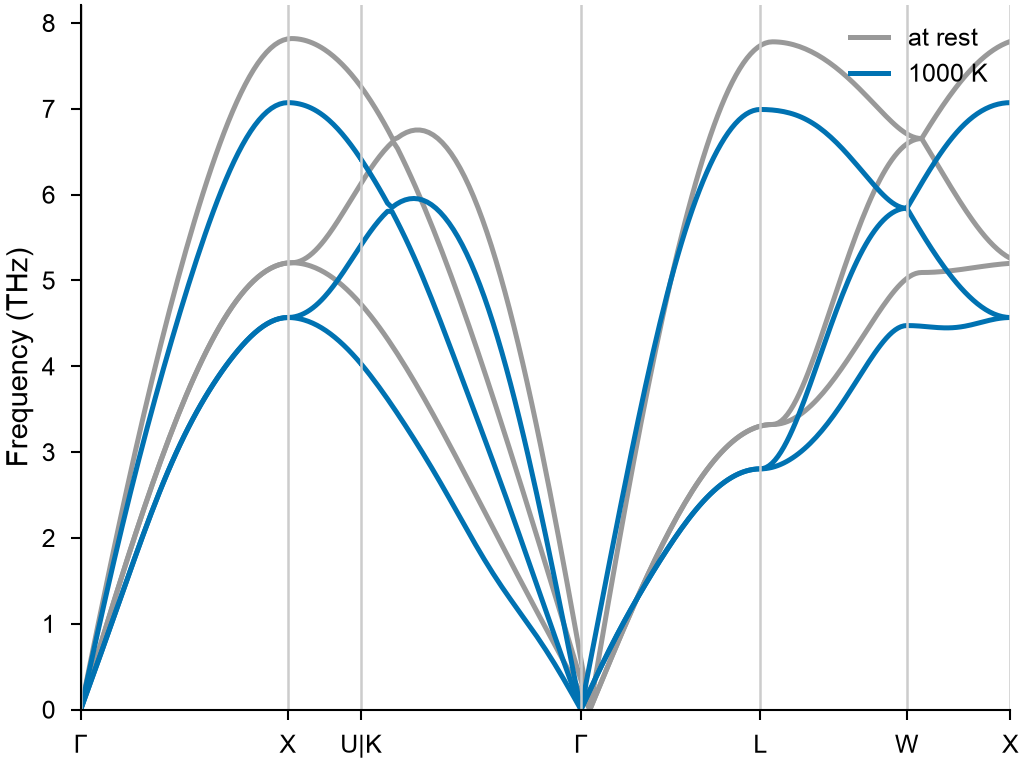
Copper with the EAM potential of Mishin et al.: the bands at rest, and at 1000 K, softer by 10 to 15 %, as the crystal has expanded and the atoms feel their neighbors further from where they rest.
| Name | Type | Default | Unit | Meaning |
|---|---|---|---|---|
cell |
System |
the cell of the crystal, relaxed, periodic in every direction, with an element column; best its primitive cell |
||
potential |
LAMMPS |
the interaction | ||
temperature |
float64 | K | the temperature | |
supercell |
int32, (3,) int32 or (3, 3) int32 | as in phonons; by default the supercell nearest a cube that is at least twice the cutoff of the potential thick in every direction |
||
pressure |
float64 or None |
0 | GPa | the pressure at which the box takes its mean size first, with the symmetry of the crystal; None to keep the box of cell |
timestep |
float64 | 0.001 | ps | the time step |
equilibration |
float64 | 10 | ps | the time of each equilibration |
production |
float64 | 100 | ps | the time over which the frames are taken |
frames |
int32 | 200 | the number of frames | |
symmetry |
bool or None |
None |
average the force constants over the symmetry operations of the crystal, found by spglib: True, False, or by default whenever spglib is installed |
|
seed |
int32 | 1 | the seed of the random numbers | |
progress |
callable | None |
called as progress(done, total) with the steps run |
|
cancel |
CancelToken |
None |
stops the calculation, which raises Cancelled |
The cell of the result has the mean box at the temperature. The vibrations are
those of classical atoms, as in molecular dynamics, so well below the Debye
temperature harmonic phonons with the
quasi-harmonic approximation are better.
From frames of any dynamics
phonons_from_frames(cell, frames, *, supercell, symmetry=None) takes the atoms of
the supercell with a forces column, in the order phonons makes them: cells of
atoms in the order of cell, the third vector varying fastest. Frames are best far
enough apart in time to differ.
from mdapy.lattice_dynamics import phonons_from_frames

result = phonons_from_frames(cell, frames, supercell=4)
| Name | Type | Default | Meaning |
|---|---|---|---|
cell |
System |
the cell of the crystal with the atoms at their places at the volume of the frames, periodic in every direction, with an element or a mass column |
|
frames |
iterable of System |
the atoms of the supercell, with forces |
|
supercell |
int32, (3,) int32 or (3, 3) int32 | repeats of the cell | |
symmetry |
bool or None |
None |
as above |
Definition
With \(u_i\) the displacement of atom \(i\) from its place and \(f_i\) the force on it, the force constants \(\Phi\) minimize
the same in every cell of the supercell, so that the crystal can translate freely
(Hellman et al. (2011)). They are then made
symmetric under the exchange of the atoms of a pair and, with symmetry, averaged
over the symmetry operations of the crystal.
Errors
thermal_phonons raises InvalidParameter for a box that is not periodic in every
direction, a temperature or a time that is not positive, a potential that is not a
LAMMPS calculator, too few frames for the force constants, or if LAMMPS fails;
MissingProperty for a system without an element column; Cancelled when
cancelled. phonons_from_frames raises InvalidParameter for a frame with another
number of atoms, too few frames or an invalid supercell, and MissingProperty for a
frame without forces.
Please cite
Hellman et al. (2011) for the method.