Defect energies
vacancy_formation_energy, surface_energy and stacking_fault_energy
relax the configurations of the structure builder
with a calculator and give the energies of their defects.
import numpy as np
from mdapy.build import build_crystal
from mdapy.calculators import EAM
from mdapy.simulation import (
    stacking_fault_energy,
    surface_energy,
    vacancy_formation_energy,
)

copper = EAM.zhou(["Cu"])
a = 3.615
crystal = build_crystal("fcc", a, elements="Cu", repeat=(4, 4, 4))
vacancy_formation_energy(crystal, copper).energy  # eV, about 1.28

layers = build_crystal(
    "fcc",
    a,
    elements="Cu",
    orientation=[(1, 1, -2), (-1, 1, 0), (1, 1, 1)],
    repeat=(2, 3, 4),
)
surface_energy(layers, copper).energy  # J/m², the (111) surface

# the generalized stacking fault energy along [11-2] on (111)
curve = stacking_fault_energy(layers, copper, [a * np.sqrt(6) / 2, 0, 0], points=13)
curve.energy[4]  # J/m², the intrinsic stacking fault at 1/6 [11-2]
The curve, with plot.stacking_fault:
from mdapy.visualization import plot

with plot.style():
    fig, ax = plot.figure("single")
    plot.stacking_fault(curve, ax=ax)
    plot.save(fig, "images/stacking-fault-energy", formats=("png",))
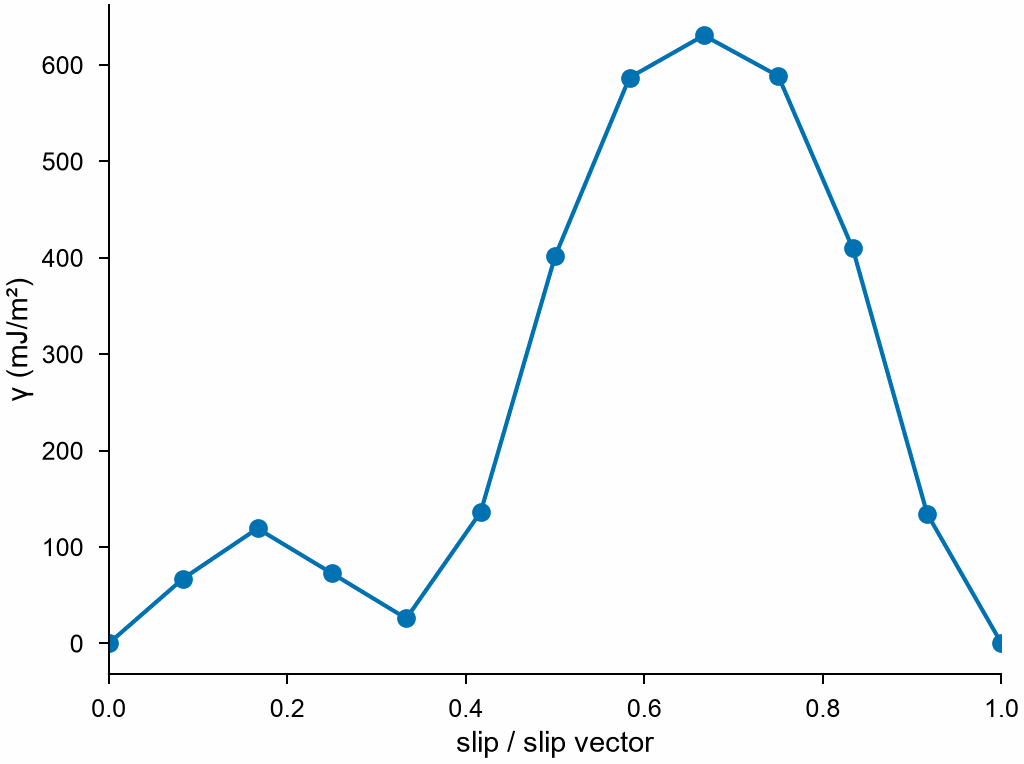
The energy of copper slipped along [11-2] on (111), over a full lattice vector: the unstable stacking fault at the first maximum, the intrinsic stacking fault at the local minimum a third of the way along, and at two thirds the highest energy, with the atoms of the two halves on top of each other.
Parameters
| Function | Parameters |
|---|---|
vacancy_formation_energy(crystal, calculator, *, atom=0, cell=None, max_force=1e-4, max_steps=10000) |
the perfect crystal, the atom removed, and how the box relaxes (cell of minimize) |
surface_energy(crystal, calculator, *, axis=2, vacuum=15.0, max_force=1e-4, max_steps=10000) |
the periodic crystal, the box vector axis across the slab, and the vacuum in Å added along it |
stacking_fault_energy(crystal, calculator, direction, *, points=21, height=None, axis=2, relax=True, max_force=1e-4, max_steps=10000) |
the crystal with the plane of the fault normal to the Cartesian axis, the slip vector direction in Å, the number of points from 0 to the whole vector, the fractional height of the fault (default 0.5) and whether the atoms relax along the normal |
max_force (eV/Å) and max_steps are those of each
minimization, with FIRE; a minimization that does not
converge raises an error. The crystal must be large enough that a defect
does not meet its periodic images, and the slab thick enough that its
surfaces do not feel each other. With a crystal periodic along the normal of
the fault, the box moves with the upper half, so that the box holds a single
fault (see slip); without it, the fault lies
between two free surfaces, whose energy cancels in the difference.
Results
| Result | Attributes |
|---|---|
VacancyResult |
energy (eV), perfect and defect energies (eV), the relaxed system |
SurfaceResult |
energy (J/m²), bulk and slab energies (eV), the area of one surface (Ų), the relaxed system |
StackingFaultResult |
fraction of the slip vector, displacement (P, 3) in Å, energy (P,) in J/m² relative to no slip, the area of the fault (Ų) |
Errors
They raise InvalidParameter for a crystal of fewer than two atoms, a
crystal that is not periodic for a surface, a vacuum that is not positive,
fewer than two points, a plane of fault not normal to the axis, an unknown
axis, and a minimization that does not converge.
Definition
With \(E_N\) the energy of the perfect crystal of \(N\) atoms and \(E_{N-1}\) that of the crystal with a vacancy, both relaxed,
With \(E_\text{slab}\) the energy of the crystal opened by the vacuum, relaxed, and \(A\) the area of each of its two surfaces,
The generalized stacking fault energy at the slip \(f\,\mathbf d\) is
each configuration relaxed along the normal of the fault only: a movable
column keeps the atoms still along the plane, as LAMMPS fix setforce 0 0
NULL does. In fcc along \([11\bar2]\) the curve has the unstable stacking
fault energy as its first maximum and the intrinsic stacking fault energy
at \(\tfrac16[11\bar2]\).