Gamma surfaces
The stacking fault energy follows one slip direction. The gamma surface gives the energy of every slip vector in the plane, as a map: its valleys show how a dislocation dissociates and which paths slip takes. This page computes it for copper on {111} and for tungsten on {110}, with the EAM potentials of Zhou et al.
The crystals
Each crystal has z normal to the plane and x and y along two directions of it, so the box repeats the map along x and y. Free surfaces along z let the fault expand along its normal: in a box periodic along z whose height stays fixed, the crystal is squeezed by the fault, and the energy falls slowly with the number of layers.
import numpy as np
import mdapy as mp
from mdapy.build import build_crystal
from mdapy.calculators import EAM
from mdapy.simulation import stacking_fault_energy


def slab(structure, a, element, orientation):
    crystal = build_crystal(
        structure, a, elements=element, orientation=orientation, repeat=(1, 1, 4)
    )
    return crystal.with_box(mp.Box(crystal.box.matrix, pbc=(True, True, False)))


copper = slab("fcc", 3.615, "Cu", [(1, 1, -2), (-1, 1, 0), (1, 1, 1)])
tungsten = slab("bcc", 3.165, "W", [(1, -1, 0), (0, 0, 1), (1, 1, 0)])
The map
With two points, stacking_fault_energy gives the energy at the end of one slip vector:
the upper half of the crystal moved by it, and the atoms relaxed along the normal. A loop
over the vectors gives the map:
def gamma_surface(crystal, potential, nx, ny):
    lx, ly = crystal.box.lengths[:2]
    x, y = np.linspace(0.0, lx, nx), np.linspace(0.0, ly, ny)
    energy = np.array(
        [
            [
                stacking_fault_energy(crystal, potential, [a, b, 0.0], points=2).energy[
                    1
                ]
                for a in x
            ]
            for b in y
        ]
    )
    return x, y, energy


fcc = gamma_surface(copper, EAM.zhou(["Cu"]), 37, 19)
bcc = gamma_surface(tungsten, EAM.zhou(["W"]), 25, 17)
What it shows
from mdapy.visualization import plot

lx, ly = copper.box.lengths[:2]
wx, wy = tungsten.box.lengths[:2]
with plot.style():
    fig, axes = plot.figure("double", ncols=2)
    for ax, (x, y, energy), title in zip(axes, (fcc, bcc), ("Cu {111}", "W {110}")):
        shown = ax.imshow(
            energy,
            origin="lower",
            extent=(0.0, x[-1], 0.0, y[-1]),
            cmap="viridis",
            interpolation="bicubic",
            aspect="auto",
        )
        ax.set_title(title)
        fig.colorbar(shown, ax=ax, label="γ (J/m²)")
    axes[0].set(xlabel="along [11-2] (Å)", ylabel="along [-110] (Å)")
    axes[1].set(xlabel="along [1-10] (Å)", ylabel="along [001] (Å)")
    # the two places of the intrinsic stacking fault in the cell
    axes[0].plot(
        [lx / 3, 5 * lx / 6], [0.0, ly / 2], "o", color="white", ms=4, clip_on=False
    )
    axes[0].annotate(
        "ISF", (5 * lx / 6, ly / 2), (5 * lx / 6 - 0.15, ly / 2 + 0.2), color="white"
    )
    # the Burgers vector a/2 <111>, across the middle of the cell
    axes[1].plot([0.0, wx / 2], [0.0, wy / 2], "--", color="white", lw=1)
    axes[1].annotate("b", (wx / 2, wy / 2), (wx / 2 + 0.1, wy / 2), color="white")
    plot.save(fig, "images/gamma-surface", formats=("png",))

fcc[2][0, 12], fcc[2][0, 6]  # 0.0225 and 0.111 J/m²: the fault, and the way to it
bcc[2][4, 6], bcc[2].max()  # 1.73 at the middle of b, and 3.57 J/m² atoms on atoms
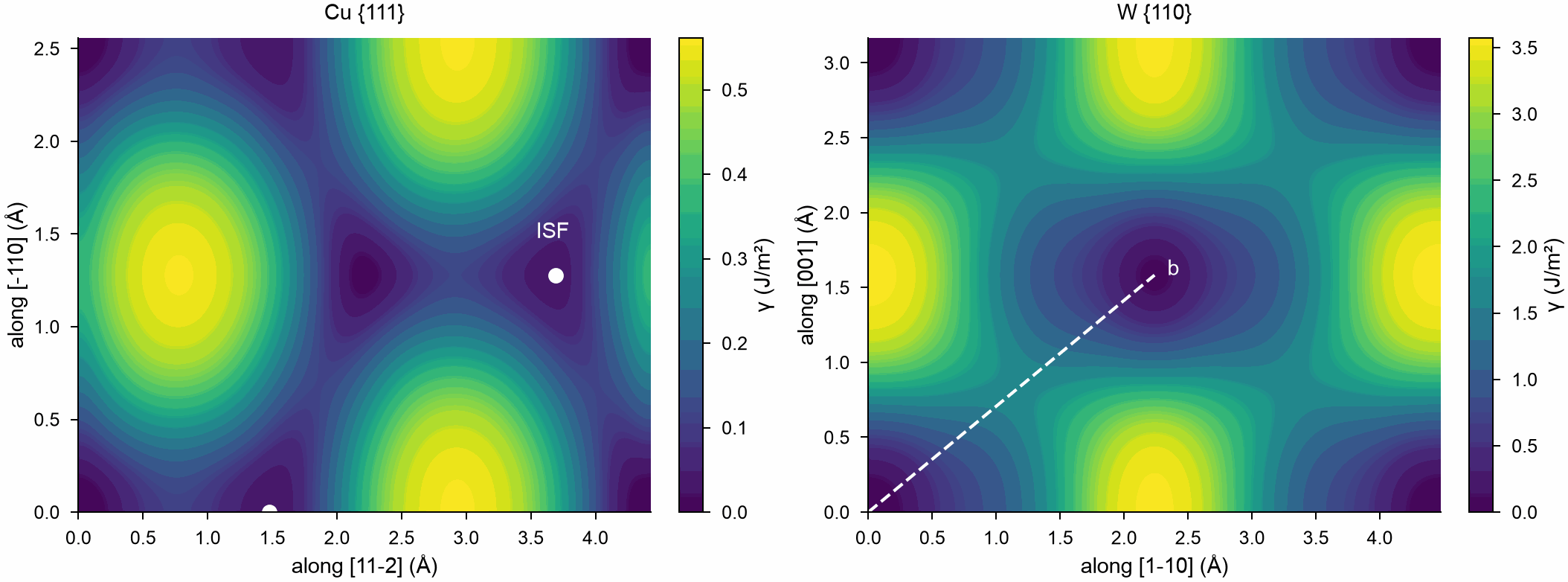
Left: copper on {111}. The deep valleys are the lattice vectors, and between them lie the shallow minima of the intrinsic stacking fault at a/6 <11-2>, so a dislocation splits into two partials. Right: tungsten on {110}. Along the Burgers vector a/2 <111> the energy rises to one maximum at its middle, with no minimum on the way: no stable stacking fault, and no splitting.
Moving by a lattice vector brings the crystal back onto itself, so the energy is zero there, and the map has the symmetry of the plane: on {111} the two sites of the fault have the same energy, and each map is its own mirror image.