Ackland–Jones analysis
AcklandJonesAnalysis gives each atom the crystal structure of its
neighborhood, fcc, hcp, bcc, icosahedral or other, from the distribution of
the angles between the bonds to its neighbors.
import mdapy as mp
from mdapy.build import build_crystal
from mdapy.identify import AcklandJonesAnalysis

# bcc iron of 5 x 5 x 5 cubic cells
system = build_crystal("bcc", 2.866, elements="Fe", repeat=(5, 5, 5))

result = AcklandJonesAnalysis().compute(system)
result.counts()  # {'other': 0, 'fcc': 0, 'hcp': 0, 'bcc': 250, 'ico': 0}
In a relaxed polycrystal of iron:
from mdapy.build import build_crystal, build_polycrystal
from mdapy.calculators import EAM
from mdapy.simulation import minimize
from mdapy.visualization import render

grains = build_polycrystal(
    build_crystal("bcc", 2.866, elements="Fe"),
    mp.Box(50.0),
    5,
    seed=4,
    min_distance=1.6,
)
grains = minimize(grains, EAM.zhou(["Fe"]), max_force=0.05, max_steps=300).system
structures = AcklandJonesAnalysis().compute(grains)
render(
    grains,
    "images/ackland-jones.png",
    color=structures,
    width=800,
    height=600,
    legend=True,
)
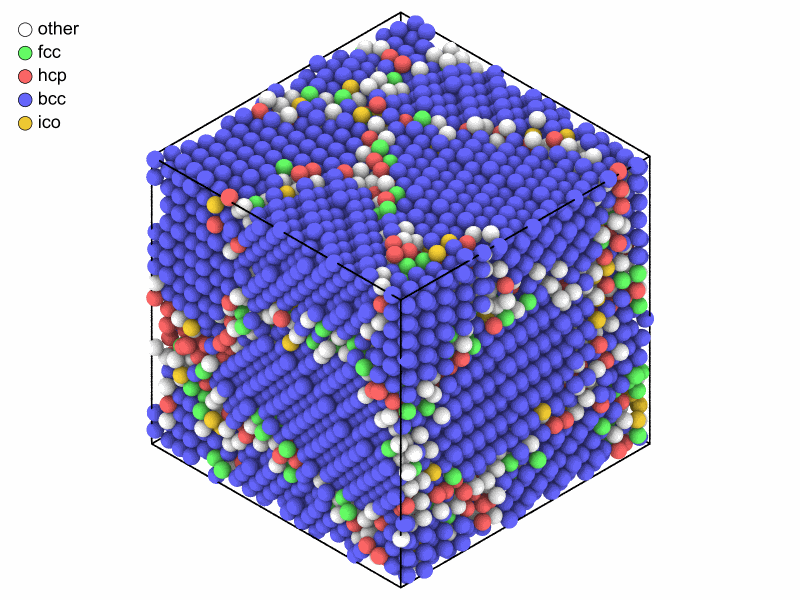
Five grains of bcc iron (blue) after a short relaxation. The atoms of the boundaries take any type, mostly other (white) but also fcc (green), hcp (red) and ico (yellow): the analysis looks at the angles between bonds and knows nothing of grains.
Parameters
AcklandJonesAnalysis() has no parameters.
compute(system, *, neighbors=None, progress=None, cancel=None) takes the
arguments of every analysis. A given neighbor list
must hold the 14 nearest neighbors of every atom.
Results
A StructureResult with the types of
common neighbor analysis: other, fcc, hcp, bcc and
ico.
Errors
compute raises InvalidParameter for a neighbor list that does not hold
the 14 nearest neighbors.
Definition
The analysis takes the 14 nearest neighbors of an atom. With \(r_0^2\) the mean squared distance of the 6 nearest, \(n_0\) and \(n_1\) count the neighbors closer than \(\sqrt{1.45}\, r_0\) and \(\sqrt{1.55}\, r_0\). The cosines of the angles between every two of the \(n_0\) bonds fall into eight bins with the bounds −1, −0.945, −0.915, −0.755, −0.195, 0.195, 0.245, 0.795 and 1, which count \(\chi_0, \dots, \chi_7\). The deviations from the ideal structures are
with \(\delta_\mathrm{bcc} = 0\) when \(\chi_0 = 7\), \(\delta_\mathrm{fcc} = 0\) when \(\chi_0 = 6\), \(\delta_\mathrm{hcp} = 0\) when \(\chi_0 \le 3\), and no bcc when \(\chi_5 + \chi_6 = \chi_4\). The atom is then, checked from the top down:
| Condition | Type |
|---|---|
| \(\chi_7 > 0\) | other |
| \(\chi_4 < 3\) | ico when \(11 \le n_1 \le 13\), else other |
| \(\delta_\mathrm{bcc} \le \delta_\mathrm{cp}\) | bcc when \(n_1 \ge 11\), else other |
| \(11 \le n_1 \le 12\) | fcc when \(\delta_\mathrm{fcc} < \delta_\mathrm{hcp}\), else hcp |
| otherwise | other |
These are the rules of the original implementation, which LAMMPS runs with
legacy yes. An atom with fewer than 6 neighbors, as in a system without
periodic directions of fewer than 7 atoms, is other.
See also
- LAMMPS
compute ackland/atom.
Please cite