Wigner–Seitz analysis
WignerSeitz finds vacancies and interstitials: each atom belongs to the
Wigner–Seitz cell of its nearest site of a reference lattice, and the
occupancy of the sites shows the defects.
import numpy as np
import mdapy as mp
from mdapy.analysis import WignerSeitz
from mdapy.build import build_crystal

# perfect fcc copper of 4 x 4 x 4 cubic cells as the reference
a = 3.615
reference = build_crystal("fcc", a, elements="Cu", repeat=(4, 4, 4))

# the crystal after a Frenkel pair: atom 0 moved to an octahedral site
moved = reference["positions"].copy()
moved[0] = [0.5 * a, 0.5 * a, 0.5 * a]
current = reference.with_columns(positions=moved)

analysis = WignerSeitz(reference)  # the reference sites are prepared once
result = analysis.compute(current)
result.vacancy_count, result.interstitial_count  # 1, 1
result.vacancies  # the empty site, 0
current = current.with_columns(result)  # columns site and occupancy
Twelve Frenkel pairs in a larger crystal, the vacancies and the doubly occupied sites drawn alone:
from mdapy.build import build_crystal
from mdapy.visualization import render

reference = build_crystal("fcc", a, elements="Cu", repeat=(8, 8, 8))
rng = np.random.default_rng(5)
moved = reference["positions"].copy()
chosen = rng.choice(len(reference), 12, replace=False)
moved[chosen] = (moved[chosen] + a * (rng.integers(0, 6, (12, 3)) + 0.5)) % (8 * a)
current = reference.with_columns(positions=moved)

result = WignerSeitz(reference).compute(current)
occupancy = current.with_columns(result)["occupancy"]
vacancies = reference["positions"][result.vacancies]
crowded = current["positions"][occupancy > 1]
defects = mp.System(np.vstack([vacancies, crowded]), reference.box)
colors = [[0.23, 0.44, 0.85]] * len(vacancies) + [[0.88, 0.29, 0.2]] * len(crowded)
render(
    defects,
    "images/wigner-seitz.png",
    color=np.array(colors),
    radius=1.2,
    width=800,
    height=600,
    legend={"vacancy": (0.23, 0.44, 0.85), "interstitial": (0.88, 0.29, 0.2)},
)
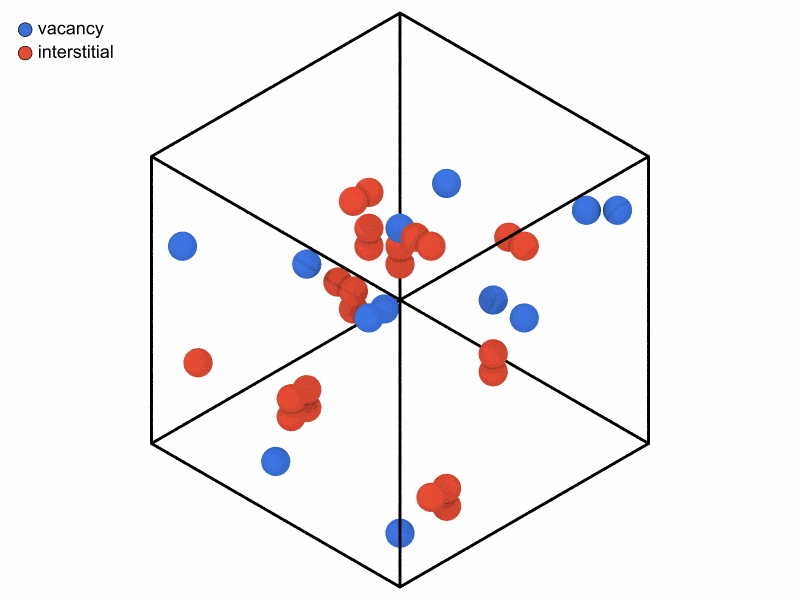
Blue: the 12 empty sites. Red: the 24 atoms of the 12 sites that hold two, each moved atom with the atom of the site it landed in.
Parameters
| Name | Type | Default | Unit | Meaning |
|---|---|---|---|---|
reference |
System |
the reference sites, usually the perfect crystal | ||
affine |
bool | False |
map the atoms into the reference box by their fractional coordinates first, which removes a homogeneous deformation of the box |
compute(system, *, progress=None, cancel=None) takes the configuration to
analyse, in a box with the periodicity of the reference; its atoms need not
be those of the reference, nor as many.
Results
A WignerSeitzResult:
| Attribute | Type | Meaning |
|---|---|---|
site |
(N,) index_dtype |
the reference site of each atom; its column site |
occupancy |
(sites,) int64 | the number of atoms on each reference site; the column occupancy holds that of each atom's site |
vacancies |
(V,) int64 | the sites without atoms |
interstitials |
(I,) int64 | the sites with more than one atom |
vacancy_count |
int64 | the number of sites without atoms |
interstitial_count |
int64 | the number of atoms beyond one on each site |
The number of atoms less the number of sites is interstitial_count less
vacancy_count.
Errors
The constructor raises InvalidParameter for a reference without atoms;
compute raises it for a system whose periodic directions differ from the
reference's.
Definition
Each atom belongs to the reference site nearest to it, periodic images
included; of equally near sites, to the one of lower index. With affine,
the fractional coordinates of the atom in its own box are first taken as
fractional coordinates in the reference box. Without it, a box stretched by
10 % puts atoms near its far side on wrong sites.
See also
- OVITO Wigner–Seitz defect analysis.
Please cite