Bond length distribution
BondLengthDistribution counts the lengths of the bonds of a topology, in
total and for each pair of elements, as OVITO's bond length distribution.
The bonds come from a file, such as a LAMMPS data file, or from
create_bonds.
import numpy as np
from mdapy import transform
from mdapy.analysis import BondLengthDistribution
from mdapy.build import build_crystal

# a silicon-germanium alloy on the diamond lattice, its atoms shaken by 0.05 Å
alloy = build_crystal("diamond", 5.53, elements="Si", repeat=(4, 4, 4))
rng = np.random.default_rng(0)
alloy = alloy.with_columns(
    element=rng.choice(["Si", "Ge"], size=len(alloy)),
    positions=alloy["positions"] + rng.normal(0, 0.05, (len(alloy), 3)),
)
bonded = transform.create_bonds(alloy, 2.8)

lengths = BondLengthDistribution(bins=60, cutoff=2.8).compute(bonded)
lengths.length, lengths.counts  # bin centers in Å, bonds in each bin
lengths.lengths  # the length of each bond
lengths.pair("Si", "Ge")  # the Si-Ge bonds
The total distribution and its three pairs:
from mdapy.visualization import plot

with plot.style():
    fig, ax = plot.figure("single")
    ax.plot(lengths.length, lengths.counts, color="black", label="all")
    for a, b in [("Si", "Si"), ("Si", "Ge"), ("Ge", "Ge")]:
        ax.plot(lengths.length, lengths.pair(a, b), label=f"{a}–{b}")
    ax.set_xlim(2.0, 2.8)
    ax.set_xlabel("Bond length (Å)")
    ax.set_ylabel("Bonds")
    ax.legend(frameon=False)
    plot.save(fig, "images/bond-lengths", formats=("png",))
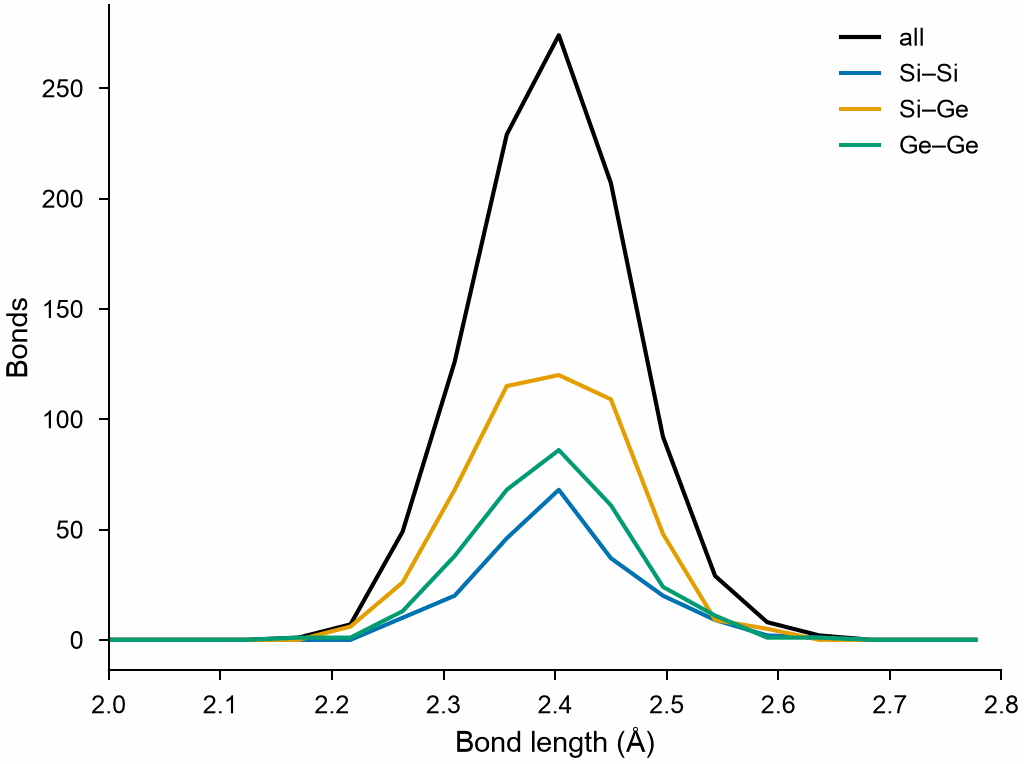
The bonds of 2.39 Å on the common lattice, spread by the shaking; the random alloy has twice as many Si–Ge bonds as Si–Si or Ge–Ge bonds.
Parameters
BondLengthDistribution(bins=100, cutoff=None)
| Name | Type | Default | Unit | Meaning |
|---|---|---|---|---|
bins |
int32 | 100 | number of bins of equal width from 0 to the cutoff | |
cutoff |
float64 | None |
Å | the upper end of the bins; longer bonds are not counted. By default the longest bond |
compute(system) takes a system with bonds in its topology. Each bond is
measured to the nearest periodic image of its second atom. Partial counts
need an element column.
Results
A BondLengthResult:
| Attribute or method | Type | Meaning |
|---|---|---|
length |
(bins,) float64 | bin centers in Å |
edges |
(bins + 1,) float64 | bin edges in Å |
counts |
(bins,) int64 | number of bonds in each bin |
density |
(bins,) float64 | the counts normalized so that their integral over Å is 1 |
lengths |
(bonds,) float64 | the length of each bond, in the order of the topology |
partial |
dict of (str, str) to (B,) int64 | counts for each pair of elements (a, b), a not after b by atomic number; they add up to counts |
pair(a, b) |
(bins,) int64 | the counts of the pair, a and b in either order |
Errors
The constructor raises InvalidParameter for fewer than one bin or a
cutoff that is not positive; compute raises MissingProperty for a
system without bonds; pair raises InvalidParameter for a pair without
counts.
Definition
A bond between atoms \(i\) and \(j\) is \(\lvert \mathbf{r}_j - \mathbf{r}_i \rvert\) long, the difference taken to the nearest periodic image, and counted in the bin \(\lfloor l / \Delta l \rfloor\), \(\Delta l\) the cutoff over the number of bins.