Warren–Cowley parameters
WarrenCowley measures the chemical short-range order of an alloy: whether
the neighbors of each element are richer or poorer in another element than
the alloy as a whole, among the nearest neighbors or shell by shell.
import numpy as np
from mdapy.analysis import WarrenCowley
from mdapy.build import build_crystal

# a CsCl-ordered CuZn crystal of 4 x 4 x 4 cubic cells
system = build_crystal("cscl", 2.95, elements=["Cu", "Zn"], repeat=(4, 4, 4))

order = WarrenCowley(num_neighbors=8).compute(system)
order["Cu", "Zn"]  # -1: every neighbor of Cu is Zn
order.alpha  # rows and columns by atomic number

# shells: the 8 nearest, then the 6 next; or between cutoffs
shells = WarrenCowley(num_neighbors=(8, 6)).compute(system)
shells["Cu", "Zn"]  # [-1, 1]: Zn around Cu, then Cu
shells["Cu", "Zn", 1]  # 1.0, the second shell only
shells.alpha.shape  # (2, 2, 2): shell, row, column
same = WarrenCowley(cutoff=(2.7, 3.3)).compute(system)
The ordered crystal against the same atoms with their elements shuffled, over the first four shells of the bcc lattice:
from mdapy.visualization import plot, render

render(
    system, "images/warren-cowley-b2.png", radius=0.8, view=[1, 0.5, 0.35], legend=True
)

rng = np.random.default_rng(1)
shuffled = system.with_columns(element=rng.permutation(system["element"]))
shells = (8, 6, 12, 24)
ordered = WarrenCowley(num_neighbors=shells).compute(system)
random = WarrenCowley(num_neighbors=shells).compute(shuffled)

with plot.style():
    fig, ax = plot.figure("single")
    k = np.arange(1, 5)
    ax.plot(k, ordered["Cu", "Zn"], "o-", label="CsCl order")
    ax.plot(k, random["Cu", "Zn"], "s-", label="shuffled")
    ax.axhline(0, color="0.5", linewidth=0.8)
    ax.set_xticks(k)
    ax.set_xlabel("Shell")
    ax.set_ylabel("Warren–Cowley α of Zn around Cu")
    ax.legend()
    plot.save(fig, "images/warren-cowley", formats=("png",))
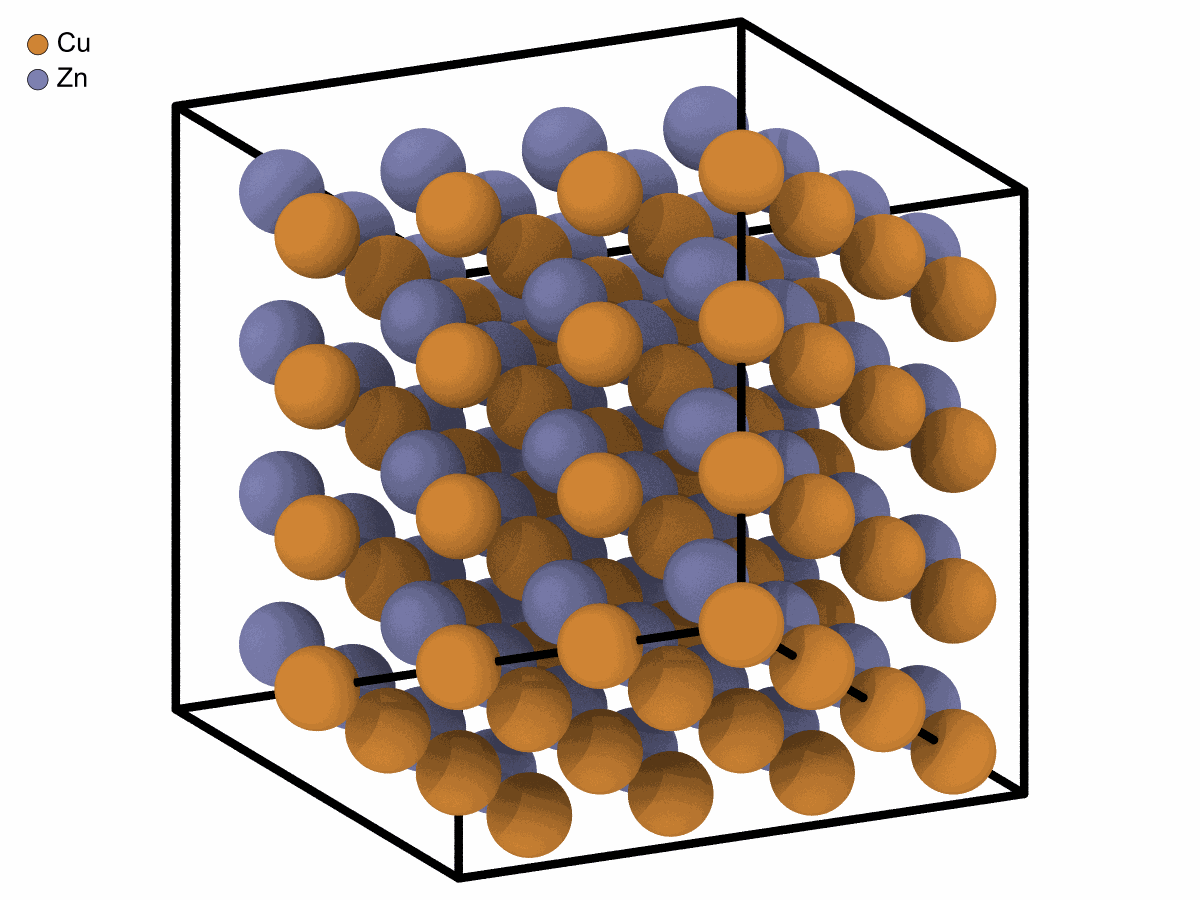
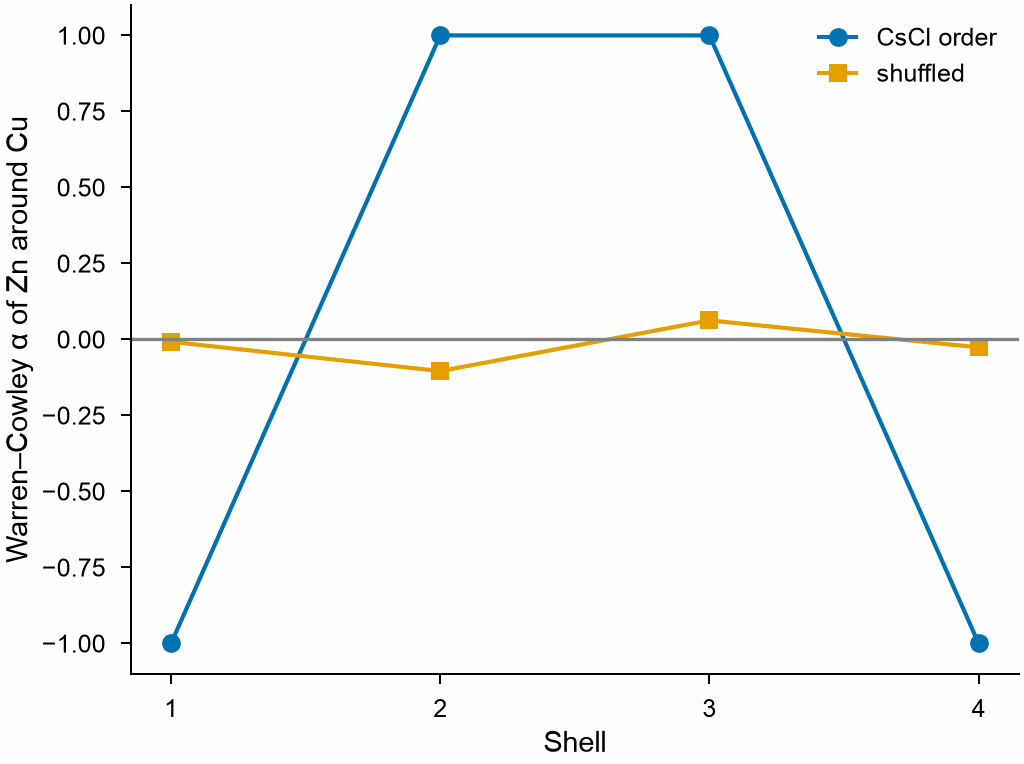
Left: CuZn in the CsCl order, Cu orange and Zn blue. Right: the order of Zn around Cu shell by shell, −1 for a shell of Zn only and 1 for one of Cu only; with the elements shuffled it stays near 0.
Parameters
| Name | Type | Default | Unit | Meaning |
|---|---|---|---|---|
cutoff |
float64 or sequence of float64 | None |
Å | neighbors are closer than it; increasing cutoffs make shells, each from the cutoff before it to its own |
num_neighbors |
int32 or sequence of int32 | None |
instead of cutoff, the number of nearest neighbors; a sequence makes shells of so many nearest neighbors one after the other, such as (12, 6, 24) in fcc |
compute(system, *, neighbors=None, progress=None, cancel=None) takes the
arguments of every analysis; the system needs an
element column. A given neighbor list must reach the cutoff or hold the
num_neighbors nearest neighbors of every atom.
Results
A WarrenCowleyResult:
| Attribute or method | Type | Meaning |
|---|---|---|
elements |
tuple of str | the elements, by atomic number |
alpha |
(n, n) float64 | \(\alpha_{ab}\), row \(a\) and column \(b\); NaN for an element whose atoms have no neighbors; (shells, n, n) for shells |
result[a, b] |
float64 | one parameter; an array over the shells for shells |
result[a, b, shell] |
float64 | the parameter of one shell |
Errors
The constructor raises InvalidParameter without exactly one of cutoff
and num_neighbors, for one that is not positive, cutoffs that do not
increase, or numbers of neighbors that are not integers; compute raises it
for a neighbor list that does not fit, and MissingProperty without an
element column; result[a, b] raises InvalidParameter for an element
not in the system, and result[a, b, shell] for parameters of one shell.
Definition
where \(p(b \mid a)\) is the fraction of atoms of element \(b\) among the neighbors of all atoms of element \(a\), and \(x_b\) the fraction of \(b\) in the system; in a shell, the neighbors are those of the shell. It is 0 for a random alloy, negative for pairs that attract each other and positive for pairs that avoid each other; in the CsCl structure with 8 neighbors, \(\alpha_{ab} = -1\) between unlike and 1 between like elements.
Please cite