Special quasirandom structures
sqs_alloy places elements in given fractions on the sites of a perfect
lattice so that the pairs of the nearest shells of neighbors are those of a
random alloy, the best that a small cell can do for a random alloy.
from mdapy.build import build_crystal, sqs_alloy

sites = build_crystal("fcc", 3.6, repeat=(4, 4, 4))
cuni = sqs_alloy(sites, {"Cu": 1, "Ni": 1}, shells=3, seed=1)
cantor = sqs_alloy(sites, {"Co": 1, "Cr": 1, "Fe": 1, "Mn": 1, "Ni": 1}, seed=1)
import numpy as np
from mdapy.visualization import render, write_png

left = render(cuni, width=600, height=600, legend=True)
right = render(cantor, width=600, height=600, legend=True)
write_png("images/sqs.png", np.hstack([left, right]))
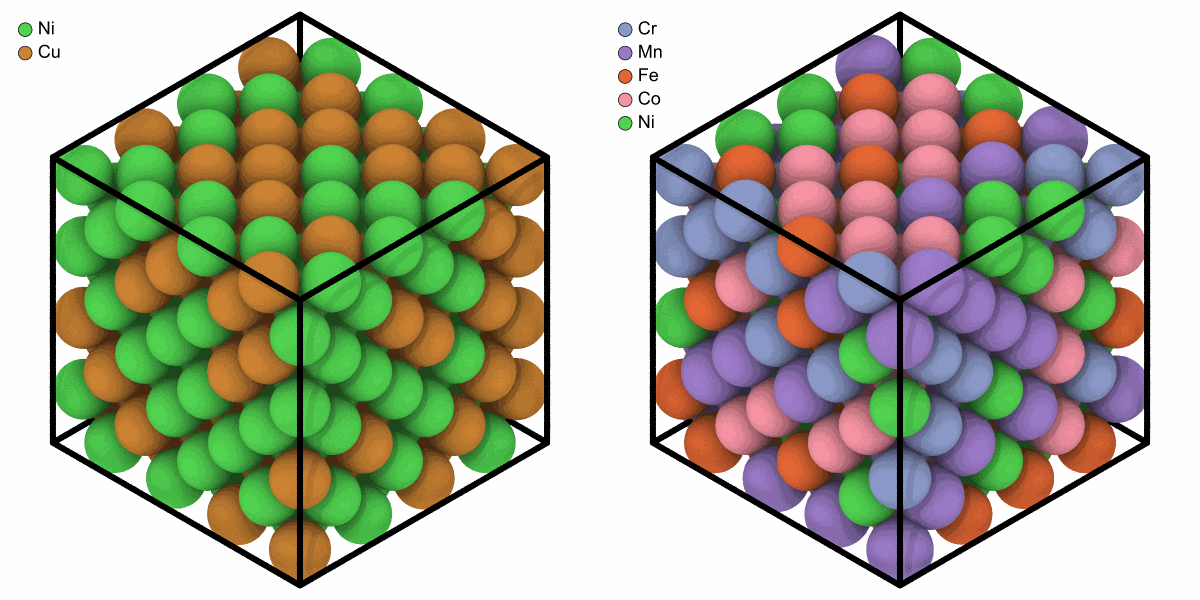
Left: equiatomic CuNi of 256 atoms whose pair correlations in the first three shells come as close as the cell allows to those of the random alloy. Right: the Cantor alloy on the same sites.
Parameters
sqs_alloy(system, fractions, *, shells=3, weights=None, steps=100000, temperature=1.0, seed=None, progress=None, cancel=None)
| Name | Type | Default | Meaning |
|---|---|---|---|
system |
System |
the sites, a perfect lattice such as from build_crystal |
|
fractions |
dict of str to float64 | the fraction of each element; the counts are those of random_alloy |
|
shells |
int32 | 3 | the number of shells of neighbors made random, 1 to 10 |
weights |
sequence of float64 | all 1 | the weight of each shell in the deviation |
steps |
int64 | 100000 | the number of swaps tried |
temperature |
float64 | 1 | the starting temperature of the annealing, in units of the typical change of a swap; 0 keeps only improvements |
seed |
int64 or numpy.random.Generator |
None |
the starting alloy and the swaps |
progress, cancel |
None |
as for every analysis |
The shells are the distinct distances between sites, nearest first, so the lattice must be perfect.
Results
The system with a new element column, the best arrangement found.
Errors
sqs_alloy raises InvalidParameter for a number of shells out of range,
weights that are not one per shell or negative, a negative number of steps
or temperature, and the errors of random_alloy; Cancelled when
cancelled.
Definition
With \(N^{(s)}_{ab}\) the ordered pairs of shell \(s\) from an atom of element \(a\) to one of \(b\), \(P_s\) all pairs of shell \(s\) and \(x_a\) the fractions, the deviation from a random alloy
is zero when the Warren–Cowley parameters \(\alpha^{(s)}_{ab} = 1 - N^{(s)}_{ab} / (x_a x_b P_s)\) of every shell vanish. Starting from a random alloy, pairs of atoms of different elements swap places when the swap lowers \(D\), or with the probability \(e^{-\Delta D / T}\) otherwise, while \(T\) falls linearly to zero; the arrangement with the lowest \(D\) is returned.
Please cite