Coordination number
CoordinationNumber counts the neighbors of each atom, in total and by
element, within one cutoff or a cutoff for each pair of elements.
import numpy as np
import mdapy as mp
from mdapy.analysis import CoordinationNumber
from mdapy.build import build_crystal

# a CsCl-ordered CuZn crystal of 4 x 4 x 4 cubic cells
system = build_crystal("cscl", 2.95, elements=["Cu", "Zn"], repeat=(4, 4, 4))

result = CoordinationNumber(cutoff=3.2).compute(system)
result.coordination  # 14 for every atom: 8 unlike and 6 like neighbors
result.partial["Zn"]  # neighbors of element Zn
unlike = CoordinationNumber(cutoffs={("Cu", "Zn"): 2.7}).compute(system)
system = system.with_columns(result)  # coordination, coordination_Cu, ...
On a particle, the coordination shows the facets, edges and corners:
from mdapy.build import build_crystal
from mdapy.visualization import render

crystal = build_crystal("fcc", 3.615, elements="Cu", repeat=(12, 12, 12))
center = crystal.box.matrix.diagonal() / 2
inside = np.linalg.norm(crystal["positions"] - center, axis=1) < 18.0
particle = crystal.filter(inside).with_box(mp.Box(12 * 3.615, pbc=False))

coordination = CoordinationNumber(cutoff=3.0).compute(particle).coordination
render(particle, "images/coordination.png", color=coordination, colormap="labels",
       box=False, width=800, height=700, legend="coordination")  # fmt: skip
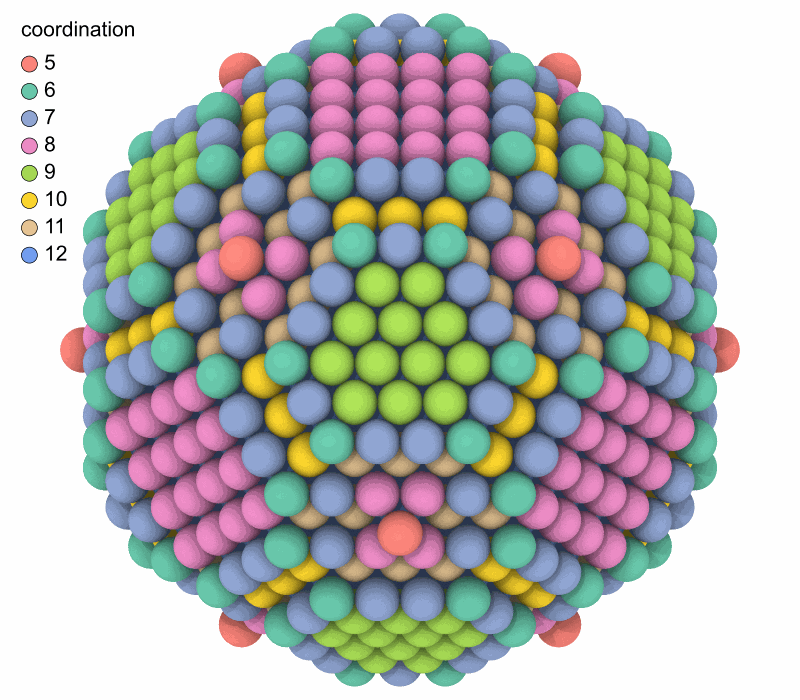
A sphere of 18 Å radius cut from copper, with one color for each number of neighbors. The inside has 12, the (111) facets 9, the (100) facets 8 and the atoms at edges and corners fewer.
Parameters
| Name | Type | Default | Unit | Meaning |
|---|---|---|---|---|
cutoff |
float64 | None |
Å | neighbors are closer than it |
cutoffs |
dict of (str, str) to float64 | None |
Å | instead of cutoff, a cutoff for each pair of elements (a, b), in either order; pairs not given are never neighbors |
compute(system, *, neighbors=None, progress=None, cancel=None) takes the
arguments of every analysis. A given neighbor list
must reach the largest cutoff; without one, the neighbors are counted as
they are found, never stored. Partial counts and cutoffs need an element
column.
Results
A CoordinationResult:
| Attribute | Type | Meaning |
|---|---|---|
coordination |
(N,) int64 | the number of neighbors of each atom; its column coordination |
partial |
dict of str to (N,) int64 | the number of neighbors of each element, by element; columns coordination_<element> |
Errors
The constructor raises InvalidParameter without exactly one of cutoff
and cutoffs, for a cutoff that is not positive or an unknown element;
compute raises it for a neighbor list that does not fit, and
MissingProperty for cutoffs without an element column.
Definition
The neighbors of an atom are the other atoms and periodic images closer than the cutoff of their pair of elements.
See also
- OVITO Coordination analysis.
- LAMMPS
compute coord/atom.