Diamond structure
DiamondStructure tells cubic diamond from hexagonal diamond (lonsdaleite)
in silicon, germanium, carbon and other tetrahedrally bonded crystals, where
common neighbor analysis of the four nearest neighbors says nothing.
import mdapy as mp
from mdapy.build import build_crystal
from mdapy.identify import DiamondStructure

# cubic diamond silicon of 3 x 3 x 3 cells
system = build_crystal("diamond", 5.431, elements="Si", repeat=(3, 3, 3))

result = DiamondStructure().compute(system)
result.counts()["cubic_diamond"]  # 216
In a polycrystal of silicon:
from mdapy.build import build_crystal, build_polycrystal
from mdapy.visualization import render

grains = build_polycrystal(
    build_crystal("diamond", 5.431, elements="Si"), mp.Box(60.0), 6, seed=4
)
structures = DiamondStructure().compute(grains)
render(
    grains, "images/diamond.png", color=structures, width=800, height=600, legend=True
)
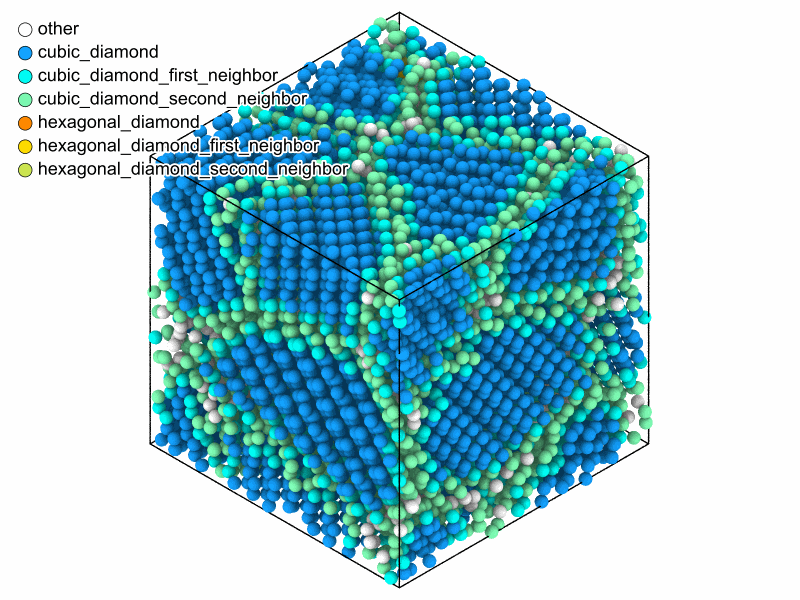
Six grains of silicon as built: cubic diamond in blue, its first and second neighbors in cyan and green. An atom is cubic diamond only if its second neighbors are in order too; the atoms of the boundaries next to the grains are their neighbors, the others white.
Parameters
DiamondStructure() has no parameters.
compute(system, *, neighbors=None, progress=None, cancel=None) takes the
arguments of every analysis. A given neighbor list
must hold the 4 nearest neighbors of every atom.
Results
A StructureResult with the types
| Index | Name | Default color |
|---|---|---|
| 0 | other |
light grey |
| 1 | cubic_diamond |
blue |
| 2 | cubic_diamond_first_neighbor |
cyan |
| 3 | cubic_diamond_second_neighbor |
light green |
| 4 | hexagonal_diamond |
orange |
| 5 | hexagonal_diamond_first_neighbor |
yellow |
| 6 | hexagonal_diamond_second_neighbor |
yellow green |
The types, their numbers and their colors are those of OVITO.
Errors
compute raises InvalidParameter for a neighbor list that does not hold
the 4 nearest neighbors, or a system without periodic directions of fewer
than 5 atoms.
Definition
The first neighbors of an atom are its 4 nearest. Each of them has 4 nearest
neighbors of its own, one of which must be the atom itself; otherwise the
atom is other. The other three of each give the 12 second neighbors of the
atom, which form an fcc shell in cubic diamond and an hcp shell in hexagonal
diamond. Common neighbor analysis of these 12, with the cutoff
\(\frac{1+\sqrt 2}{2}\) times their mean distance, decides: fcc is
cubic_diamond and hcp hexagonal_diamond. Then, atom by atom in the
order of the system, an atom that is still other and among the 4 nearest
of a diamond atom becomes its first neighbor (of cubic or hexagonal
diamond, as that atom); after all first neighbors, an atom that is still
other and among the 4 nearest of a first neighbor becomes a second
neighbor of the same kind. The first atom in order to reach an atom
decides its kind.
Please cite