Periodic copies and images
mdapy.transform.replicate places copies of a system side by side along its
periodic directions, as LAMMPS replicate does; wrap moves atoms into the
box and unwrap puts them at their unwrapped positions.
import mdapy as mp
from mdapy.transform import replicate, unwrap, wrap

box = mp.Box([[4.0, 0, 0], [1.0, 4.0, 0], [0, 0, 4.0]])
system = mp.System([[0.5, 0.5, 0.5], [3.9, 2.0, 2.0]], box, elements="Cu")
system = system.with_columns(id=[1, 2], image=[[0, 0, 0], [-1, 0, 0]])

bigger = replicate(system, (2, 3, 1))  # 12 atoms, ids 1 to 12
bigger.box.matrix  # rows 2a, 3b and c
inside = wrap(system)  # fractional coordinates in [0, 1), image flags updated
moved = unwrap(system)  # the second atom at x = -0.1, image flags zero
The copies are numbered along a first. A cell of graphene, two atoms, replicated 6 × 4 times, each copy colored by its number:
import numpy as np
from mdapy.build import build_crystal
from mdapy.visualization import render

cell = build_crystal("graphene", 2.46, c=10.0, elements="C")
sheet = replicate(cell, (6, 4, 1))
copy = np.arange(len(sheet)) // len(cell)  # the copy of each atom
render(
    sheet,
    "images/replicate.png",
    color=copy,
    colormap="labels",
    representation="ball_and_stick",
    view="top",
)
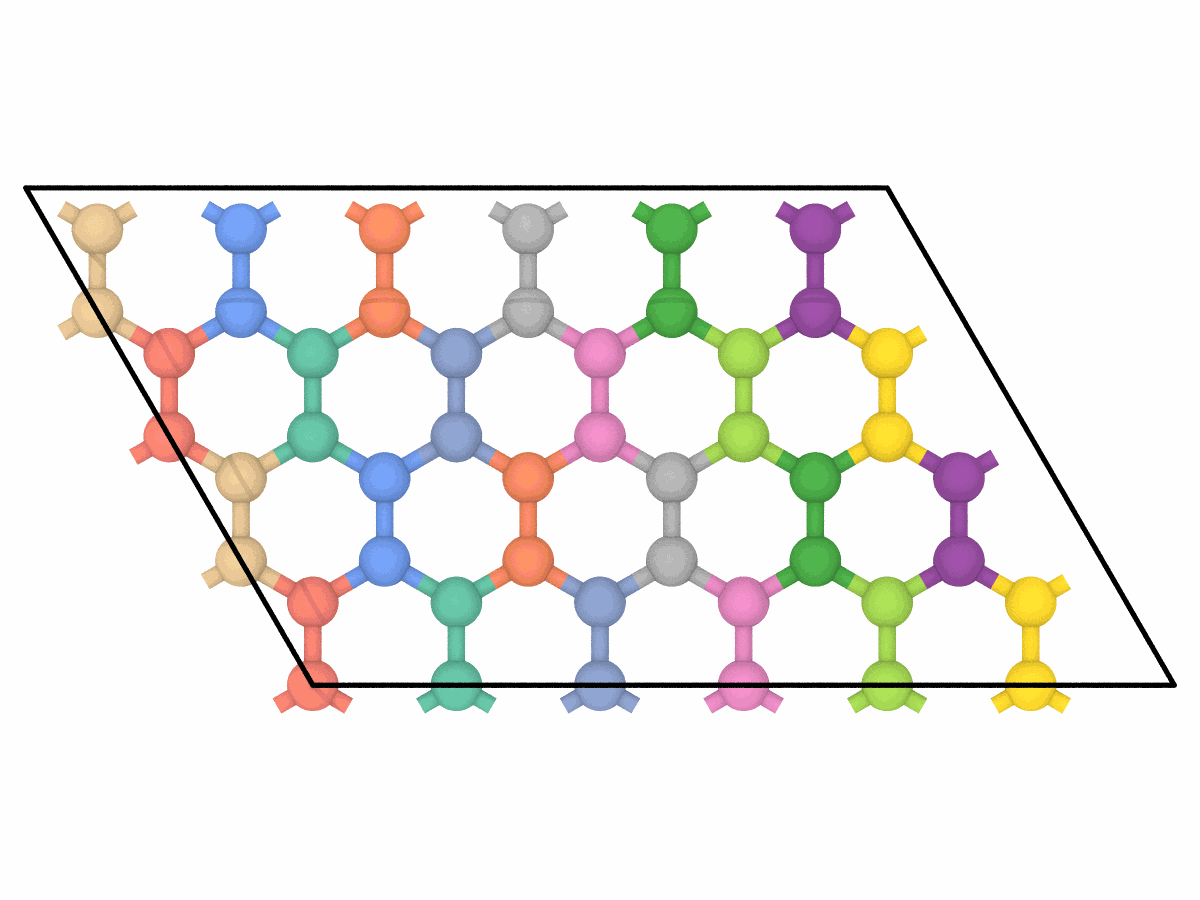
Seen from above, with one color for each copy: copy 0 at the origin, the next copies along a to its right, the rows of copies along b above. The twelve colors start again after the twelfth copy.
Parameters
| Function | Name | Type | Meaning |
|---|---|---|---|
replicate(system, repeat) |
repeat |
int32 or (3,) int32 | copies along a, b and c, at least 1; above 1 only along periodic directions |
wrap(system) |
|||
unwrap(system) |
needs an image column |
Each returns a new System.
Results
replicate gives the copies in a box with lattice vectors
\(n_a\mathbf a\), \(n_b\mathbf b\) and \(n_c\mathbf c\) and the same origin:
- Copy \((i, j, l)\) is number \(k = i + n_a (j + n_b l)\), so the copy along a changes fastest; its atoms are rows \(kN\) to \(kN + N - 1\), in the order of the original.
- Its
ids are those of the original plus \(k\) times the largestid.moleculenumbers above 0 are offset the same way; 0, no molecule, stays 0. - Bonds, angles, dihedrals and impropers of copy \(k\) join the atoms of copy \(k\).
- With an
imagecolumn, each atom is placed at its unwrapped position moved by \(i\mathbf a + j\mathbf b + l\mathbf c\) and wrapped into the new box, which gives its new image flags, so a molecule whole in unwrapped positions is whole in every copy. Without one, the atoms are moved by \(i\mathbf a + j\mathbf b + l\mathbf c\) and not wrapped. - Other columns are copied.
energyandvirial, which describe the original system, are left out ofinfo; the rest is kept.
wrap moves each atom by whole lattice vectors so that its fractional
coordinates along the periodic directions lie in \([0, 1)\); an image column
changes by the same vectors, so the unwrapped positions stay where they were.
unwrap puts each atom at its unwrapped position, its position plus its
image flags times the lattice vectors, and sets the image flags to zero.
Neither changes the topology.
Errors
replicate raises
InvalidParameter
when repeat is not one or three positive integers, or is above 1 along a
direction that is not periodic. unwrap raises
MissingProperty
without an image column.
See also
- LAMMPS replicate.