Atomic temperature
AtomicTemperature gives each atom the temperature of the group formed by
the atom and its neighbors, from their velocities relative to the group's
center of mass; it shows hot spots, for example around a collision cascade
or a moving crack.
import numpy as np
from mdapy import units
from mdapy.analysis import AtomicTemperature
from mdapy.build import build_crystal

# an fcc Cu crystal of 6 x 6 x 6 cubic cells with velocities at 300 K
a = 3.615
system = build_crystal("fcc", a, elements="Cu", repeat=(6, 6, 6))
mass = 63.546  # amu
spread = np.sqrt(units.BOLTZMANN * 300 / (mass * units.AMU_A2_PER_PS2_TO_EV))
velocities = np.random.default_rng(0).normal(scale=spread, size=(len(system), 3))
system = system.with_columns(velocities=velocities)  # Å/ps

result = AtomicTemperature(cutoff=3.0).compute(system)
result.temperature.mean()  # about 300 K
system = system.with_columns(result)  # the column 'temperature'
A thermal spike: atoms near the middle of a larger crystal move as if at 2300 K, the others at 300 K:
from mdapy.build import build_crystal
from mdapy.visualization import render

crystal = build_crystal("fcc", a, elements="Cu", repeat=(14, 14, 14))
x = crystal["positions"] - crystal.box.matrix.diagonal() / 2
kelvin = 300 + 2000 * np.exp(-(x**2).sum(axis=1) / (2 * 8.0**2))
spread = np.sqrt(units.BOLTZMANN * kelvin / (mass * units.AMU_A2_PER_PS2_TO_EV))
rng = np.random.default_rng(1)
spike = crystal.with_columns(velocities=rng.normal(size=x.shape) * spread[:, None])

local = AtomicTemperature(cutoff=5.0).compute(spike).temperature
render(spike, "images/temperature.png", atoms=x[:, 1] < 0, color=local, colormap="coolwarm",
       value_range=(0, 2400), width=800, height=700, legend="temperature (K)")  # fmt: skip
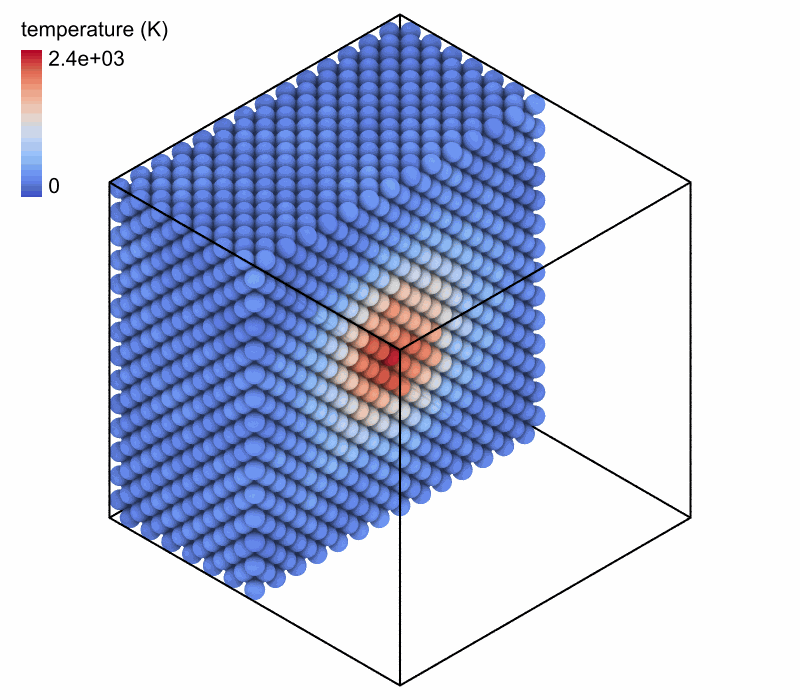
The crystal cut through the middle: the temperature averaged over the neighbors within 5 Å, from 300 K (blue) to about 2000 K in the core (red).
Parameters
| Name | Type | Default | Unit | Meaning |
|---|---|---|---|---|
cutoff |
float64 | Å | the neighbors closer than it form the group of an atom |
compute(system, *, neighbors=None, progress=None, cancel=None) takes the
arguments of every analysis. A given neighbor list
must reach cutoff; without one, the neighbors are found and used at once,
never stored. The system needs the velocities in Å/ps and the mass
column in amu, else an element column for the standard atomic weights.
Results
A TemperatureResult:
| Attribute | Type | Meaning |
|---|---|---|
temperature |
(N,) float64 | the temperature in K of each atom and its neighbors; NaN for an atom without neighbors; its column temperature |
Errors
The constructor raises InvalidParameter for a cutoff that is not positive;
compute raises it for a neighbor list that does not fit, and
MissingProperty without velocities or without both mass and element.
Definition
For the group \(G_i\) of atom \(i\) and its neighbors closer than the cutoff, \(n_i\) atoms with masses \(m_j\) and velocities \(\mathbf v_j\),
Removing the motion of the center of mass takes three of the \(3 n_i\) degrees of freedom, so that a group in equilibrium at a temperature \(T\) has \(T_i = T\) on average and a uniform drift of the atoms changes nothing. Periodic images of the atom itself are not counted.