Cluster analysis
ClusterAnalysis finds the groups of atoms joined by bonds, also across
periodic boundaries, and, when asked for, the positions that keep each
group unbroken by the boundaries and the centers of mass and gyration.
import numpy as np
import mdapy as mp
from mdapy.analysis import ClusterAnalysis

# two groups of atoms far apart in a 30 Å box
rng = np.random.default_rng(0)
positions = np.vstack([rng.random((20, 3)) * 4, rng.random((10, 3)) * 4 + 15])
system = mp.System(positions, mp.Box(30.0), elements="Cu")

result = ClusterAnalysis(cutoff=3.0).compute(system)
result.sizes  # atoms in each cluster, largest first
system = system.with_columns(result)  # the column 'cluster'

clusters = ClusterAnalysis(cutoff=3.0, unwrap=True, center_of_mass=True, gyration=True)
result = clusters.compute(system)
result.center_of_mass, result.radius_of_gyration  # Å, of each cluster
whole = system.with_columns(
    positions=result.unwrapped
)  # no cluster cut by the boundaries
Copper particles, some of them touching, each cluster in its own color:
from mdapy.build import build_crystal
from mdapy.visualization import render

crystal = build_crystal("fcc", 3.615, elements="Cu", repeat=(22, 22, 22))
rng = np.random.default_rng(3)
centers, radii = rng.uniform(15, 65, (9, 3)), rng.uniform(5, 10, 9)
distance = np.linalg.norm(crystal["positions"][:, None] - centers, axis=2)
particles = crystal.filter((distance < radii).any(axis=1))

found = ClusterAnalysis(cutoff=3.0).compute(particles)
found.sizes  # [396, 364, 322, 220, 79, 60, 48]: nine spheres, seven clusters
render(particles, "images/clusters.png", color=found.cluster, colormap="labels",
       box=False, width=800, height=600, legend="cluster")  # fmt: skip
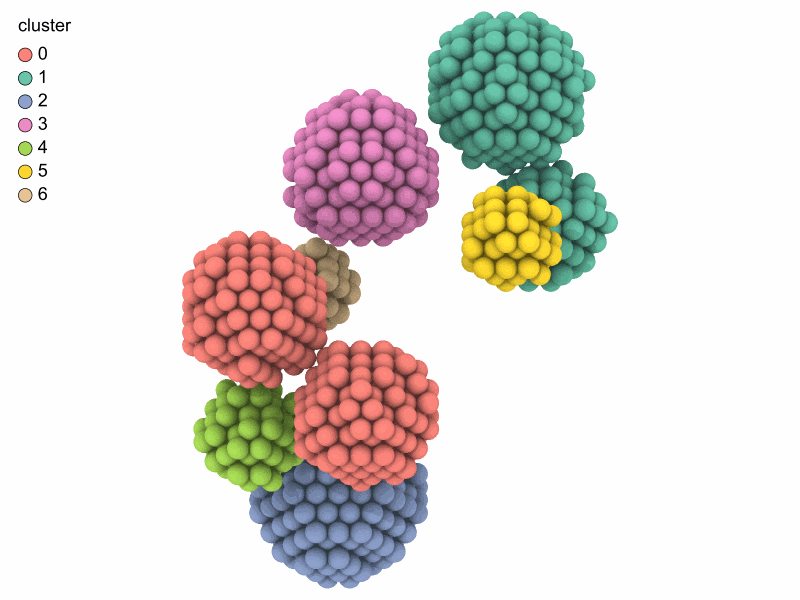
Nine spheres cut from a crystal make seven clusters: the spheres that overlap or touch within the cutoff of 3 Å join into one.
Parameters
| Name | Type | Default | Unit | Meaning |
|---|---|---|---|---|
cutoff |
float64 | None |
Å | atoms closer than it are bonded |
cutoffs |
dict of (str, str) to float64 | None |
Å | instead of cutoff, a bond length for each pair of elements (a, b), in either order; pairs not given are never bonded |
unwrap |
bool | False |
also give the positions with no cluster cut by the periodic boundaries | |
center_of_mass |
bool | False |
also compute the mass and the center of mass of each cluster | |
gyration |
bool | False |
also compute the gyration tensor and the radius of gyration of each cluster |
compute(system, *, neighbors=None, progress=None, cancel=None) takes the
arguments of every analysis. A given neighbor list
must reach the largest cutoff; without one, the bonds are found and used at
once, never stored. cutoffs need an element column. The masses are the
mass column, else those of the elements, else 1 for every atom.
Results
A ClusterResult:
| Attribute | Type | Meaning |
|---|---|---|
cluster |
(N,) int64 | the cluster of each atom, numbered from 0 by decreasing size, equal sizes in the order of their first atom; its column cluster |
sizes |
(clusters,) int64 | the number of atoms of each cluster |
spanning |
(clusters,) bool | whether the cluster joins a periodic image of itself, spanning the box |
unwrapped |
(N, 3) float64 | positions in Å with no cluster cut by the periodic boundaries, the first atom of each cluster at its own position; with unwrap, else None |
masses |
(clusters,) float64 | the mass of each cluster in amu, or its number of atoms without masses; with center_of_mass, else None |
center_of_mass |
(clusters, 3) float64 | the center of mass of each cluster in Å; with center_of_mass, else None |
radius_of_gyration |
(clusters,) float64 | the radius of gyration \(R_g\) of each cluster in Å; with gyration, else None |
gyration_tensor |
(clusters, 3, 3) float64 | the gyration tensor \(G\) of each cluster in Ų; with gyration, else None |
Errors
The constructor raises InvalidParameter without exactly one of cutoff
and cutoffs, for a cutoff that is not positive or an unknown element;
compute raises it for a neighbor list that does not fit, and
MissingProperty for cutoffs without an element column.
Definition
Two atoms are bonded when closer than the cutoff of their pair of elements; a cluster is a largest set of atoms connected by bonds. An atom without bonds is a cluster of its own.
The unwrapped positions keep the first atom of each cluster where it is and place every other atom at the periodic image next to the atoms it is bonded to. With these positions \(\mathbf u_i\) and the masses \(m_i\) of the atoms of a cluster of mass \(M\),
A cluster that joins a periodic image of itself, such as a percolating
network or a layer through the box, has no unbroken position: its unwrapped
positions, center of mass and gyration depend on the order in which its
bonds are taken, and spanning marks it.
See also
- OVITO Cluster analysis.
- LAMMPS
compute cluster/atom.